

Air pollution poses one of the greatest risks to health globally. As policy focuses on reducing NOx emissions, tropospheric ozone is expected to rise due to changes in precursor chemistry. According to the IPCC AR6 report, there is low confidence regarding the response of tropospheric ozone under future climate conditions due to widespread uncertainties in the quantification of the processes that drive its formation, depletion and transport mechanisms. Tropospheric ozone has a high oxidative capacity and is known to have detrimental effects on respiratory health.
A topic of particularly high uncertainty is the contribution of stratosphere-troposphere exchange (STE) to tropospheric ozone pollution under future climate conditions. The STE is a key atmospheric process that is crucial for the distribution of gaseous species between the stratosphere and troposphere, influencing global background air quality. Stratospheric cooling due to tropospheric warming has been observed, and the implications of this on the STE, and subsequently air quality, must be deduced. Furthermore, there is high spatial variability in model projections of STE-induced tropospheric ozone, particularly in polluted areas hence quantifying its dynamics and global health burden is of upmost concern.
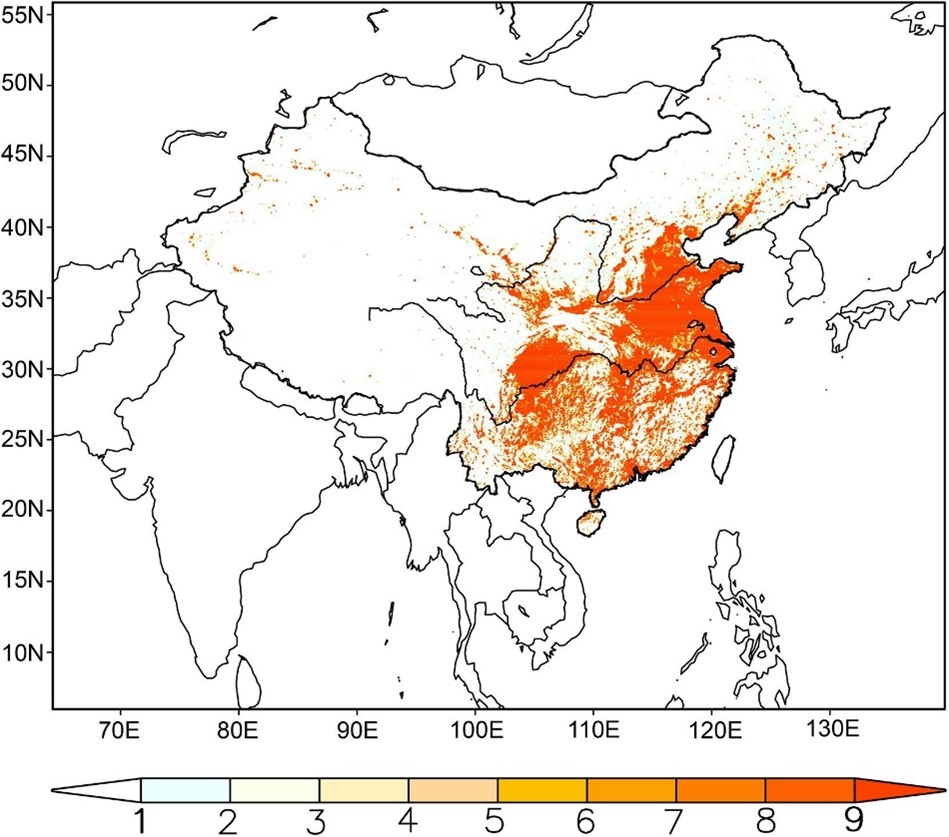
Figure 1: Ozone threaten to public health: spatial distribution of premature deaths in China, attributed to long-term ozone exposure per 100,000 people as a 5-year mean. Sourced from Wang, Y., et al. (2020).
This project is not suitable for CASE funding
Each host has a slightly different application process.
Find out how to apply for this studentship.
All applications must include the CENTA application form.
Choose your application route
Previous studies have difficulty isolating STE-derived tropospheric ozone from NOx-catalysed ozone due to their identical molecular structure and lack of definitive observational tracers. This project will investigate the parameterisation of advanced chemical and atmospheric models (e.g. CMIP6, AerChemMIP, UKESM, WACCM) to quantify the contribution of STE flux on surface ozone and disentangle this from the chemical production of ozone, under future warming scenarios. Exposure dose-based epidemiology model will be used to estimate the advert impacts of ozone changes on publica health. By doing so, we will be able to answer the key questions: 1) how much influence on surface ozone is from the Net-Zero emission strategies (co-emit NOx and carbon)? 2) how much influence on surface ozone is from the change of STE dynamic due to global warming? 3) How much impact of the increased/decreased surface ozone on global public health?
DRs will be awarded CENTA Training Credits (CTCs) for participation in CENTA-provided and ‘free choice’ external training. One CTC can be earned per 3 hours training, and DRs must accrue 100 CTCs across the three and a half years of their PhD.
You will be trained in multiple aspects of satellite Earth observation system, data-science analysis and climate modelling skills. You will receive support and training in disseminating the project outcomes through various outlets, including publications, international conferences and public media. The project also offers an option of 3-18 months placement in the UK Met Office to gain understanding of atmospheric data collection and how climate projection and weather forecast work. You will be a member of the atmospheric research team here in Birmingham, also part of a wider international team of world-leading researchers, allowing you to build and develop your global network.
UKCEH has agreed to be co-supervisor.
Year 1: Familiarisation of key concepts, small-scale atmospheric processes, diabatic ozone circulation, dynamics of the tropopause and their sensitivity under future climate conditions, and climate-chemistry modelling techniques. Collection and interpretation of model parameters that govern STE.
Year 2: Further training in climate-chemistry modelling and data-science analysis. Evaluate and determine improvements to advanced climate chemistry model ensembles. Implementation of improvements through external collaboration and comparison of model output performance.
Year 3: Global-level analysis and quantification of the burden of STE-induced ozone under different warming scenarios. Begin writing of thesis.
Doherty, R. M., Wild, O., Shindell, D. T., Zeng, G., MacKenzie, I. A., Collins, W. J., Fiore, A. M., Stevenson, D. S., Dentener, F. J., Schultz, M. G., Hess, P., Derwent, R. G. and Keating, T. J. (2013) ‘Impacts of climate change on surface ozone and intercontinental ozone pollution: A multi-model study’, Journal of Geophysical Research: Atmospheres, 118(9), pp. 3744-3763.
Jing, P., Banerjee, S. and Barrera, M. (2020) ‘Impact of Rossby wave breaking on ozone variation in the upper troposphere and lower stratosphere, 1985–2015’, Atmospheric Environment, 222, pp. 117122.
Li, Y., Xia, Y., Xie, F. and Yan, Y. (2024) ‘Influence of stratosphere-troposphere exchange on long-term trends of surface ozone in CMIP6’, Atmospheric Research, 297, pp. 107086.
Meul, S., Langematz, U., Kröger, P., Oberländer-Hayn, S. and Jöckel, P. (2018) ‘Future changes in the stratosphere-to-troposphere ozone mass flux and the contribution from climate change and ozone recovery’, Atmos. Chem. Phys., 18(10), pp. 7721-7738.
Wang, Y., He, Y., Sheng, Z., Sun, J., Qin, Z. and Tao, Y. (2025) ‘Vertical ozone transport by Rossby wave breaking in upper troposphere-lower stratosphere is weakening’, Atmospheric Environment, 343, pp. 120999.
Wang, Y., Wild, O., Chen, X., Wu, Q., Gao, M., Chen, H., Qi, Y. and Wang, Z. (2020) ‘Health impacts of long-term ozone exposure in China over 2013-2017’, Environment international , 144 , 106030., (1873-6750 (Electronic)).
Zhou, X., Li, M., Huang, X., Liu, T., Zhang, H., Qi, X., Wang, Z., Qin, Y., Geng, G., Wang, J., Chi, X. and Ding, A. (2025) ‘Urban meteorology–chemistry coupling in compound heat–ozone extremes’, Nature Cities.
For any enquiries related to this project please contact Ying Chen, [email protected]
To apply to this project: