

Hydrothermal systems can develop in areas within the Earth’s crust where fluids coexist with either a magmatic or impact-induced heat source. Due to the presence of fluids, elevated temperatures, and the availability of chemical potentials during mineralisation, hydrothermal systems have been proposed as potential environments for life’s origin on Earth, and on other terrestrial planets such as Mars. However, the geological record of hydrothermal systems on Early Earth has been erased by plate tectonics and we rely on studying younger analogue systems to better constrain hydrothermal environments and their importance for habitability.
This project will investigate a hydrothermal system developed during and after the active eruption phase of the Geitafell central volcano in Iceland to quantify the following key processes: (1) the mineralisation during different phases of hydrothermal activity including metamorphic zones; (2) the composition of hydrothermal fluids associated with the mineralogy; and (3) the mobility of elements and potential habitability. The Geitafell central volcano consists primarily of basaltic lavas and volcanic breccias with minor rhyolites and shows extensive hydrothermal alteration. Due to glacial erosion, the hydrothermal minerals can be studied on the surface throughout the system. The mineral record ranges from low-temperature alteration including zeolites, chlorite, prehnite, and carbonates to higher-temperature assemblages including actinolite and garnet. Constraining these alteration zones will allow for the determination of the evolution of a magmatic hydrothermal system, in particular temperature and composition of the fluid, which will then be used in models to simulate hydrothermal systems in the oldest preserved rocks on Earth (Archaean; 4-2.5 Ga). By investigating the mineralogy, temperature, and fluid composition of the hydrothermal system in Iceland, this project aims to improve the understanding of the significance of these systems for Early Earth and potentially other terrestrial planets.
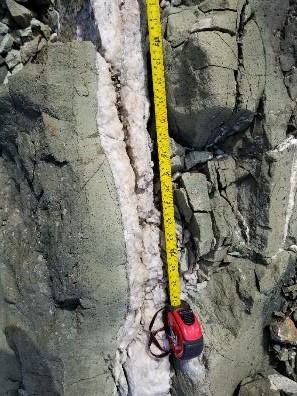
Figure 1: Example of a vein with hydrothermal minerals in altered basaltic host rock form the Geitafell central volcano, Iceland. Image credit: J Semprich.
This project is not suitable for CASE funding
Each host has a slightly different application process.
Find out how to apply for this studentship.
All applications must include the CENTA application form.
Choose your application route
DRs will be awarded CENTA Training Credits (CTCs) for participation in CENTA-provided and ‘free choice’ external training. One CTC can be earned per 3 hours training, and DRs must accrue 100 CTCs across the three and a half years of their PhD.
This project includes training in optical microscopy, analytical data acquisition, and using a range of modelling methods, as well as handling of large datasets and their interpretation. Field work will provide planning and sampling skills. Special emphasis will be on developing excellent oral and written communications skills, including report and publication writing following scientific standards as well as presenting at interdisciplinary meetings and conferences.
Not applicable.
Year 1: Literature review, optical microscopy, and analytical analysis of available Iceland samples (collected in previous field campaign). Training in modelling software. First year report writing and mini viva. Preparations for field tip.
Year 2: Field trip to Iceland to study relationships in the field with opportunity to collect more samples. Detailed petrological and geochemistry on samples and modelling fluid compositions. Preparing for and presenting at a conference.
Year 3: Apply modelling to Early Earth conditions and other environments. Prepare and present at conferences and meetings. Prepare a publication. Write and submit thesis.
Pirajno, F. (2008) ‘Hydrothermal Processes and Mineral Systems’, Springer, Heidelberg.
Farmer, J. (2000) ‘Hydrothermal systems: Doorways to early biosphere evolution’. GSA Today, 10, pp. 1-9.
The project will be embedded within the Dynamic Earth (https://www5.open.ac.uk/stem/environment-earth-ecosystem-sciences/research/dynamic-earth) and Astrobiology (https://university.open.ac.uk/stem/environment-earth-ecosystem-sciences/research/astrobiology) groups offering a range of interdisciplinary research in Earth and Planetary Sciences. For more information, please contact Dr Julia Semprich ([email protected]).
To apply to this project:
Applications must be submitted by 23:59 GMT on Wednesday 7th January 2026.