

Simulating the impacts of future climate change at an ecosystem level is extremely challenging. One of the few experiments globally investigating this in forest systems, and the only one for mature deciduous woodland, is the Birmingham Institute of Forest Research (BIFoR) Free Air Carbon dioxide Enrichment (FACE) facility1. This institute brings together a unique research community, as well as a broad range of stakeholders and policy makers. The BIFoR FACE experiment is an exceptional experimental facility in which to study for a PhD.
Insect biodiversity is in decline globally, and understanding the cause of this decline has applications in food security, conservation and human health. This project builds on 7 years of data at the FACE site to examine how elevated CO2 (eCO2), and recent extreme climate events, have impacted on insect diversity, abundance and phenology. Because insects are ectotherms, their development and population growth are directly influenced by temperature. For insect herbivores and pollinators, all these attributes are indirectly affected by climate change impacts on plants.
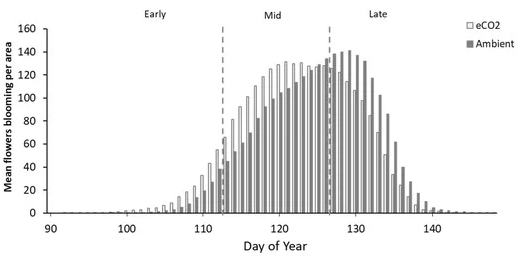
An important knowledge gap remains our limited understanding of how climate warming and eCO2 will alter insect-plant interactions. Our previous work has shown that eCO2 could decouple important plant-pollinator relationships, with plant flowering shifting to earlier in the year (Fig. 1), which may not be matched by changes in pollinator phenology2. Our work at BIFoR has also shown that plant-herbivore interactions may change and could significantly alter nutrient cycling processes 3,4. We have already identified several excellent model insect systems to examine eCO2 impacts on herbivory, e.g. leaf miners, which undergo all development and metamorphosis in a single leaf. This allows us to accurately quantify both rates of development and levels of herbivory through image analysis of leaves. Determining the chemical responses of plants to enhanced herbivory under eCO2 remains poorly understood and is likely to form an important part of the programme.
As well as building on existing studies, there is huge scope for the successful applicant to develop their own new research questions, with huge potential for collaboration with other researchers as well as stakeholders and policy makers linked to BIFoR.
Figure 1: Daily mean totals of bluebell (Hyacinthoides non-scripta) flowers per patch area (m2) under elevated CO2 and ambient conditions at the BIFoR FACE site. Elevated CO2 has clearly advanced bluebell flowering time.2
This project is not suitable for CASE funding
Each host has a slightly different application process.
Find out how to apply for this studentship.
All applications must include the CENTA application form.
Choose your application route
Both the Hayward and Sadler labs are highly experienced in field sampling of insects and have well established methods at the BIFoR FACE site5. Taxonomic training will be provided for the key insect groups. Core experiments involve a fairly small number of species that are readily identifiable. Time lapse photography will be use to record bluebell flowering phenology. Image analysis is used to quantify insect herbivory from digital leaf imagery. The FACE site is already very heavily instrumented, and continuously recording, but DRs will be given a detailed tour of this equipment (and training where required). Training will be given in how to set up project-specific microclimate monitoring equipment, cameras etc. Depending on the interests of the successful applicant, there are opportunities to employ molecular and/or biochemical techniques to further investigate insect (or plant) responses, such plant defence mechanisms.
DRs will be awarded CENTA Training Credits (CTCs) for participation in CENTA-provided and ‘free choice’ external training. One CTC can be earned per 3 hours training, and DRs must accrue 100 CTCs across the three and a half years of their PhD.
The DR will receive specialist training in the use of state-of-the art facilities at the vanguard of environmental research within the Biosystems and Environmental Change (BEC) theme in the School of Biosciences. They will also have access to the full range of facilities within BIFoR, including the unique woodland FACE project.
While there are no partners specifically linked with this project, there are numerous partners directly linked to BIFoR that provide exceptional collaboration opportunities: Woodland Trust, Natural England, Defra, the Sanger Institute, Walking Forest etc.
Year 1: Literature review to form part of general introduction. Initiate field experiments at the FACE site to examine insect abundance, diversity and phenology. Set up time lapse photography of bluebell flowering. Collect leaves for image analysis/quantification of herbivory. First UK Conference end of Yr 1.
Year 2: Second season of field work at the FACE site. Data analysis from year 1. Undertake detailed assessment of how eCO2 has affected insect herbivory across different feeding guilds. Potential biochemical analysis of plants to understand what might be driving any shifts in herbivory. Developing new/novel research questions for Yr 3. Ongoing preparation/submission of manuscripts for publication.
Year 3: Continued fieldwork and lab investigation of insects and biochemical samples. International conference, ongoing submission of manuscripts and thesis writing.
Any further questions about the project, please contact: Dr Scott Hayward, School of Biosciences, University of Birmingham, e-mail: [email protected]
To apply to this project:
Applications must be submitted by 23:59 GMT on Wednesday 7th January 2026.