

Ammonia (NH3) presents a distinctive challenge in air quality sciences, threatening both human and ecological health. Whilst modern air quality policy has driven substantial decreases for other air quality pollutants in the order of 35 – 84% in the EU since 2005, ammonia has decreased only 17%. European ammonia emissions are agricultural in origin (94%), making policy intervention complex due to the broad distribution of farms and diverse, region-specific farming practises, coupled with the political sensitivity of implementing controls on domestic food production. UK and EU member states have consequently and consistently missed their targets under the National Emission reduction Commitments Directive (NECD). Atmospheric ammonia is a major threat to both human health through secondary particulate matter formation, and to ecosystems as the dominant source of nitrogen deposition which drives eutrophication and acidification. Despite this, ammonia remains one of the most poorly quantified air quality pollutants due to its agricultural origin and complex atmospheric chemistry and land surface interactions, with recent satellite studies indicating that bottom-up national emission inventories severely underestimate real-world emissions.
Ammonia emissions are tied strongly to meteorology, through both natural processes (e.g. temperature dependent volatilisation) and human responses to weather (e.g. timing, extent, and method of fertiliser application). Atmospheric concentrations are also governed by complex atmospheric chemistry and the availability of acidic gases (NOx, SO2) which convert NH3 into ammonium particulates, which have themselves fallen in recent decades. Together with meteorological dependence, these factors lead to a non-linear relationship between observed concentrations of NH3 and emission.
This PhD will combine satellite measurements from IASI, CrIS, and the upcoming IASI-NG instruments with high resolution WRF-Chem simulations of Europe and the UK. You will create a harmonised multi-instrument satellite record from 2007 – present, using WRF-Chem to resolve fine-scale spatial and temporal variability between measurements. This dataset will then be used to generate measurement informed constraints on ammonia emissions, test the feasibility of emission reduction scenarios, and evaluate their potential impact on health and sensitive ecosystems.
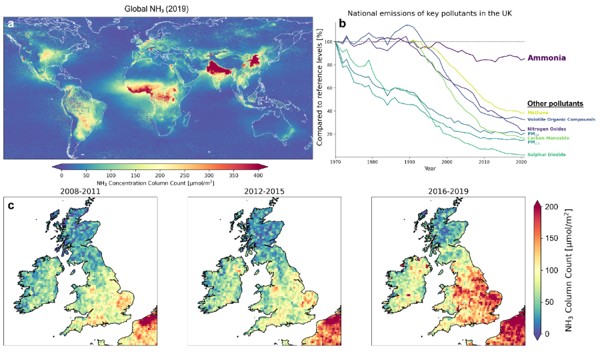
Figure 1: (a) Global NH3 concentrations from IASI for 2019, (b) UK bottom-up reported emissions of major air quality pollutants, (c) 4-year averages of UK ammonia from IASI.
This project offers a CASE studentship
Each host has a slightly different application process.
Find out how to apply for this studentship.
All applications must include the CENTA application form.
Choose your application route
You will assemble a continuous satellite NH3 dataset using the ULB-LATMOS retrievals from IASI onboard MetOp-A/B/C, CrIS onboard SNPP/NOAA, and later IASI-NG onboard MetOp-SG-A1, accounting for differences in spatial sampling and vertical sensitivity, and will use modelling to investigate the effect of different overpass times. The WRF-Chem chemical transport model will then be used in a nested configuration for Europe and the UK to simulate atmospheric NH3 using ERA5 meteorology and emission inventories from CAMS/EDGAR (6 – 10 km) for Europe and NAEI (1 km) for the UK. Simulations will then be compared to the satellite dataset and available ground-based networks where they will act to constrain and correct the input emission inventories. Adjusted emissions can then be used to explore themes of air quality impacts, deposition into sensitive areas, transboundary pollution episodes, and the impacts of future policy changes on NH3 emissions and secondary aerosol formation.
DRs will be awarded CENTA Training Credits (CTCs) for participation in CENTA-provided and ‘free choice’ external training. One CTC can be earned per 3 hours training, and DRs must accrue 100 CTCs across the three and a half years of their PhD.
You will develop advanced programming skills for geospatial data analysis through the processing and interpretation of satellite, model, and in situ sensor data sets. Working as part of a multidisciplinary team, you will build upon Leicester’s experience with WRF-Chem to become proficient in chemical transport modelling, and you will bring together diverse datasets to answer key environmental policy questions. Through a CASE partnership with the Environment Agency, you will learn how research can inform regulation whilst developing strong science communication and stakeholder engagement skills.
This project will be in collaboration with the Environment Agency (EA) as a CASE partner. The EA is responsible for regulating and assessing ammonia emissions from intensive agriculture in England, and for evaluating its impact on the local environment. You will work closely with the EA Chief Scientist’s Group (CSG), the EA’s science, research, and monitoring division, working to improve the evidence base that underpins ammonia regulation. Working alongside the CSG, you will translate atmospheric research into policy-relevant information to inform how ammonia emissions are managed and ultimately reduced.
The EA will be providing a top-up of £1000 per annum (up to £4000) to supplement the RTSG for this project.
Year 1: Literature review, explore available NH3 products, gain familiarity with data processing methods. Assemble combined NH3 dataset. WRF training.
Year 2: Set up nested WRF-Chem environment, including collation and pre-processing of input datasets. Perform exploratory WRF-Chem runs, comparisons to satellite observations, explore and test assimilation frameworks. Work closely with EA to shape science studies towards policy relevant interests.
Year 3: Perform emission inversions using satellite datasets to constrain and correct national inventories. Evaluate new emission estimates, demonstrate applications to air quality and ecosystem impact assessments and policy scenario modelling.
Potts, D., Vande Hey, J., Ferranti, E. and Timmis, R., 2021. Smarter analysis of satellite data for air quality regulators. doi.org/10.25392/leicester.data.27879852
Van Damme, M., Clarisse, L., Franco, B., Sutton, M.A., Erisman, J.W., Wichink Kruit, R., Van Zanten, M., Whitburn, S., Hadji-Lazaro, J., Hurtmans, D. and Clerbaux, C., 2021. Global, regional and national trends of atmospheric ammonia derived from a decadal (2008–2018) satellite record. Environmental Research Letters, 16(5), p.055017. doi.org/10.1088/1748-9326/abd5e0
The Bureau of Investigative Journalism, MPs pledge to investigate toxic gas from animal farming, 2026, https://www.thebureauinvestigates.com/stories/2026-02-17/mps-pledge-to-investigate-toxic-gas-from-animal-farming
Interested applicants are encouraged to contact Dr. Josh Vande Hey before applying at [email protected].
To apply to this project:
Applications must be submitted by 23:59 GMT on Wednesday 6th January 2027.