

The Cretaceous-Palaeogene (K-Pg) mass extinction event was the result of an asteroid impact on what is now the Yucatán Peninsula of Mexico 66 million years ago, wiping out ~76% of all species of life. Recent evidence from exceptional fossils suggests that the impact may have occurred in boreal spring, with adverse effects on organisms at key stages of their reproductive cycles (During et al. 2022).
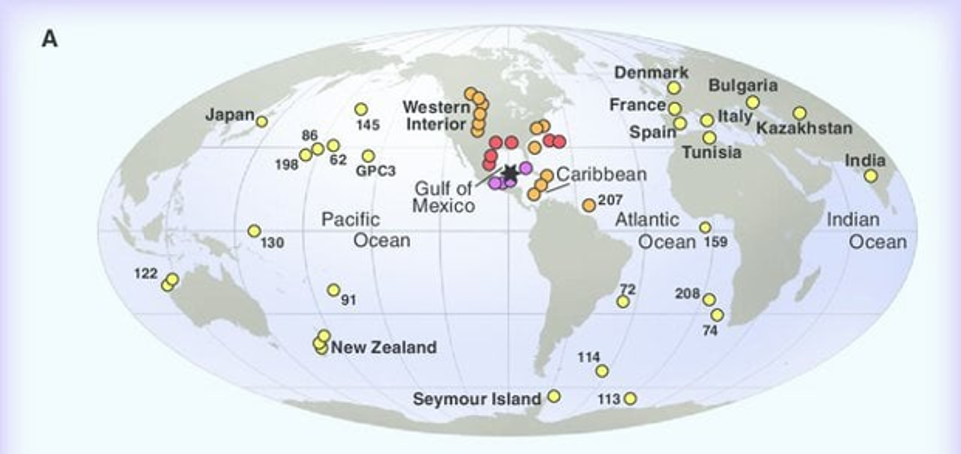
Modern marine plankton bloom during the spring, undergoing periods of dormancy during the autumn and winter months. This may result in a strong hemispheric bias in recovery, with significant cascading effects across ecosystems. Such hemispheric heterogeneity has already been shown among calcareous nannoplankton assemblages (e.g., Jiang et al., 2010; Schueth et al., 2015), thought by Jiang et al. (2010) to have been caused by proximity to the impact crater. However, those studies were limited to a handful of sites examined directly by their authors. The spatial and hemispheric biodiversity and community response remains poorly understood due to inconsistent data synthesis (Figure 1).
This project will address this key knowledge gap: the student will synthesize all marine K-Pg records from around the globe (Figure 1), filling in spatial and temporal gaps by generating new records where necessary. All sites will be calibrated to a unified temporal framework, and all marine plankton groups will be assigned to functional groups. By leveraging this substantial dataset of Earth system response, the student will assess the following research questions:
This project aims to provide the student with mentorship from internationally renowned researchers at the forefront of palaeobiology, providing them the training and skillset to establish themself as an independent research leader.
Figure 1: Current global distribution of key K-Pg boundary locations. Deep-Sea drill sites are referred to by the corresponding drilling leg numbers. Asterisk indicates the location of the Chicxulub impact site. Coloured dots mark the four distinct types of K-Pg boundary event deposit related to distance from the Chicxulub impact site: magenta, very proximal (up to 500 km); red, proximal (up to 1000 km); orange, intermediate distance (1000 to 5000 km); and yellow, distal (>5000 km). Modified from Schulte et al. (2010).
This project is a CENTA Flagship Project.
This project does not offer a CASE studentship
Each host has a slightly different application process.
Find out how to apply for this studentship.
All applications must include the CENTA application form.
Choose your application route
The student will mine all published data of marine plankton across the K-Pg event, screening data quality and updating all records to accepted species concepts and geological time scales. They will develop substantial skills in the application of the R programming language to assemble and analyse the resulting large palaeobiological database, and will apply methods from network science, causal inference, and artificial intelligence in both the collection and analysis of the database. Where spatial and temporal gaps exist within marine plankton assemblage records, the student will order new samples from sediment repositories and generate new data to complement the database using the facilities at The Open University and BGS. Species taxonomy will be facilitated by PI Woodhouse and Co-PI Lowery, with support in quantitative palaeobiology from Co-PI Swain. Further, where functional ecological data do not exist, the student will generate new data using stable isotope analysis (Co-I Anand).
DRs will be awarded CENTA Training Credits (CTCs) for participation in CENTA-provided and ‘free choice’ external training. One CTC can be earned per 3 hours training, and DRs must accrue 100 CTCs across the three and a half years of their PhD.
The student will gain training in computational palaeobiology and marine microfossil taxonomy and palaeoecology from an international and interdisciplinary supervisory team. Depending on the student’s programming proficiency, they will attend Transmitting Science courses such as “Introduction to R: Starting from scratch” and “Network Analysis in Ecology and Evolution”. For taxonomic/biological and environmental/geochemical training, the student will be encouraged and supported to attend the International School on Foraminifera and Urbino Summer School in Paleoclimatology both hosted in Urbino Italy. Finally, training avenues in communication, opportunities to interact with the public in national science festivals and policy initiatives within The Open University such as PolicyWISE will be available for the student to enhance skills.
Prof Melanie Leng (BGS) has agreed in principle to support the project and provide facilities where appropriate, alongside offering support to apply for an NEIF grant for stable isotope analysis of smaller planktonic foraminifera.
Year 1: Assembly and digitization of fossil occurrence dataset spanning 75-55 million years ago based on collected literature. Spatio-temporal gaps in global record identified and new samples ordered where available from geological repositories. Taxonomic and geochemical training completed in Year 1, alongside computational training with R software and network analysis. Present preliminary data at TMS meeting.
Year 2: Assemblage analysis of ordered samples, and species-specific geochemical analysis of all species to establish a functional ecological framework spanning the study interval. Final dataset assembled, drafted for publication and disseminated at an international conference.
Year 3: Address three primary hypotheses using new dataset applying traditional biodiversity analyses alongside network analysis. Publication and thesis writing.
Throughout the PhD, the student will attend 1 national (The Micropalaeontological Society Annual General Meeting or UK Palaeoclimate Society Meeting) and 1 international (EGU or GSA or ICP) to disseminate research results and network with two US-based supervisors.
Journal:
During, M.A., Smit, J., Voeten, D.F., Berruyer, C., Tafforeau, P., Sanchez, S., Stein, K.H., Verdegaal-Warmerdam, S.J. and van der Lubbe, J.H., 2022. The Mesozoic terminated in boreal spring. Nature, 603(7899), pp.91-94.
Jiang, S., Bralower, T.J., Patzkowsky, M.E., Kump, L.R. and Schueth, J.D., 2010. Geographic controls on nannoplankton extinction across the Cretaceous/Palaeogene boundary. Nature Geoscience, 3(4), pp.280-285.
Schueth, J.D., Bralower, T.J., Jiang, S. and Patzkowsky, M.E., 2015. The role of regional survivor incumbency in the evolutionary recovery of calcareous nannoplankton from the Cretaceous/Paleogene (K/Pg) mass extinction. Paleobiology, 41(4), pp.661-679.
Schulte, P., Alegret, L., Arenillas, I., Arz, J.A., Barton, P.J., Bown, P.R., Bralower, T.J., Christeson, G.L., Claeys, P., Cockell, C.S. and Collins, G.S., 2010. The Chicxulub asteroid impact and mass extinction at the Cretaceous-Paleogene boundary. science, 327(5970), pp.1214-1218.
Students should have a background in Earth science, geography, environmental science or similar, and an enthusiasm for palaeobiology and palaeoclimate. Experience in R and statistics is highly desirable, but not a requirement. If you would like to apply or require further information, please contact [email protected].
To apply to this project:
You should make your application via The Open University’s applications portal. If you do not already have an account for this portal, you will need to register your interest and will be prompted to create an account. As part of your application, you will need to provide:
Applications must be submitted by 23:59 GMT on Wednesday 6th January 2027.