

Large hypervelocity impact events that generate craters >75 km diameter on Earth are environmentally modifying and may influence mass extinction events. However, the heat distributed by these impacts via subsequent melting and fluid release can potentially provide new habitats for microbial life on Earth, especially during its very early history (>4 Ga). The main barrier to testing this is that plate tectonics, erosion, burial and volcanicity have erased these early environments such that our knowledge is primarily derived from models that have limited ground truth.
This project will investigate the hydrothermal system of the ~85 km-diameter Manicouagan impact structure of Quebec, Canada. The following key processes will be investigated: (1) generation of the hydrothermal system, with heat from the impact-generated superheated melt sheet mobilizing ground- and surface-waters in the immediate environment; (2) the spatial distribution of hydrothermal alteration within the structure; and (3) the mobility of elements and potential habitability within the modified rocks. Manicouagan is well exposed and ~10 km of drill core is held by the collaborator Dr Spray at the Planetary and Space Science Centre in eastern Canada. This provides an unprecedented third dimension to the impact structure, with three of the drill holes held penetrating ~1.5 km depth. Access to these materials will facilitate characterisation of the temperature evolution and fluid availability in a terrestrial crater, which will then be used in models to simulate impact-induced hydrothermal systems in the oldest preserved rocks (Archean 2.5 – 4.0 Ga and Hadean >4.0 Ga). Further, the temperature profiles and fluid geochemistry can be implemented into simulation experiments to test implications for the survival of microbial life. By investigating the temperature, volatile- and fluid-flow and associated bio-geochemical history of the Manicouagan structure, and extrapolating the obtained data to Early Earth impact scenarios, this project will improve our understanding of the role of impact craters as warm, wet oases for supporting life.
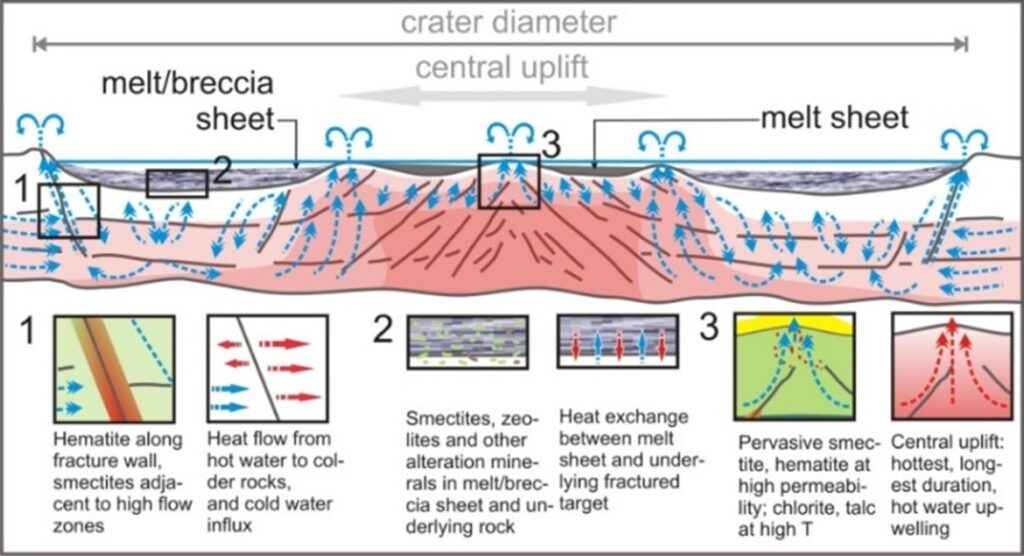
Figure 1: Qualitative assessment of the impact heat distribution, water flux and alteration minerals for a crater in basaltic target lithology. The goal of this project is to quantify the contribution of hydrothermal systems to habitability for Early Earth.
This project is not suitable for CASE funding
Each host has a slightly different application process.
Find out how to apply for this studentship.
All applications must include the CENTA application form.
Choose your application route
DRs will be awarded CENTA Training Credits (CTCs) for participation in CENTA-provided and ‘free choice’ external training. One CTC can be earned per 3 hours training, and DRs must accrue 100 CTCs across the three and a half years of their PhD.
The student will be trained in optical microscopy, electron beam mineral analytical techniques and petrologic, laboratory, and modelling methods, to the level of independent user. In addition, field work will provide planning and sampling skills. With the international and interdisciplinary nature of the project, teamwork and collaboration are an essential aspect of the work. Special emphasis will be on the oral and written communications skills, ranging from e-mail and phone to Teams/Zoom discussions, e.g., in the planning of the field work, to conference presentations, report writing and publication in peer-reviewed journals.
This project will be in collaboration with Professor John Spray, Director of the Planetary and Space Science Centre at the University of New Brunswick in Fredericton, Canada. John’s team focuses on investigating hypervelocity impacts, planetary materials, frictional melting, impact cratering mechanics, terminal ballistics and the geology of the Moon and Mars. As part of this collaboration, the supervisory team will encourage the successful doctoral researcher to apply for a Mitacs Globalink Research Award (https://www.mitacs.ca/our-programs/globalink-research-award/), which would enable the student to visit the core repository and to carry out field work and research in Canada.
Year 1: Oct to July: Literature work, familiarising with mineralogy, petrology, geochemistry of rocks in the impact structure, familiarising with cooling and thermochemical modelling, and initial models based on estimated temperature values and rock compositions from the literature, preparation of the field trip; prepare application for internship. July to October: Project report writing, summarizing petrological data in writing, preparation for more detailed geochemical work.
Year 2: Detailed petrological and geochemical work (ideally in the field as part of the exchange), understanding the cooling history from data obtained from the rock samples studied. Attend a national or international conference.
Year 3: Phase equilibria and thermochemical modelling to understand fluid conditions and extrapolation of models to Early Earth conditions. Prepare publication. Write up and submit thesis.
Osinski, G.R., Spray, J.G. and Lee, P. (2001) ‘Impact-induced hydrothermal activity within the Haughton impact structure, arctic Canada: Generation of a warm, wet oasis’, Meteoritics and Planetary Science, 36, pp. 731-745. https://doi.org/10.1111/j.1945-5100.2001.tb01910.x
Osinski, G.R., et al. (2013) ‘Impact-generated hydrothermal systems on Earth and Mars’, Icarus, 224, pp. 347–363.
Schwenzer, S.P. and Kring, D.A. (2009) ‘Impact-generated hydrothermal systems capable of forming phyllosilicates on Noachian Mars, Geology, 37, pp. 1091-1094.
Spray, J.G., Thompson, L.M., Biren, M.B. and O’Connell-Cooper, C.D. (2010) ‘The Manicouagan impact structure as a terrestrial analogue site for lunar and martian planetary science.’ Planetary and Space Science, 58, pp. 538-551.
Students should have a strong background in Earth sciences and enthusiasm for laboratory work and data analysis. Experience of thermochemical modelling is desirable. The student will join a well-established team researching into fluid rock-interaction and geo-microbiology on Earth, Mars, Venus, and icy moons (https://www.open.ac.uk/research-groups/astrobiology/). Please contact Dr. Susanne P. Schwenzer ([email protected]) for further information.
To apply to this project:
Applications must be submitted by 23:59 GMT on Wednesday 7th January 2026.