

Population fragmentation and isolation reduce genetic diversity, increases the risk of inbreeding depression and accelerates extinction risk (Saccheri et al. 1998). Less well understood is whether this effect is amplified by specific sex determination mechanisms. This project investigates if the sex determination in the insect order Hymenoptera (ants, bees, wasps, and sawflies) – known as haplodiploidy (diploid females and haploid males) – might compromise population persistence when populations become fragmented and isolated (Zayed & Packer 2005).
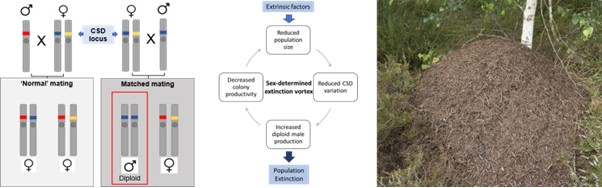
Paradoxically, haplodiploidy should lead to lower levels of genome-wide inbreeding depression because deleterious genes are effectively selected against in haploid males. However, the genetic mechanism underlying haplodiploidy, known as CSD (Complementary Sex Determiner), is predicted to be detrimental (Figure 1) (Harpur et al. 2013). This is because diploid individuals that are homozygous at CSD erroneously develop as males not as females which are always heterozygous. In social insects, diploids male production incurs a substantial cost to colonies because productive female workers are replaced by non-working males.
Importantly, matings between queens and haploid males that share one of the queens CSD alleles, so-called ‘matched matings’ that lead to diploid males (Figure 1), become more likely as genetic variation is lost at the CSD locus. The doomsday scenario is that small, fragmented populations enter a diploid male extinction vortex (Figure 1) (Zayed & Packer 2005), but this is yet to be tested. One understudied argument is that CSD genetic variation is buffered against fluctuations in allele frequency that would drive the extinction vortex because genetic variation is maintained because rare alleles are positively selected and common alleles selected against (Gloag et al. 2016). The relevance of the diploid male extinction vortex therefore requires further research (Leung & van der Meulen 2022).
Recently there has been progress identifying the CSD locus is an array of Hymenoptera (Lacy et al. 2025; Pan et al. 2024; Miyakawa & Miyakawa 2023), it is therefore timely to understand how variation at CSD relates to population isolation and population size. This PhD aims to understand more fully this relationship and so understand a fundamental assumption of the diploid male extinction vortex.
Figure 1: Left: CSD sex determination and matched matings producing diploid males. Centre: the diploid male extinction vortex. Right: A readily identifiable Formica rufa nest mound.
This project does not offer a CASE studentship
Each host has a slightly different application process.
Find out how to apply for this studentship.
All applications must include the CENTA application form.
Choose your application route
Recent work has identified the CSD region in several species showing genomic position is evolutionarily conserved. You will locate CSD and assess genetic variation at this locus and contrast it with genetic variation across the genome using whole genome resequencing. Past population size will be estimated from genome wide genetic variation and used to contrast with variation at CSD. You will also devise genetic methods of estimating the frequency of matched matings in natural populations.
Mound forming wood ants (genus Formica) will be the focus of the research (Figure 1). These species have fragmented populations at the edge of their range (e.g. Formica rufa) allowing fragmented and less fragmented populations to be compared. The work will involve molecular genetics (DNA extraction, PCR, Nanopore sequencing) and bioinformatic and population genetic analysis of whole genome data (Illumina short read sequencing). You will conduct UK field work to collect samples and survey colonies.
DRs will be awarded CENTA Training Credits (CTCs) for participation in CENTA-provided and ‘free choice’ external training. One CTC can be earned per 3 hours training, and DRs must accrue 100 CTCs across the three and a half years of their PhD.
You will receive training in a broad array of skills that will prepare you for a career in the environmental sciences: biological / environmental computing and programming (e.g. GIS, bash scripting, R, Linux), molecular genetic analysis, manuscript preparation and oral presentation.
In addition to CENTA training, you will receive tailored training from:
Year 1: Identification of CSD in study species, verification that CSD genetic variation underpins the determination of sex, identification of fragmented and unfragmented populations, population sampling.
Year 2: DNA extraction and sequencing, QC of DNA sequences, bioinformatics and population genetics analysis. Development of methods to identify matched matings. Presentation of research at UK conference.
Year 3: Population genetics analysis, estimating of matched mating frequency, manuscript writing and thesis preparation. Presentation of research at an international conference.
Gloag R, Ding G, Christie JR, Buchmann G, Beekman M, Oldroyd BP (2016) An invasive social insect overcomes genetic load at the sex locus. Nature Ecology & Evolution, 1, 0011.
Harpur BA, Sobhani M, Zayed A (2013) A review of the consequences of complementary sex determination and diploid male production on mating failures in the Hymenoptera. Entomologia Experimentalis et Applicata, 146, 156–164.
Lacy KD, Lee J, Rozen-Gagnon K, Wang W, Carroll TS, Kronauer DJC (2025) Heterozygosity at a conserved candidate sex determination locus is associated with female development in the clonal raider ant (Ooceraea biroi). eLife, 14, RP106913.
Leung K, van der Meulen H (2022) Revisiting the hymenopteran diploid male vortex: a review of avoidance mechanisms and incidence. Entomologia Experimentalis et Applicata, 170, 1010–1031.
Miyakawa MO, Miyakawa H (2023) Transformer gene regulates feminization under two complementary sex determination loci in the ant, Vollenhovia emeryi. Insect biochemistry and molecular biology, 156, 103938.
Pan Q, Darras H, Keller L (2024) LncRNA gene ANTSR coordinates complementary sex determination in the Argentine ant. Science Advances, 10, eadp1532.
Saccheri I, Kuussaari M, Kankare M, Vikman P, Fortelius W, Hanski I (1998) Inbreeding and extinction in a butterfly metapopulation. Nature, 392, 491–494.
Zayed A, Packer L (2005) Complementary sex determination substantially increases extinction proneness of haplodiploid populations. Proceedings of the National Academy of Sciences of the United States of America, 102, 10742–10746.
For any enquiries related to this project please contact Dr Rob Hammond: Division of Genetics and Genome Biology, School of Biological and Biomedical Sciences, University of Leicester. (email: [email protected]; telephone: 0116 252 5302).
To apply to this project:
Applications must be submitted by 23:59 GMT on Wednesday 6th January 2027.