

Environmental stressors such as heavy metal contamination from mining, industry and agriculture can have profound effects on microbial communities. These microbial communities are often the first to respond to environmental change, altering their composition, behaviour and antimicrobial resistance traits. While we know a great deal about how microbes react during exposure to environmental stress, much less is known about what happens afterwards. Emerging evidence suggests that bacteria can retain a form of ‘environmental memory’ after stress exposure. Whether environmentally relevant heavy metals generate such memory and influence future interactions among species remains largely unknown.
Can a brief encounter with environmental stress leave a lasting imprint on a bacterium and influence its future interactions with other species?
This project will investigate whether a bacterium’s history of metal exposure can shape how it later interacts with other species, using environmental bacteria such as Pseudomonas, Burkholderia and Bacillus as model systems. You will test whether prior exposure to environmentally relevant heavy metals influences competition, biofilm formation, antimicrobial resistance and resilience to disturbance, revealing how environmental history shapes bacterial behaviour and interactions.
The project will reveal how environmental stress can leave lasting effects on bacterial behaviour, with important consequences for microbial communities and ecosystem function. Because microorganisms underpin nutrient cycling, pollutant degradation and ecosystem resilience, lasting effects of environmental stress on microbial interactions could influence broader ecosystem processes long after contamination events have ceased.
Bringing together expertise in environmental microbiology, microbial physiology, ecological modelling and systems biology, the multidisciplinary project combines high-throughput experimentation, imaging, multi-omics and computational modelling. You will receive training in state-of-the-art experimental and computational approaches to investigate how environmental history shapes microbial behaviour and interactions.
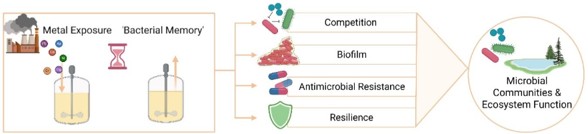
Figure 1: Diagram showing the proposed research concept. Environmental bacteria are exposed to heavy metals, generating environmental memory after stress removal. This altered physiological state influences bacterial interactions, including competition, biofilm formation, antimicrobial resistance and resilience to disturbance. These changes ultimately affect microbial communities and ecosystem function. Created in BioRender.
This project does not offer a CASE studentship
Each host has a slightly different application process.
Find out how to apply for this studentship.
All applications must include the CENTA application form.
Choose your application route
You will use an optimised high-throughput mini-bioreactor system to investigate how a bacterium’s history of environmental stress influences its subsequent interactions with other species. Long-term adaptation experiments will determine whether exposure to environmentally relevant heavy metals induces persistent physiological states that alter competition, biofilm formation, antimicrobial resistance and resilience to disturbance. Experimental approaches will combine microbial physiology, interaction assays, fluorescence microscopy, transcriptomics and metabolomics to characterise the molecular and phenotypic consequences of prior stress exposure, while distinguishing transient physiological memory from longer-term genetic adaptation. Computational modelling and data-driven analyses will integrate experimental observations and identify mechanisms linking environmental history to interaction outcomes and community dynamics. This multidisciplinary project will provide training in experimental microbiology, systems biology and computational analysis, enabling you to investigate fundamental questions surrounding ecological memory and microbial adaptation.
DRs will be awarded CENTA Training Credits (CTCs) for participation in CENTA-provided and ‘free choice’ external training. One CTC can be earned per 3 hours training, and DRs must accrue 100 CTCs across the three and a half years of their PhD.
The CENTA DR will receive multidisciplinary training in environmental microbiology, microbial ecology, bacterial physiology and systems biology. Training will include operation of mini-bioreactor systems, microbial interaction assays, fluorescence microscopy, transcriptomics, metabolomics and computational modelling. The DR will gain experience in experimental design, bioinformatics, quantitative data analysis and integration of multi-omics datasets. Through collaboration with microbiologists and ecological modellers across Leicester and Birmingham, including joint research group meetings and journal clubs, the DR will develop skills in critical evaluation of scientific literature, interdisciplinary research, scientific communication, and project management, preparing them for careers in academia, environmental science and related sectors.
Year 1: Establish model bacterial systems and optimise mini-bioreactor experiments. Determine whether transient exposure to environmentally relevant heavy metals induces persistent physiological changes after stress removal.
Year 2: Characterise the consequences of stress history for bacterial behaviour, including competition, biofilm formation, antimicrobial resistance and resilience to disturbance. Use transcriptomic and metabolomic analyses to identify pathways associated with environmental memory.
Year 3: Identify the molecular mechanisms underlying environmental memory and determine how stress history influences interactions and community assembly in multi-species microbial communities. Integrate experimental findings with computational modelling.
Year 3-4: Synthesize findings across the project, prepare publications and complete thesis write-up.
Journal:
Andrade-Linares, D.R., Lehmann, A. and Rillig, M.C. (2016) ‘Microbial stress priming: a meta-analysis’, Environmental Microbiology, 18(4), pp. 1277–1288. doi: 10.1111/1462-2920.13223.
Martins, D., McKay, G.A., English, A.M. and Nguyen, D. (2020) ‘Sublethal paraquat confers multidrug tolerance in Pseudomonas aeruginosa by inducing superoxide dismutase activity and lowering envelope permeability’, Frontiers in Microbiology, 11, 576708. doi: 10.3389/fmicb.2020.576708.
Wesener, F., Szymczak, A., Rillig, M.C. and Tietjen, B. (2021) ‘Stress priming affects fungal competition – evidence from a combined experimental and modelling study’, Environmental Microbiology, 23(10), pp. 5934–5945. doi: 10.1111/1462-2920.15418.
Bhattacharyya, S., Bhattarai, N., Pfannenstiel, D.M. et al. (2023) ‘A heritable iron memory enables decision-making in Escherichia coli’, Proceedings of the National Academy of Sciences of the United States of America, 120(48), e2309082120. doi: 10.1073/pnas.2309082120.
Widder, S., Allen, R.J., Pfeiffer, T. et al. (2016) ‘Challenges in microbial ecology: building predictive understanding of community function and dynamics’, The ISME Journal, 10(11), pp. 2557–2568. doi: 10.1038/ismej.2016.45.
For any enquiries related to this project please contact Katrin Schilcher, [email protected].
To apply to this project:
Applications must be submitted by 23:59 GMT on Wednesday 6th January 2027.