

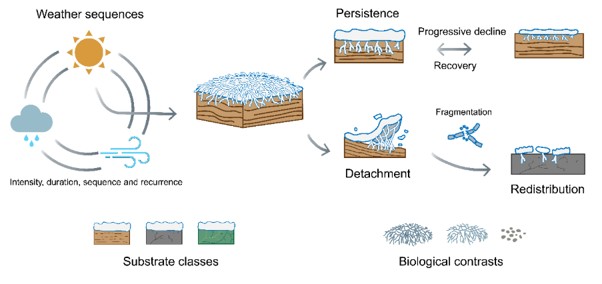
Fungi colonise terrestrial surfaces, where they contribute to decomposition and carbon cycling. Their persistence depends on both biological growth and the physical forces acting on their networks. Rainfall and wind can detach fungal material, while drying and rewetting affect its survival, attachment and capacity to resume growth. However, it remains unclear how successive weather events interact to determine whether established fungal networks persist, progressively decline, recover after disturbance or redistribute to new locations.
This project will investigate how dynamic weather exposure controls these four outcomes across terrestrial surfaces. It will test the hypothesis that the intensity, duration, combination and timing of successive events influence fungal responses beyond cumulative exposure, with effects shaped by fungal characteristics and substrate properties.
The genetically tractable filamentous fungus Schizophyllum commune will first be studied on model surfaces with controlled roughness and wettability under sequences of rainfall, airflow, simulated sunlight and drying–rewetting. Individual colonised surfaces will be followed through successive events to track fungal retention, progressive loss and regrowth. Material released into air or water will be collected and classified as spores, vegetative fragments or colonised particles. Its viability and ability to establish on receiving surfaces will be assessed, connecting physical release with its biological consequences. Selected findings will then be tested on natural substrates, including wood, leaf litter and rock.
Wild-type and defined mutant strains will be compared to identify how attachment-related surface proteins, cell-wall organisation and extracellular matrix production influence these responses. Fungal network organisation and attachment will be examined alongside substrate properties to explain the resulting variation. Experimental results will inform a dynamic model linking environmental exposure with fungal retention, recovery, release and establishment. Predictions will then be tested using independent weather sequences.
Combining fungal biology, controlled environmental experiments and modelling will reveal how weather sequences and attachment mechanisms shape fungal colonisation and movement across terrestrial surfaces.
Figure 1. Weather-driven fungal persistence, progressive decline, recovery and redistribution across terrestrial surfaces.
This project does not offer a CASE studentship
Each host has a slightly different application process.
Find out how to apply for this studentship.
All applications must include the CENTA application form.
Choose your application route
Wild-type and deletion strains of Schizophyllum commune, differing in surface proteins, cell-wall organisation or extracellular matrix production, will be compared on model surfaces differing in roughness and wettability under standardised nutrient supply. Rainfall, airflow, simulated sunlight and drying–rewetting experiments will vary event intensity, duration, combination, sequence, recurrence and recovery intervals, with comparisons at matched cumulative exposure. Temperature and humidity will be recorded. Repeated imaging will track coverage and regrowth, supported by biomass measurements on parallel specimens. Material transported by air or rainwater will be classified as spores, vegetative fragments or colonised particles. Viability and establishment will be tested on receiving surfaces. Microscopy and surface characterisation will relate network organisation and attachment to surface properties. Statistical analysis and dynamic modelling will quantify persistence, progressive decline, recovery and redistribution. Predictions will be tested using independent weather sequences, with selected findings validated on wood, leaf litter and rock.
DRs will be awarded CENTA Training Credits (CTCs) for participation in CENTA-provided and ‘free choice’ external training. One CTC can be earned per 3 hours training, and DRs must accrue 100 CTCs across the three and a half years of their PhD.
The doctoral researcher will receive practical training in fungal cultivation, sterile techniques, strain comparisons, and assessment of spore and hyphal viability. Training will cover model surface preparation and characterisation, controlled weather exposures, microscopy and image analysis, and collection of fungal material transported by air and water. The supervisory team will provide training in experimental design, statistical analysis and dynamic modelling. The researcher will develop skills in research planning, data management, scientific writing and presentation through supervisory meetings, interdisciplinary collaboration and conferences.
Dr Wenjing Sun will lead project integration, fungal experiments and attachment characterisation. Dr Luofeng Huang will lead controlled weather exposures and instrumentation in Cranfield’s Ocean Systems Test Laboratory. Dr Danlei Yang will contribute modelling expertise in fluid flow and heat transfer, integrating experimental data to predict fungal responses and assess uncertainty. Professor Han Wösten (Utrecht University) will provide characterised Schizophyllum commune wild-type and deletion strains, confirm their genotype and provenance, and advise on strain selection and biological interpretation. Joint supervisory discussions will connect fungal biology, environmental experiments and modelling throughout the project.
Year 1: Complete initial training, select Schizophyllum commune wild-type and mutant strains and establish cultivation on model surfaces. Develop methods for controlled weather exposure, fungal retention, regrowth, and collection and viability assessment. Conduct baseline experiments and establish the initial modelling framework.
Year 2: Investigate responses to dynamic weather exposures across selected strains and model surfaces, varying intensity, duration, combined forcing and recurrence. Use targeted comparisons to resolve the effects of event sequence and recovery intervals. Quantify persistence, progressive decline, recovery and redistribution, and integrate the results into the dynamic model.
Year 3: Test model predictions using independent weather sequences. Evaluate selected findings on natural substrates. Complete targeted experiments, integrate findings and prepare publications and thesis chapters.
Final six months: Complete data synthesis, thesis writing and submission, and communicate the findings through publications and presentations.
Chaudhary, V.B., Aguilar-Trigueros, C.A., Mansour, I. and Rillig, M.C. (2022) ‘Fungal dispersal across spatial scales’, Annual Review of Ecology, Evolution, and Systematics, 53, pp. 69–85. doi: 10.1146/annurev-ecolsys-012622-021604.
European Commission (2025) MyBond: Mycelium Material Bonding: Molecular Mechanism and Enhancement Strategy. CORDIS. Available at: https://cordis.europa.eu/project/id/101107639 (Accessed: 15 September 2026).
Kim, S., Park, H., Gruszewski, H.A., Schmale, D.G. and Jung, S. (2019) ‘Vortex-induced dispersal of a plant pathogen by raindrop impact’, Proceedings of the National Academy of Sciences, 116(11), pp. 4917–4922. doi: 10.1073/pnas.1820318116.
Wösten, H.A.B., Schuren, F.H.J. and Wessels, J.G.H. (1994) ‘Interfacial self-assembly of a hydrophobin into an amphipathic protein membrane mediates fungal attachment to hydrophobic surfaces’, The EMBO Journal, 13(24), pp. 5848–5854. doi: 10.1002/j.1460-2075.1994.tb06929.x.
For project enquiries, please contact Dr Wenjing Sun, Cranfield University: [email protected].
To apply to this project:
Applications must be submitted by 23:59 GMT on Wednesday 6th January 2027.