

What was it that first sparked your interest in the environmental sciences? Do you have an ‘origin story’, one that drove you to make a difference as an environmental scientist?
The values environmental scientists hold, and how they value nature, inform why and how they conduct research activities, and how they connect with wider society through forms of social and/or economic impact (Garrido Mateos et al. 2025; Hooton et al. 2025; Himes and Muraca, 2018). These values are formed in the early stages of life, developing over an environmental scientist’s career, e.g. in response to the ethos of an employer, the instrumental need for employment, and higher education policies.
Amidst the impacts of anthropogenic climate change and socioeconomic inequality, the ways that scientists engage with wider society and justify the importance of the environment, e.g., in terms of geosystem services, ecosystem services, and natural capital, are becoming ever more significant (Dupont et al., 2025).
Three areas within NERC’s higher-level research subjects will form the basis of this PhD research, e.g. Geosciences; Terrestrial and freshwater environments; and Tools, technology and methods. The PhD candidate will explore the values of environmental scientists at different career stages, both within and outside of academia (potentially including the NHM), as they conduct research and engagement.
The PhD candidate will conduct ethically informed engaged research with, rather than research on, environmental scientists (Holliman et al. 2022). This could involve a social appraisal of the values that underpin environmental scientists, and those working in related careers, to make engagement more effective through consideration of: normative dimensions, what is the right thing to do?; instrumental dimensions, what is the best or most efficient thing to do?; and substantive dimensions, how will this improve the quality of the activity (Stirling, 2008).
The findings will inform the co-creation, with environmental scientists and NHM museum specialists, of communication and engagement activities that draw on a range of values to create zones of proximal development (ZPD) (Walker, 2010) that ‘meet different people where they are’, thereby seeking to make stronger connections, and extend access to communities that have otherwise not been engaged.
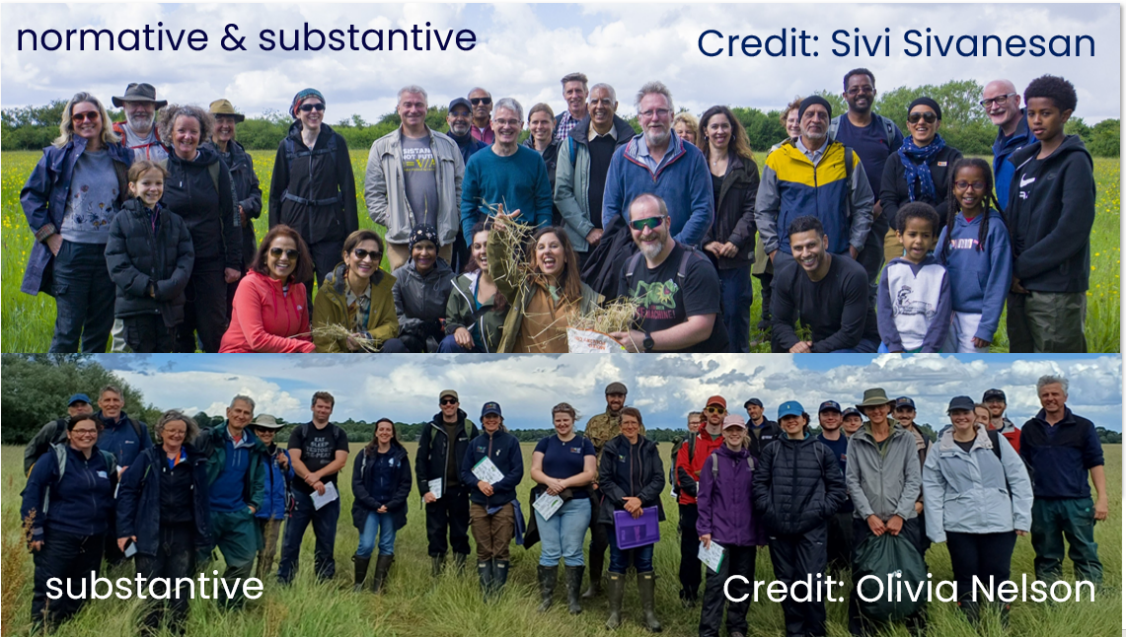
Figure 1: Two images portraying environmental scientists engaging with different constituencies to value, conserve and explore floodplain meadows (Holliman et al. 2026). Credits: Sivi Sivanesan and Olivia Nelson.
This project is a CENTA Flagship Project.
This project does not offer a CASE studentship
Each host has a slightly different application process.
Find out how to apply for this studentship.
All applications must include the CENTA application form.
Choose your application route
Data collection and analysis will draw on a mixed methods methodology (Morgan, 2007), involving:
DRs will be awarded CENTA Training Credits (CTCs) for participation in CENTA-provided and ‘free choice’ external training. One CTC can be earned per 3 hours training, and DRs must accrue 100 CTCs across the three and a half years of their PhD.
We will provide training in research design, methods and analysis. Specific training in aspects of geosystem services, ecosystem services and/or the social aspects of co-creating communication and engagement activities with specific groups will be provided, as required. A placement will be hosted at the NHM. It is not expected that applicants will have experience in all relevant methods prior to starting the PhD.
The candidate will join a thriving postgraduate community. Our students can gain teaching experience (e.g. Willow Neal), alongside placements and internships (e.g. Kate Hand), policy (e.g. Elaine Hooton), and by contributing to different media (e.g. Liz Danner).
Dr. Victoria Burton (NHM) will co-supervise, supporting the co-creation of engagement activities in informal learning contexts. Based in the Centre for UK Nature on the National Education Nature Park, she empowers children and young people across England to make a positive difference to both their own and nature’s future. Dr. Burton will be supported by her Line Manager, Lucy Robinson, who leads the NHM’s Community Science Programme.
Dr. Sasha Woods, Chief of Staff at the UKCEH, will also co-supervise. She will bring considerable expertise in environmental citizen science and policy-relevant science communication to the project.
Year 1: Develop and implement information literacy strategy and deliver a ‘systematic review’ of relevant documentation. Pilot study: collect a small number of origin stories, and organise, conduct and analyse related ethnographic interviews. Present preliminary project outline/results to the School. Pass probation upgrade.
Year 2: Select further sample of research participants, collect origin stories and conduct related ethnographic interviews. Plan and deliver a workshop, based on the analysis of origin stories and values, to co-create communication or engagement activities for specific communities or groups in collaboration with the Natural History Museum. Deliver and evaluate at least one of these activities.
Years 3-4: Finalise analytical work on data collected in Year 2. Deliver and evaluate further trials of communication and engagement activities with selected community groups. Present results at an international conference. Write thesis, prepare articles for publication.
Dupont, L., Jacob, S. and Philippe, H. (2025). Scientist engagement and the knowledge–action gap. Nat Ecol Evol, 9, 23–33, https://doi.org/10.1038/s41559-024-02535-0.
Garrido Mateos, L., Rodríguez-López, F. Sánchez-Macías, J. I. (2025) ‘The three-stage evolution in the economic valuation of nature: Externalities, ecosystem services, and natural capital accountability’, Journal of Cleaner Production, 518: 145899, https://doi.org/10.1016/j.jclepro.2025.145899.
Gordon, J. E., Kubalíková, L., Vaněk, J. et al. (2026) ‘Geopoetic practice and experiential engagement can enable rediscovery of a sense of wonder about geoheritage and foster geoconservation’, Geoheritage, 18: 200, https://doi.org/10.1007/s12371-026-01411-6.
Himes, A. and Muraca, B. (2018) ‘Relational values: the key to pluralistic valuation of ecosystem services’, Current Opinion in Environmental Sustainability, 35, https://doi.org/10.1016/j.cosust.2018.09.005.
Holliman, R., Gowing, D., Bowskill, V. et al. (2026, early access). ‘Exploring tensions in co-creating a proposal for floodplain meadows research’, Cultures of Science, 9 (4), https://doi.org/10.1177/20966083261483222.
Hooton, E., Holliman, R., Warren, C. J., Larwood, J. G. and Clarke, S. J. (2025) ‘International Geodiversity Day: Broadening Values and Justifications for Geosciences in Society’, Earth Science, Systems and Society, 5 (1):esss2024-015. https://oro.open.ac.uk/105614.
Kimber, L. R. and Dairon, E. (2023) ‘Ethnographic Interviews’. In Kimber, L. R. et al. (eds.) International Organizations and Research Methods: An Introduction. University of Michigan Press. http://www.jstor.org/stable/10.3998/mpub.11685289.16.
Miljand, M. (2020) ‘Using systematic review methods to evaluate environmental public policy: methodological challenges and potential usefulness’, Environmental Science and Policy, 105, 47-55, https://doi.org/10.1016/j.envsci.2019.12.008.
Morgan, D. L. (2007) ‘Paradigms lost and pragmatism regained’, Journal of Mixed Methods Research, 1 (1), 48–76. https://doi.org/10.1177/2345678906292462.
Stirling, A. (2008). ‘“Opening Up” and “Closing Down”: Power, Participation, and Pluralism in the Social Appraisal of Technology’, Science, Technology, & Human Values, 33 (2), 262–94. https://doi.org/10.1177/0162243907311265.
Tadaki, M., Sinner, J. and Chan, K. M. A. (2017) ‘Making sense of environmental values: A typology of concepts’, Ecology and Society, 22 (1), https://doi.org/10.5751/ES-08999-220107.
Walker, R. (2010). ‘Sociocultural Issues in Motivation’. In P. Peterson, E. et al. (eds.) International Encyclopedia of Education (pp. 712-7). 3rd Edition. Elsevier Ltd.
For any enquiries related to this project please contact Prof. Richard Holliman, [email protected].
To apply to this project:
You should make your application via The Open University’s applications portal. If you do not already have an account for this portal, you will need to register your interest and will be prompted to create an account. As part of your application, you will need to provide:
Applications must be submitted by 23:59 GMT on Wednesday 6th January 2027.