

Defining the environmental limits of life is one of the most fundamental questions in science, informing our understanding of ecosystem resilience on Earth and the potential habitability of environments beyond our planet. Microorganisms have been discovered in environments once considered uninhabitable, including hypersaline lakes, sub-zero brines, permafrost, polar ice-associated habitats and deep subsurface ecosystems. Understanding the conditions that constrain microbial survival and activity is increasingly important as climate change alters the distribution, persistence and geochemistry of extreme environments worldwide.
Warming temperatures are driving glacial retreat, permafrost thaw, reduced ice cover and hydrological change, reshaping saline and hypersaline habitats in cold regions. Microorganisms inhabiting these environments must tolerate low temperatures, water stress and chemically extreme brines. These changes have important implications for ecosystem functioning because microorganisms regulate key carbon and nutrient cycling processes, including those linked to greenhouse gas production in climate-sensitive environments.
While temperature, salinity and water availability are recognised controls on microbial activity, the role of chaotropicity remains poorly understood. Chaotropic salts, including magnesium chloride (MgCl₂), calcium chloride (CaCl₂) and (per)chlorates, destabilise proteins, membranes and other biological structures, imposing stresses that differ fundamentally from osmotic stress alone. Although highly chaotropic brines have been identified in environments such as the Kryos Basin in the Mediterranean, the Dry Valleys of Antarctica, and the deep subsurface, the combined effects of chaotropicity and low temperature on microbial survival and activity remain poorly constrained.
This project will investigate microbial survival, growth and activity in chaotrophic cryobrines across a range of low and sub-zero temperatures. Using laboratory microcosms, microbiology, molecular biology and geochemical approaches, the student will determine how environmental chemistry influences microbial viability, metabolism and adaptation under combined cold and chaotropic stress. The project will identify the physiological and molecular mechanisms that enable microorganisms to persist under these conditions and define how multiple environmental stresses interact to shape the limits of life. In addition, the project will explore whether entombment within salt crystals represents an opportunity for long-term persistence of communities within such environments where the presence of liquid can be transient.
Beyond its environmental relevance, this research has important implications for astrobiology. Many proposed extraterrestrial habitats, including subsurface brines on Mars and the icy oceans of Europa and Enceladus, are predicted to contain chaotropic salts and exist at low temperatures. By defining the conditions under which life can remain active in chaotrophic cryobrines, this project will advance our understanding of habitability on Earth and beyond, while helping predict microbial responses to increasingly extreme environments in a changing world.
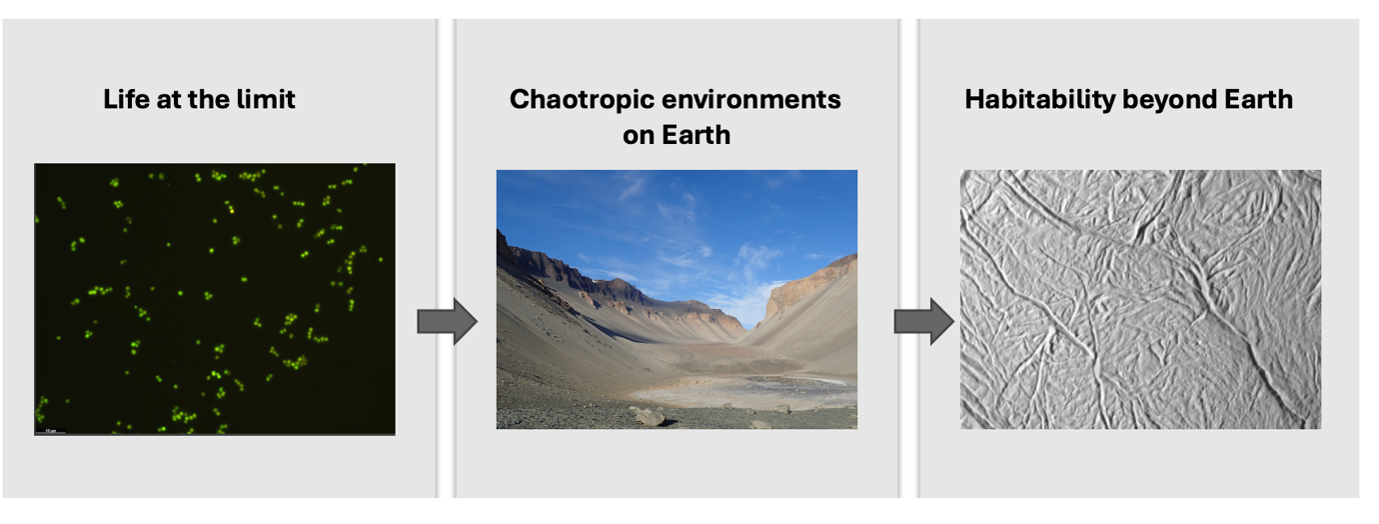
Figure 1: Linking the limits of life on Earth to the search for habitability beyond our planet. Left: fluorescence microscopy showing microbial cells surviving under extreme environmental stress. Centre: Don Juan Pond, Antarctica, one of Earth’s most saline and chemically extreme environments. Right: the tiger stripe fractures of Enceladus, Saturn’s ice-covered moon, where subsurface brines may provide potentially habitable environments.
This project does not offer a CASE studentship
Each host has a slightly different application process.
Find out how to apply for this studentship.
All applications must include the CENTA application form.
Choose your application route
A combination of microbiological, molecular and geochemical approaches will be used to investigate microbial survival, growth and activity in chaotrophic cryobrines. Laboratory experiments will be established using a range of environmentally relevant salts across temperatures from 10°C to below 0°C. Representative halophilic (salt-loving), psychrophilic (cold-loving) microbes will be cultured under controlled conditions to determine how combined cold and chaotropic stress influences microbial viability, metabolism and growth.
Microbial responses will be assessed using culture-dependent approaches, live/dead fluorescence staining and microscopy. Physiological adaptation mechanisms will be investigated through measurements of membrane integrity, metabolic activity, cellular stress responses and transcriptomic analyses. X-ray micro-computed tomography (micro-CT) will be used to visualise the three-dimensional architecture of salt crystals and determine whether microorganisms become entrapped within pore spaces or fluid inclusions during crystal formation. These analyses will provide insights into the mechanisms by which microorganisms survive in chaotrophic cryobrines and the role of mineral entombment as a potential refuge under extreme environmental conditions.
DRs will be awarded CENTA Training Credits (CTCs) for participation in CENTA-provided and ‘free choice’ external training. One CTC can be earned per 3 hours training, and DRs must accrue 100 CTCs across the three and a half years of their PhD.
The student will receive multidisciplinary training in environmental microbiology, molecular biology, microbial ecology and geochemistry. Laboratory-based training will include cultivation of extremophiles, live/dead fluorescence staining, microscopy, nucleic acid extraction, transcriptomics and bioinformatic analysis. The student will develop skills in designing and running low-temperature brine microcosm experiments and characterising environmental stress responses. Through collaboration with the Natural History Museum, the student will receive specialist training in micro-CT to visualise salt crystal architecture, fluid inclusions and microbial entombment within crystals. Additional training will include data analysis, scientific communication and conference presentation skills.
Prof Caroline Smith is Head of Collections and Principal Curator of Meteorites at the Natural History Museum. Her research focuses on meteorites, planetary materials and sample curation for space missions. She has played leading roles in Mars Sample Return planning and ESA exploration programmes, bringing extensive expertise in planetary science, astrobiology and extraterrestrial habitability.
Year 1: Experimental Design and Baseline Studies
Year 2: Mechanisms of Adaptation and Microbial Entombment
Year 3: Integration, Synthesis and Habitability Framework
Background:A degree in microbiology is needed with an interest in astrobiology.
For any enquiries related to this project please contact Karen Olsson-Francis, karen.olsson–[email protected].
To apply to this project:
You should make your application via The Open University’s applications portal. If you do not already have an account for this portal, you will need to register your interest and will be prompted to create an account. As part of your application, you will need to provide:
Applications must be submitted by 23:59 GMT on Wednesday 6th January 2027.