

The above ground parts of trees, the so-called tree phyllosphere, has an area of around 109 km2 (Zhu et al 2021), about twice Earth’s surface area. This vast habitat composed of leaves, trunks and branches, is colonised by diverse and dynamic microbial communities that affect the health and resilience of their plant hosts and contribute to biogeochemical cycles. For instance, specialised epiphytic and endophytic bacteria utilise plant volatiles such as methanol or methyl halides as carbon and energy sources, thereby acting as a sink for these compounds and limiting their emission (Vorholt 2012, Bringel & Couée, 2025). Being located in the lower atmosphere, these phyllosphere microbiomes can also utilise compounds present in the atmosphere such as trace gases. Previously, we showed that the phyllosphere hosts a wide diversity of CO-degrading bacteria (Palmer et al. 2021) and we have isolated a number of novel phyllosphere CO degrading bacteria (Palmer et al 2021, Banerjee et al 2025, Prondvai 2026). Similarly, Leung et al (2026) and our own work (Prondvai, PhD Thesis, Warwick 2026) showed uptake of trace gases by bark-associated bacteria. The phyllosphere microbiome also contains bacteria capable of degrading airborne pollutants such as phenol (Sandhu et al 2007) demonstrating the potential importance of the phyllosphere microbiome in mitigation of climate active gases and pollutants.
This project will build on our recent and ongoing work, investigating the dynamics and functional diversity of leaf and bark associated microorganisms, focussing on degradation of pollutants and trace gases. This will be pursued by (i) using our extensive strain portfolio to characterise phyllosphere microorganisms with hitherto unidentified and novel pathways of CO degradation, and/or (ii) further exploration of the functional diversity of phyllosphere microorganisms involved in pollutant degradation, in combination with (iii) direct ribosomal RNA gene amplicon sequencing and metagenomics, and data mining of existing metagenomic and metatranscriptomic data from our ongoing phyllosphere work.
The overall aim of this project is to advance our understanding of the role that phyllosphere microorganisms play in delivery of ecosystem services such as trace gas and pollutant degradation, including the identification of the biochemical and genetic determinants that effect these activities.
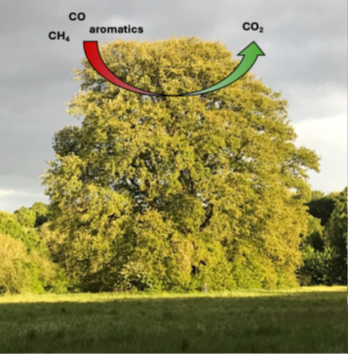
Figure 1: Tree stems and leaves encompass a huge aerial surface colonised by dynamic and functionally diverse microbiomes. Previous and ongoing research in our group is unravelling the microbial drivers of the trace gas and pollutant degradation in the phyllosphere.
This project does not offer a CASE studentship
Each host has a slightly different application process.
Find out how to apply for this studentship.
All applications must include the CENTA application form.
Choose your application route
You will apply a combination of analytical, microbiological and molecular approaches in order to characterise the activity, diversity and physiology of tree–associated microorganisms. Analytical techniques (e.g. gas chromatography or HPLC) will be applied to determine degradation of specific compounds. Microbiological methodologies will include enriching and isolating phyllosphere microorganisms, and omics and genetics approaches can be used to identify key genes supporting their degradative activities. Molecular techniques will be used for analysis of microbial diversity including metabarcoding and metagenomics
DRs will be awarded CENTA Training Credits (CTCs) for participation in CENTA-provided and ‘free choice’ external training. One CTC can be earned per 3 hours training, and DRs must accrue 100 CTCs across the three and a half years of their PhD.
Training in gas chromatography, HPLC, handling gases and volatiles, microbiological and molecular approaches will be provided by the team of supervisors and technical support staff in the School of Life Sciences.
This project is a continuation of an established research theme in the laboratory of Hendrik Schaefer, building on previous PhD and UKRI funded projects that explore the role and diversity of microbial communities in the phyllosphere. As a student in the group, you will be able to benefit from a wide network of the supervisors which will facilitate ad hoc collaborations with researchers elsewhere in the UK and overseas.
Year 1: Enrichment and isolation of new pollutant/trace gas degrading bacteria and their genomic characterisation
Year 2: Analysis of the diversity of environmental phyllosphere microbial communities and enriched pollutant/trace gas degrading consortia using metabarcoding and metagenomics
Year 3: Characterisation of model isolates including genetic/biochemical approaches OR further analysis of environmental regulation of degradation processes (eg designing reporter strains)
Previous and ongoing work has targeted atmospheric trace gases such as methane, CO and methyl halides, as well as pollutants such as para-nitrophenol. This PhD project offers the opportunity to continue previous work or break new ground by targeting degradation of other pollutants (BTEX, PFAS).
Banerjee S, Táncsics A, Wu Z, Stafioiu T, Gao J, Tóth E, Baka E, Bending GD, and H Schäfer. 2025. ‘Foliimonas ilicis gen. nov., sp. nov., a carbon monoxide-oxidizing bacterium belonging to a novel genus of the family Phyllobacteriaceae isolated from leaves of Ilex aquifolium‘, International Journal of Systematic and Evolutionary Microbiology, 75.
Bringel F, Couée I, 2015. ‘Pivotal roles of phyllosphere microorganisms at the interface between plant functioning and atmospheric trace gas dynamics’, Frontiers in Microbiology, 6.
Koskella B, 2020. ‘The phyllosphere’, Current Biology, 30: R1143-R46.
Leung PM, Jeffrey LC, Bay SK, Gomez-Alvarez P, Hall M, Johnston SG, Dittmann J, et al 2026. ‘Bark microbiota modulate climate-active gas fluxes in Australian forests’, Science, 391: eadu2182.
Palmer JL, Hilton S, Picot E, Bending GC, and H Schäfer. 2021. ‘Tree phyllospheres are a habitat for diverse populations of CO-oxidizing bacteria’, Environmental Microbiology, 23: 6309-27.
Prondvai E, 2026. PhD Thesis, School of Life Sciences, University of Warwick
Vorholt JA, 2012. ‘Microbial life in the phyllosphere’, Nat Rev Micro, 10: 828-40.
Zhu, Y-G, Xiong C, Wei Z, Chen Q-L, Ma B, Zhou S-Y-D, Tan J, et al. 2022. ‘Impacts of global change on the phyllosphere microbiome’, New Phytologist, 234: 1977-86.
Applicants are strongly encouraged to contact Hendrik Schäfer ([email protected]) to discuss the project and ask any questions they may have.
To apply to this project:
Applications must be submitted by 23:59 GMT on Wednesday 6th January 2027.