

Finding the Most Explosive Volcanoes on Earth
While advances in volcanology have revealed much about eruption processes, research has largely concentrated on a small set of well-monitored volcanoes, geographically skewed towards continental and northern hemisphere regions. This focus has left significant gaps in our understanding of many volcanoes, especially in resource-poor regions including island arcs in Southeast Asia. These areas coincide with the world’s highest volcanic activity, yet eruption histories, geological maps, and monitoring data are incomplete or absent. Volcanoes capable of very large magnitude eruptions (M ≥ 6), with the potential to cause severe regional or global impacts, remain missing from current risk assessments.
This PhD project will address this critical knowledge gap by identifying which volcanoes are most likely to produce highly explosive, large-magnitude eruptions. The student will combine global datasets with targeted field investigations to test the attributes hypothesised to favour such eruptions. Using a training dataset of well-studied volcanoes with known large eruptions, the project will employ statistical and machine learning (ML) methods to identify the strongest predictors of eruption magnitude. These predictive models will then be applied to poorly characterised volcanoes, producing a prioritised list for further research and monitoring.
Fieldwork in Southeast Asia, in collaboration with Indonesian partners, will test and refine these predictions. The student will also help organise a joint field course (with the Global Volcano Risk Alliance charity), to train local and international students in volcanic mapping, tephra sampling, dating techniques, and the analysis of volcanic ash for health impacts. This component will strengthen scientific capacity, foster community engagement, and produce valuable new data for the project.
By integrating advanced data science with traditional field volcanology and community-based training, the project will identify hidden high-risk volcanoes and contribute directly to monitoring priorities and the next generation of volcano scientists. The outcomes will be relevant to global disaster risk reduction efforts and will support targeted investment in monitoring infrastructure where it is most urgently needed.
Applicants should be comfortable working with quantitative analytical methods (specific machine learning skills can be developed during the PhD). Willingness for fieldwork in challenging environments is essential.
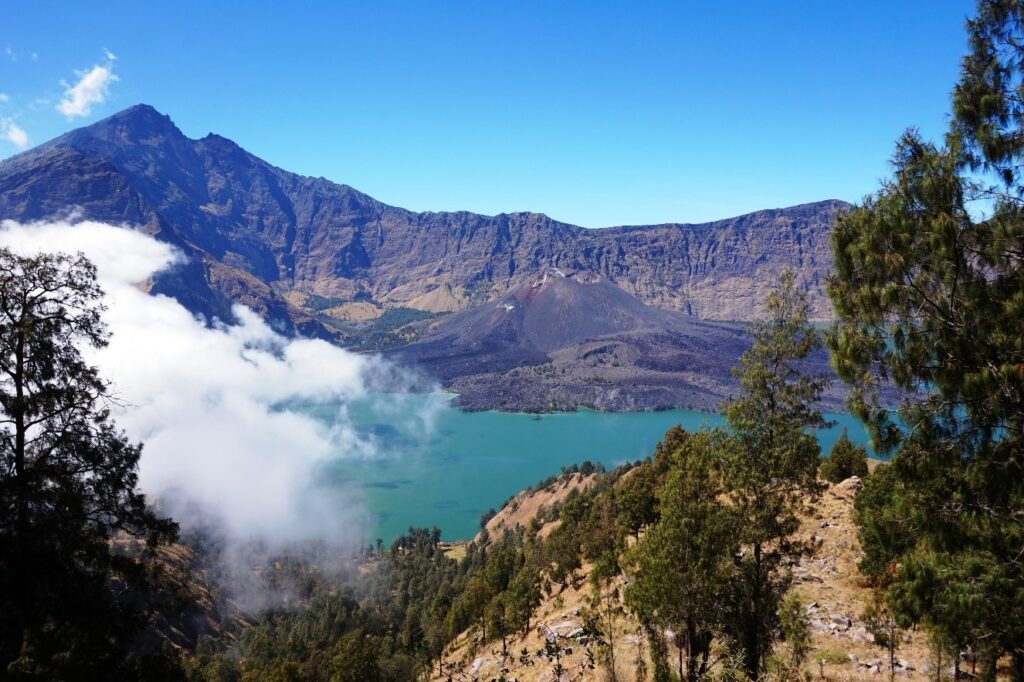
Figure 1: The lake-filled caldera of Rinjani volcano in Lombok, Indonesia, the site of the Samalas eruption in 1257 that had global climatic effects. The volcano culprit for these climatic effects was only discovered to be Rinjani as recently as 2013.
This project is not suitable for CASE funding
Each host has a slightly different application process.
Find out how to apply for this studentship.
All applications must include the CENTA application form.
Choose your application route
The project begins with compiling a global database of volcano attributes, integrating geological, geochemical, geophysical, and historical eruption data from multiple open and proprietary sources. A subset of well-characterised volcanoes with documented large eruptions (M ≥ 6–7) will serve as a supervised training set for statistical and ML models, enabling identification of attributes most predictive of extreme explosivity. These models will be applied to under-studied volcanoes to generate a ranked list of candidates for further investigation.
Fieldwork will target selected volcanoes, focusing on geological mapping, tephra sampling, and dating of eruptive deposits. The student will co-lead a joint field course with Indonesian partners and a UK charity, integrating training for students with data collection for the project. Laboratory analyses of tephra, including health impact assessment, will be undertaken in collaboration with partner institutions. Model outputs and field data will be iteratively integrated to refine predictions and produce actionable monitoring recommendations.
DRs will be awarded CENTA Training Credits (CTCs) for participation in CENTA-provided and ‘free choice’ external training. One CTC can be earned per 3 hours training, and DRs must accrue 100 CTCs across the three and a half years of their PhD.
The student will gain advanced skills in volcanology, statistical modelling, and machine learning, alongside practical field methods in geological mapping, tephra sampling, and dating techniques. Training will include programming for data science, geospatial analysis, and supervised/unsupervised ML workflows. Through co-organising the joint field course, the student will develop leadership, project management, and science communication skills, as well as cross-cultural collaboration experience. Laboratory training will cover geochemical analysis and ash health hazard assessment. Engagement with the partner charity will provide experience in community-based science and public engagement, while dissemination of findings to policymakers will strengthen science-policy interface skills.
Year 1
Year 2
Year 3
Cassidy, When sleeping volcanoes wake Aeon Magazine (September 2025)
Costa, Antonio, Joachim Gottsmann, Oleg Melnik, and R. S. J. Sparks. ‘A Stress-Controlled Mechanism for the Intensity of Very Large Magnitude Explosive Eruptions’. Earth and Planetary Science Letters 310, nos 1–2 (2011): 161–66.
Costa, Antonio, and Joan Martí. ‘Stress Field Control during Large Caldera-Forming Eruptions’. Frontiers in Earth Science 4 (2016): 92.
Giordano, G., and L. Caricchi. ‘Determining the State of Activity of Transcrustal Magmatic Systems and Their Volcanoes’. Annual Review of Earth and Planetary Sciences 50, no. 1 (2022): 231–59. https://doi.org/10.1146/annurev-earth-032320-084733.
Maisonneuve, C. Bouvet de, Francesca Forni, and Olivier Bachmann. ‘Magma Reservoir Evolution during the Build up to and Recovery from Caldera-Forming Eruptions–a Generalizable Model?’ Earth-Science Reviews 218 (2021): 103684.
Newhall, Chris, Stephen Self, and Alan Robock. ‘Anticipating Future Volcanic Explosivity Index (VEI) 7 Eruptions and Their Chilling Impacts’. Geosphere 14, no. 2 (2018): 572–603. https://doi.org/10.1130/GES01513.1.
Sheldrake, Tom, and Luca Caricchi. ‘Regional Variability in the Frequency and Magnitude of Large Explosive Volcanic Eruptions’. Geology 45, no. 2 (2017): 111–14.
Sparks, R. S. J., J. D. Blundy, K. V. Cashman, M. Jackson, A. Rust, and C. J. N. Wilson. ‘Large Silicic Magma Bodies and Very Large Magnitude Explosive Eruptions’. Bulletin of Volcanology 84, no. 1 (2022): 8. https://doi.org/10.1007/s00445-021-01510-y.
Weber, Gregor, and Tom E. Sheldrake. ‘Geochemical Variability as an Indicator for Large Magnitude Eruptions in Volcanic Arcs’. Scientific Reports 12, no. 1 (2022): 15854.
For any enquiries related to this project please contact Michael Cassidy, [email protected]
To apply to this project:
Applications must be submitted by 23:59 GMT on Wednesday 7th January 2026.