

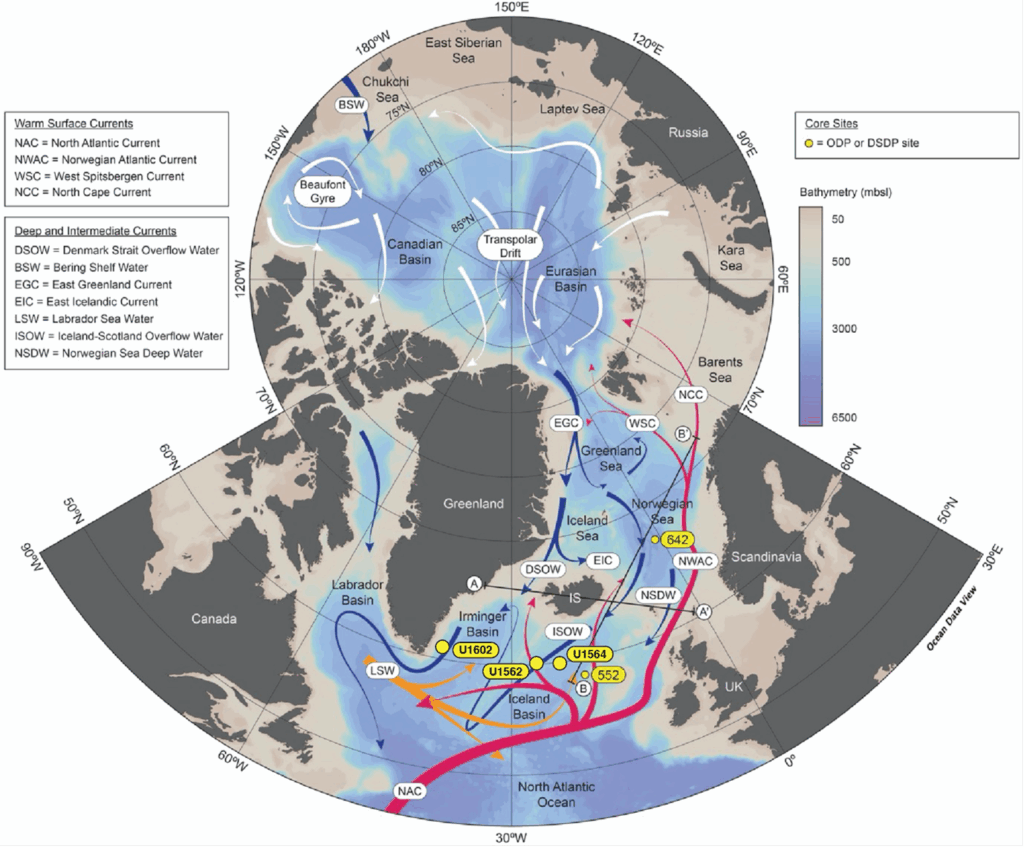
Northwest Eurasia owes its anomalously temperate climate to the oceanic circulation cell known as the Atlantic Meridional Overturning Circulation (AMOC). Regional warmth is maintained by northward-flowing Atlantic surface currents – including the Gulf Stream – that lose their heat to the atmosphere in the mid-to-high latitudes, before sinking as cold and saline waters in the Nordic seas. These dense bottom waters then flow south over sills either side of Iceland before combining to contribute >85% of the deep-water return flow of the AMOC (Figure 1). Anthropogenic climate change will warm and freshen the surface waters of the sub-Polar North Atlantic, reducing their density and possibly inhibiting the formation of deep waters. Such a break in this critical region of overturning may slow down or even shut down the AMOC, which is highlighted as a global tipping point of major concern by the Intergovernmental Panel on Climate Change (IPCC).
This project seeks to understand the operation of this sub-polar component of the AMOC in the most recent past climate, the Pliocene, which had similar global temperatures to those predicted for the near future. Recently published work, based on new core material from International Ocean Discovery Program (IODP) Expedition 395 (June-August 2023), has shown tipping point behaviour during the Pliocene in the deep-water return flow of the AMOC (Sinneseal et al. 2025). The aim of this project is to generate thermo-haline (temperature-salinity) reconstructions of the surface ocean in the critical sub-Polar North Atlantic zone, to understand surface ocean density controls on this tipping point in deep-water formation. These reconstructions will be based on the paired measurements of both stable isotopes and trace metal concentrations (Mg/Ca) in planktic (surface ocean) and benthic (deep ocean) foraminifera shells preserved in sediment cores from IODP Exp. 395 Site U1564. Together oxygen isotope (δ18O) and Mg/Ca measurements can be used to deconvolve surface ocean δ18O composition and temperatures, with the former strongly correlated with surface ocean salinity. The project will build on existing post-expedition sample processing and pilot analyses.
Figure 1. Bathymetric map of the NE Atlantic Ocean, Nordic Seas and Arctic Ocean. Red, orange, and blue arrows indicate surface, intermediate and deep ocean currents respectively. Deep ocean sediment cores spanning the Pliocene are highlighted in yellow, including the critical new sites that will be a focus of this study: IODP Expedition 395 Sites U1562, U1564 and U1602. (Jonathan Hall, PhD Thesis 2021).
This project is a CENTA Flagship Project.
This project is suitable for CASE funding
Each host has a slightly different application process.
Find out how to apply for this studentship.
All applications must include the CENTA application form.
Choose your application route
Samples required for this work have been taken from Site U1564 (Gardar Drift; 59°51’N; 23°16’W; WD 2208m), which has a complete sedimentary record with good to excellent foraminifera preservation, through an interval that represents 4.5 to 3.4 Ma. Samples will be washed and then picked for foraminiferal assemblage, isotope and trace metal analyses. A significant number (>150) of samples have already been washed, picked and with some pilot stable isotope data obtained from some species. The project will build on this work, with the aim of generating a continuous, ~4ka resolution, paired stable isotope and trace metal record on the planktic foraminifera Neogloboquadrina atlantica and an epibenthic species / species group. Other planktic foraminifera will be analysed for stable isotopes where present and informative for the interpretation of the N. atlantica record.
DRs will be awarded CENTA Training Credits (CTCs) for participation in CENTA-provided and ‘free choice’ external training. One CTC can be earned per 3 hours training, and DRs must accrue 100 CTCs across the three and a half years of their PhD.
The student will receive training in palaeoceanography, marine plankton, geochemistry and climate change from lead supervisors Dunkley Jones and Edgar. This will be supplemented where appropriate with external courses and summers schools provided by The Micropalaeontological Society or through the IODP3 network. Project partner Prof. Mel Leng (BGS) will provide direct training on stable isotope analyses and data interpretation within her facility. Staff at CASE Partner Petrostrat Ltd. will provide training in the integration of micropaleontological and stratigraphic data.
The project is strongly collaborative across two partner organisations:
1) British Geological Survey Centre for Environmental Geochemistry (project partner); Prof. Mel Leng (Director) is a world-leader in the application of isotope geochemistry and will guide analyses over the course of the PhD.
2) Case Partner Petrostrat Ltd. have extensive expertise in the study of North Atlantic marine microplankton and benthic foraminiferal communities across many staff. Working alongside this expertise, including co-supervision, will contextualise the PhD within existing data to generate a reference standard for the Pliocene high latitude North Atlantic.
Year 1: Sample processing, foraminiferal picking and assemblage analyses.
Year 2: CASE Placement and isotope training and analyses.
Year 3: Trace metal analyses and thesis write-up.
Årthun, M., Asbjørnsen, H., Chafik, L., Johnson, H.L., Våge, K. Future strengthening of the Nordic Seas overturning circulation. Nature Communications 14, 2065 (2023). https://doi.org/10.1038/s41467-023-37846-6.
Sinnesael, M., Boris Th Karatsolis, B. Th., Pearson, P.N., Briais, A., Hemming, S.R., LeVay, L.J., Dunkley Jones, T., Cui, Y., Di Chiara, A., Dodd, J.P., Dwyer, D., Eason, D.E., Friedman, S.A., Hanson, E., Hochmuth, K, Ibrahim, H.E., Jasper, C.E., Lee-Takeda, S., LeBlanc, D.E., Lindsay, M.R., McNamara, D.D., Modestou, S.E., Morris, M., Murton, B.J., Oconnell, S., Pasquet, G., Qian, S-P, Rosenthal, Y., Satolli, S., Suzuki, T., Thulasi, T., Wade, B.S., White, N.J., Wu, T., Yang, A.Y. & Ross E. Parnell-Turner. 2025. Onset of strong Iceland-Scotland overflow water 3.6 million years ago. Nature Communications. https://doi.org/10.1038/s41467-025-59265-5.
For any enquiries related to this project please contact Tom Dunkley Jones, [email protected]
https://www.birmingham.ac.uk/staff/profiles/gees/dunkley-jones-tom.aspx
https://publications.iodp.org/proceedings/395/395title.html
To apply to this project:
Applications must be submitted by 23:59 GMT on Wednesday 7th January 2026.