

Growing evidence suggests that hydroclimatic compound events – where multiple hazards occur simultaneously or sequentially – are becoming more frequent and severe in some regions of the UK (Visser-Quinn et al., 2019). These events can lead to significant economic losses and are of particular concern because their combined impacts often exceed the effects of individual hazards (Chun et al., 2024; Ridder et al., 2020). For instance, prolonged droughts can harden soils and reduce infiltration, making it more vulnerable to flash flooding when heavy rainfall occurs. Successive heavy rainfall events can result in multiple floods, leaving little time for affected areas to recover. Heatwaves, by increasing evaporation, can be followed by sudden rainfall that intensity flash flood risks.
Human activities, such as reservoir construction, urban expansion, water abstraction, and wastewater discharge, are key drivers of changing hydroclimatic patterns (Han et al., 2022; Sarojini et al., 2016). However, our current understanding of how human activities influence hydroclimatic compound events remains limited. This is partly due to the lack of comprehensive human-related datasets representing diverse anthropogenic activities, as well as limitations of existing models in effectively integrating human data to quantify human influence.
Foundation AI models offer significant potential due to their strength in integrating multi-modal data (e.g., time series, geospatial data, text, and image – including both hydrological and human-related data) and capturing complex, non-linear relationships (Bommasani et al., 2021; Nguyen et al., 2023). By integrating large scale, multi-modal data and leveraging self-supervised and transfer learning, these models demonstrate satisfactory spatial-temporal simulation and predictions across domains, even with limited data.
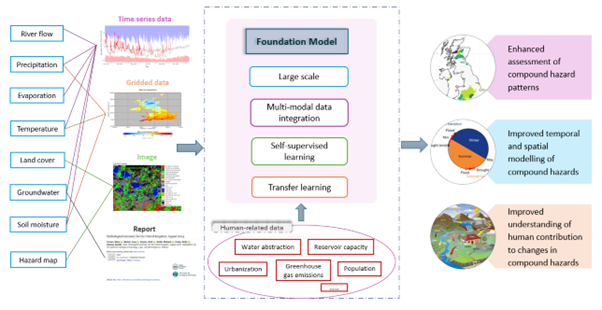
Leveraging recent advances in foundation AI and availability of muti-modal data, this project aims to (overall workflow is in Figure 1):
Figure 1. Overall workflow of foundation AI model.
This project is not suitable for CASE funding
Each host has a slightly different application process.
Find out how to apply for this studentship.
All applications must include the CENTA application form.
Choose your application route
Building on previous projects, we have developed a comprehensive, multi-modal national hydrological dataset for the UK. This includes variables such as river flow, precipitation, evapotranspiration, temperature, land cover, groundwater levels, soil moisture, reservoir, water abstraction, and catchment attributes. A foundation AI model has been developed using these datasets, which has shown improved performance in hydrological forecasting.
This PhD project will leverage this hydroclimatic dataset. Statistical methods will be applied to extract compound hydroclimatic events across human-influenced UK catchments, the temporal dynamics and spatial patterns of these events will then be analysed. Using high-performance computing, the project will further enhance the foundation model by incorporating various human-related data into the training process, building on top of the core hydrological dataset. This advanced model will aim to capture hidden interactions and non-linear relationships within human–hydrology systems, enabling the quantification of the impact of different human activities on changes in compound hazards.
DRs will be awarded CENTA Training Credits (CTCs) for participation in CENTA-provided and ‘free choice’ external training. One CTC can be earned per 3 hours training, and DRs must accrue 100 CTCs across the three and a half years of their PhD.
This project brings together expertise from hydrology (hydroclimatic hazards), climate science (climate change), sustainable development (water management and climate resilience), data science (multi-modal data analysis), and computer science (foundation AI models). The PhD candidate will receive comprehensive training and knowledge across all these research areas through the supervisory team. Extensive training will be provided in large-scale multi-modal data analysis, programming, AI-based numerical modelling, and ArcGIS. The candidate will also have access to a wide range of personal and professional development trainings. Through collaboration with government and industry partners, the student will learn how research is translated in practical contexts.
AtkinsRéalis is a one of the leading engineering, design, and project management consultancies. It will play a key role in fine-tuning the AI model to optimize it for practical application in real-world planning, decision-making, and emergency response scenarios.
Year 1: Attend relevant training (e.g., Python programming, machine learning), become familiar with multi-modal datasets, identify human-influenced catchments in the UK, and develop a statistical approach to extract compound events.
Year 2: Collect all available human influence data from public resources and project partners. Further enhance the pre-developed foundation AI model by integrating human-related data. Attend conferences and prepare journal paper(s) to disseminate research findings.
Year 3: Quantify the impact of various human activities on the occurrence and severity of compound hazards. Present research at conferences (e.g., EGU), write additional journal paper(s), and complete and submit the thesis.
Bommasani, R., Hudson, D.A., Adeli, E., Altman, R., Arora, S., von Arx, S., Bernstein, M.S., Bohg, J., Bosselut, A., Brunskill, E. and Brynjolfsson, E., 2021. On the opportunities and risks of foundation models. arXiv preprint arXiv:2108.07258.
Chun, K.P., Octavianti, T., Papacharalampous, G., Tyralis, H., Sutanto, S.J., Terskii, P., Mazzoglio, P., Treppiedi, D., Rivera, J., Dogulu, N. and Olusola, A., 2024. Unravelling compound risks of hydrological extremes in a changing climate: Typology, methods and futures. arXiv preprint arXiv:2409.19003.
Han, S., Slater, L., Wilby, R.L. and Faulkner, D., 2022. Contribution of urbanisation to non-stationary river flow in the UK. Journal of Hydrology, 613, p.128417.
Nguyen, T., Brandstetter, J., Kapoor, A., Gupta, J.K. and Grover, A., 2023. Climax: A foundation model for weather and climate. arXiv preprint arXiv:2301.10343.
Ridder, N.N., Pitman, A.J., Westra, S., Ukkola, A., Do, H.X., Bador, M., Hirsch, A.L., Evans, J.P., Di Luca, A. and Zscheischler, J., 2020. Global hotspots for the occurrence of compound events. Nature communications, 11(1), p.5956.
Sarojini, B.B., Stott, P.A. and Black, E., 2016. Detection and attribution of human influence on regional precipitation. Nature Climate Change, 6(7), pp.669-675.
Visser-Quinn, A., Beevers, L., Collet, L., Formetta, G., Smith, K., Wanders, N., Thober, S., Pan, M. and Kumar, R., 2019. Spatio-temporal analysis of compound hydro-hazard extremes across the UK. Advances in Water Resources, 130, pp.77-90.
For more information on the project, please do not hesitate to contact Dr Shasha Han: [email protected]
To apply to this project:
Applications must be submitted by 23:59 GMT on Wednesday 7th January 2026.