

Vulnerability of the Greenland Ice Sheet (GIS) to current climate warming, which could provide c. 7 m of dangerous sea-level rise if it melted completely, is a first-order global concern. GIS melt has already begun, but it is unclear whether it will gain pace significantly over the coming century, or what the associated sea-level rise will be.
One way to address this concern is to measure how the GIS grew to its current extent. During the Mid-Piacenzian Warm Period (MPWP), c. 3.2 million years ago, atmospheric CO2 concentrations were similar to present, and global temperature was as predicted for the coming century. Prior to the MPWP, the GIS was limited to a smaller upland area. As global temperature cooled after the MPWP, the GIS expanded rapidly to near its current extent. If we could measure the speed of initial GIS growth, it would be valuable in calibrating model forecasts of melt.
Reconstructing growth of the GIS is a 10s-of-million-dollar endeavour that requires deep drilling of marine sedimentary successions in iceberg-infested seas. Several international scientific drilling expeditions to collect this dataset are planned, but it will be >10 years before they bear full fruit.
Instead, this PhD project will get an answer much more quickly by exploiting the adjacent Iceland Ice Sheet (IIS) as a GIS analogue. The IIS also advanced rapidly from the uplands to the coast after the MPWP. Crucially, this advance is recorded by easily accessible sedimentary rocks in northeastern Iceland, and we have £40k of confirmed NERC facility funding to improve age resolution by a factor of >10. The PhD student will join a Birmingham-led, international, cross-disciplinary team to measure initial advance of the IIS, explore implications for the GIS, and pave the way for a NERC-funded study.
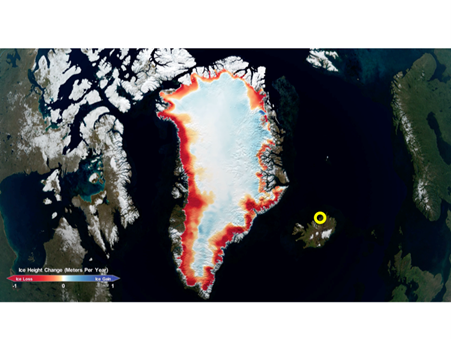
Figure 1: The Greenland and Iceland Ice Sheets. During the last glacial maximum, both ice sheets extended as far as the edges of their continental shelves. The yellow circle shows the sedimentary archive of Icelandic lowland glaciation that this project will analyze. Greenland Ice Sheet vulnerability is shown in terms of ice loss between 2003 and 2019 superimposed as a colour scale; most of the ice sheet margin lost c. 1 m per year. Credit: NASA.
This project is not suitable for CASE funding
Each host has a slightly different application process.
Find out how to apply for this studentship.
All applications must include the CENTA application form.
Choose your application route
The PhD dissertation will centre around three methodologies which will result in an equal number of papers submitted to peer-reviewed journals.
Method 1/Paper 1. We have already dated the lower Tjörnes succession (Hall et al., 2023). The doctoral researcher (DR) will follow this template to integrate new radiometric ages with magnetostratigraphy and build a new age model for the upper Tjörnes succession.
Method 2/Paper 2. From Paper 1 we have: (i) onset age of lowland glaciation; (ii) durations of the six oldest lowland glacial-interglacial cycles. Icelandic collaborators provide: (iii) age and extent of upland glaciation. The DR will work with Birmingham and external supervisors to develop the first palaeo-icesheet model that satisfies these constraints.
Method 3/Paper 3. Working alongside our international project team of glaciologists, the DR will (i) compare our new observationally ground-truthed constraints on IIS expansion with existing model-based constraints on GIS expansion, and (ii) use the resulting process knowledge to make initial assessment of implications for near-future GIS melt.
DRs will be awarded CENTA Training Credits (CTCs) for participation in CENTA-provided and ‘free choice’ external training. One CTC can be earned per 3 hours training, and DRs must accrue 100 CTCs across the three and a half years of their PhD.
Dan Barfod (Scottish Environmental Research Centre) is facilitating the radiometric dating. Áslaug Geirstóttir is expert in the Icelandic record of glaciation and will advise on Paper 2. Benjamin Keisling (U. Texas) will provide specialist knowledge of GIS modelling, and Kasia Sliwinska (Geological Survey of Denmark and Greenland) will provide observations and models of the GIS, for Paper 3. Jonathan Hall (Natural England) will contribute public outreach training and external DR mentorship.
Year 1: Produce draft age model for upper Tjörnes succession. Ice sheet modelling training. Trip to Iceland for field area familiarization and to collect new drone imagery of upper succession, to aid science communication and public outreach.
Year 2: Finish and submit paper 1 (age model). Carry out ice sheet modelling and produce draft paper 2 on Iceland ice sheet.
Year 3: Finish and submit paper 2. Compare early growth histories of the Iceland and Greenland Ice Sheets, and draft paper 3 on implications for near-future Greenland Ice Sheet melt.
Allison, M.S., Hall J.R., Papadopoulos, M.T., Eiríksson, J., Jones, S.M. (2025) ‘Updated stratigraphy and structure of the Barmur Group (Tjörnes beds, Iceland) and implications for the opening of the Bering Strait’, in: Hernández-Molina, F.J., Davoli, G., Stirling, E.J., Chiarella, D. and Viana, A.R. (eds) Oceanic Gateways: Modern and Ancient Analogues and their Conceptual and Economic Implications. Geological Society, London, Special Publications, 553, https://doi.org/10.1144/SP553-2023-152.
Geirsdóttir, Á., Eiríksson, J. (1994). ‘Growth of an Intermittent Ice Sheet in Iceland during the Late Pliocene and Early Pleistocene’, Quaternary Research 42(2), 115–130, https://doi.org/10.1006/qres.1994.1061.
Hall, J.R., Allison, M.S., Papadopoulos, M.T., Barfod, D.N., Jones, S.M. (2023) ‘Timing and consequences of Bering Strait opening: new insights from 40Ar/39Ar dating of the Barmur Group (Tjörnes beds), northern Iceland’, Paleoceanography and Paleoclimatology, 38, e2022PA004539, https://doi.org/10.1029/2022PA004539.
Prospective applicants are positively encouraged to contact Marco Maffione ([email protected]) or Steve Jones ([email protected]) in advance of applying to ask questions about the project, discuss whether working with us on this project at the University of Birmingham is a good fit for you, or to ask questions about putting together a strong application. We are also happy to put you in contact with current and former students to ask questions about their experiences. See CENTA web page for information on how to apply and general information.
To apply to this project:
Applications must be submitted by 23:59 GMT on Wednesday 7th January 2026.