

Exploring how sulphur metabolism shapes the oak tree microbiome
Sulphur is a vital macronutrient for plant growth and resilience, as a component of amino acids and proteins, and signalling pathways involved in responses to both biotic and abiotic stress. Plant-associated microbiota play essential roles in the uptake of sulphur from the soil, and emerging evidence suggests that sulphur metabolism influences the composition and function of plant microbiomes. However, this phenomenon has barely been studied in tree species. In our previous microbiome analysis of oak trees across Britain (see Downie et al., 2025 BioRxiv), metagenome analysis of trees affected by the complex decline disease, Acute Oak Decline (AOD), demonstrated an increase in genes associated with sulphur utilisation in the inner stem microbiome of AOD affected trees. Bacterial canker in the stems of affected trees is a key symptom of AOD, raising the question of whether changes in sulphur chemistry drive changes in microbiome function that lead to disease development.
This project hypothesises that alterations in sulphur chemistry in oak trees affected by Acute Oak Decline (AOD) drives shifts in microbiome structure and activity, potentially by promoting the growth and virulence of pathogenic bacteria associated with stem cankers in AOD.
Project Aims:
To address this hypothesis, the PhD will explore the interplay between sulphur metabolism and microbiome dynamics in oak (Quercus robur) through the following objectives:
The project will provide novel insights into how host chemistry influences plant-microbe interactions and disease progression. Understanding these mechanisms could inform new strategies for managing oak health and resilience in the face of emerging tree diseases.
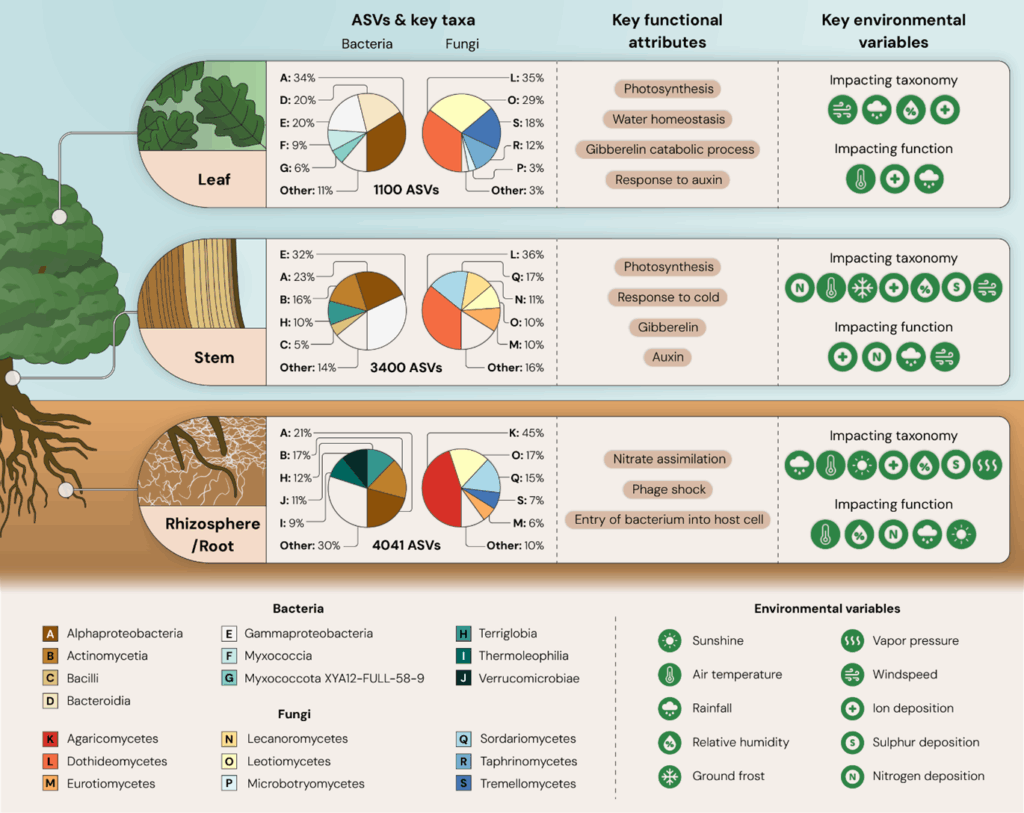
Figure 1: Overview of the composition of the oak microbiome across Britain, highlighting microbial community composition across tissue types based on single gene community profiling analysis of the 16S rRNA gene (bacteria) and ITS (fungi). Key functional attributes were identified using Gene Ontology term abundance in metagenome datasets. Key environmental variables impacting taxonomic and functional composition of the microbiome were identified using a three-level occupancy model. Source: Downie et al., 2025 BioRxiv https://doi.org/10.1101/2025.08.15.670310
This project is not suitable for CASE funding
Each host has a slightly different application process.
Find out how to apply for this studentship.
All applications must include the CENTA application form.
Choose your application route
The project will utilise analytical chemistry techniques including Ion Chromatography and Liquid Chromatography-Mass Spectrometry (LC-MS) to chemically profile oak tissues. Field sampling of oak tissue samples, followed by nucleic acid extraction, shotgun metagenomics and meta-transcriptomics, coupled with bioinformatics analyses, will be used to functionally profile the oak microbiome. The candidate will also work with pure and mixed cultures of oak-associated bacteria in the laboratory, using in vitro assays to explore the impact of sulphur compounds on bacterial growth and gene expression using aseptic technique, bacterial growth curves and qPCR or transcriptome analysis.
DRs will be awarded CENTA Training Credits (CTCs) for participation in CENTA-provided and ‘free choice’ external training. One CTC can be earned per 3 hours training, and DRs must accrue 100 CTCs across the three and a half years of their PhD.
The PhD candidate will join a dynamic research team enabling a diverse and interdisciplinary training in a variety of skills and techniques, including analytical chemistry, bacteriology, functional microbiome analysis, bioinformatics analyses, and working with microbial isolates and culture collections. The project will also include fieldwork in oak woodlands in the UK. The candidate will also have access to training opportunities (bioinformatics and statistical analysis), seminars, symposia and research events at the host and partner institutions, and opportunities to present their research at appropriate research conferences and workshops with project partners.
Not applicable.
Year 1: Training, literature review, field sampling and chemical profiling.
Year 2: Functional analysis of the oak microbiome (nucleic acid extraction, sequencing, analysis).
Year 3: Lab based in vitro functional assays (growth and gene expression) and data analysis.
Year 4: Thesis writing and manuscript preparation.
Herschbach, C. and Rennenberg, H., 2001. Sulfur nutrition of deciduous trees. Naturwissenschaften, 88(1), pp.25–36. https://doi.org/10.1007/s001140000200
Denman, S., Doonan, J., Ransom-Jones, E., Broberg, M., Plummer, S., Kirk, S.A., Scarlett, K., Griffiths, A., Kaczmarek, M., Foster, J., Peace, A., Golyshin, P., Hassard, F., Brown, N., Kenny, J.G. and McDonald, J., 2018. Microbiome and infectivity studies reveal complex polyspecies tree disease in Acute Oak Decline. The ISME Journal, 12, pp.386–399. https://doi.org/10.1038/ismej.2017.170
Downie, J., Ordonez, A., Cambon, M.C., Hussain, U., Brown, N., Beckmann, M., Finch, J., Draper, J., Denman, S. and McDonald, J.E., 2025. [Preprint] Environment and disease have tissue-specific effects on the tree microbiome. bioRxiv. https://doi.org/10.1101/2025.08.15.670310
To enquire about this project, please contact Prof. James McDonald [email protected]
Professor James McDonald – School of Biosciences – University of Birmingham
To apply to this project:
Applications must be submitted by 23:59 GMT on Wednesday 7th January 2026.