

Pollinators such as bees, butterflies and hoverflies are essential for ecosystem functioning and food security, contributing to the pollination of over 1/3 of global food crops (Klein et al., 2006; Ollerton et al., 2011). However pollinator populations are in significant decline due to a combination of anthropogenic pressures including habitat loss, pesticide use, climate change and disease (Potts et al., 2016; Rundlöf et al., 2015). This decline poses a substantial threat to ecosystem resilience and agricultural productivity. Despite their ecological and economic importance, current pollinator monitoring methods remain labour-intensive, spatially constrained and temporally limited (O’Connor et al., 2019). There is a pressing need for scalable, cost-effective and accurate tools to monitor pollinator populations and inform conservation and land management strategies.
This project aims to develop and deploy an AI-driven image analysis tool to automate the identification and quantification of insect pollinators from large-scale photographic and video datasets. The research will integrate ecological fieldwork, computer vision and stakeholder engagement to:
The project will leverage Cranfield University’s Living Laboratory and Urban Observatory for image collection and stakeholder engagement. The resulting tool will support national biodiversity monitoring efforts and contribute to policy development through evidence-based insights into pollinator dynamics. By enabling high-throughput, standardised and accessible pollinator monitoring, our platform has the potential to transform how we assess pollinator health, evaluate the impacts of environmental change and design effective conservation interventions.
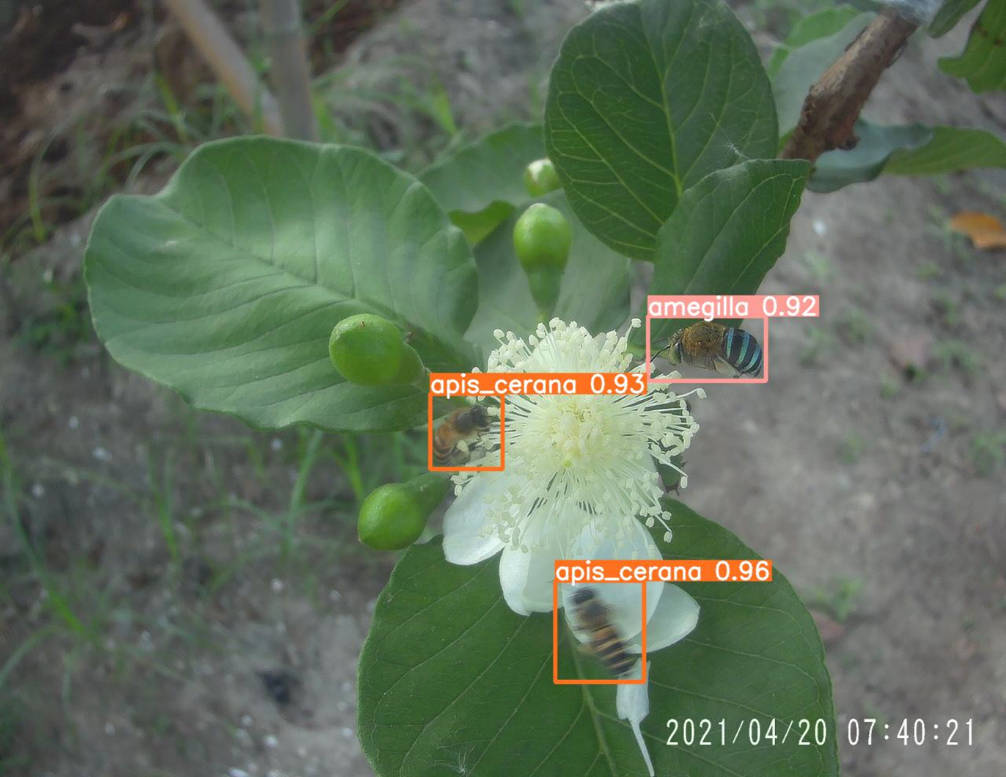
Figure 1: Example of using computer vision to detect and identify pollinators in Thailand.
This project is not suitable for CASE funding
Each host has a slightly different application process.
Find out how to apply for this studentship.
All applications must include the CENTA application form.
Choose your application route
The project will adopt a mixed-methods approach:
Data collection: Deploy camera traps and artificial flower attractants across urban and agricultural sites to capture pollinator activity.
Model development for Pollinator Monitoring: Train and optimise deep learning models for pollinator detection and classification using annotated image datasets. Post-processing object tracking algorithms will be incorporated on the acquired videos to provide abundance estimation.
Model Development for Plant-Pollinator Interactions Prediction: The information-rich datasets acquired during the project will also be used to develop ML models such as Random Forest and Neural Networks to help understand and predict pairwise interactions between pollinators and plant species.
Software Engineering: integrate models into a standalone application with automated image processing, statistical analysis and reporting features.
Stakeholder Engagement: conduct workshops and interviews with conversation organisations, farmers and researchers to co-design the tool and ensure usability.
Validation: compare model outputs with manual field surveys to assess accuracy and reliability.
DRs will be awarded CENTA Training Credits (CTCs) for participation in CENTA-provided and ‘free choice’ external training. One CTC can be earned per 3 hours training, and DRs must accrue 100 CTCs across the three and a half years of their PhD.
The doctoral researcher will gain transdisciplinary training in:
They will participate in CENTA training and attend relevant MSc modules and short courses and be embedded in Cranfield University’s Early Career Network and the Environmental Sustainability Theme.
The project will engage with the UK Pollinator Monitoring Scheme (PoMS) and DEFRA’s Pollinator Advisory Group to ensure alignment with national biodiversity goals.
Year 1:
Year 2:
Year 3:
Klein, A. M., Vaissière, B. E., Cane, J. H., Steffan-Dewenter, I., Cunningham, S. A., Kremen, C., & Tscharntke, T. (2006). Importance of pollinators in changing landscapes for world crops. Proceedings of the Royal Society B: Biological Sciences, 274(1608), 303–313. https://doi.org/10.1098/RSPB.2006.3721
O’Connor, R. S., Kunin, W. E., Garratt, M. P. D., Potts, S. G., Roy, H. E., Andrews, C., Jones, C. M., Peyton, J. M., Savage, J., Harvey, M. C., Morris, R. K. A., Roberts, S. P. M., Wright, I., Vanbergen, A. J., & Carvell, C. (2019). Monitoring insect pollinators and flower visitation: The effectiveness and feasibility of different survey methods. Methods in Ecology and Evolution, 10(12), 2129–2140. https://doi.org/10.1111/2041-210X.13292
Ollerton, J., Winfree, R., & Tarrant, S. (2011). How many flowering plants are pollinated by animals? Oikos, 120(3), 321–326. https://doi.org/10.1111/J.1600-0706.2010.18644.X
Potts, S. G., Imperatriz-Fonseca, V., Ngo, H. T., Aizen, M. A., Biesmeijer, J. C., Breeze, T. D., Dicks, L. V., Garibaldi, L. A., Hill, R., Settele, J., & Vanbergen, A. J. (2016). Safeguarding pollinators and their values to human well-being. Nature, 540(7632), 220–229. https://doi.org/10.1038/NATURE20588;SUBJMETA
Rundlöf, M., Andersson, G. K. S., Bommarco, R., Fries, I., Hederström, V., Herbertsson, L., Jonsson, O., Klatt, B. K., Pedersen, T. R., Yourstone, J., & Smith, H. G. (2015). Seed coating with a neonicotinoid insecticide negatively affects wild bees. Nature, 521(7550), 77–80. https://doi.org/10.1038/NATURE14420;SUBJMETA
For any enquiries related to this project please contact Theresa Mercer, [email protected].
To apply to this project:
Applications must be submitted by 23:59 GMT on Wednesday 7th January 2026.