

Amphibian populations are declining globally due to interacting pressures from habitat fragmentation, agriculture, road networks and climate change. These stressors operate across spatial and temporal scales, and their combined effects on survival, movement, recruitment and long-term population dynamics remain poorly understood. Despite extensive monitoring, there are few tools capable of predicting amphibian population responses under future scenarios.
This PhD project will develop a process-based, spatially explicit agent-based model for one or more widespread European amphibian species (e.g. Bufo bufo, Rana temporaria, Epidalea calamita), capable of capturing how individuals make movement and life-history decisions in dynamic agricultural landscapes. A baseline model and dynamic energy budget framework already exist, but require development to incorporate individual decision-making, trade-offs among energy, risk and habitat quality, and demographic feedbacks across heterogeneous landscapes.
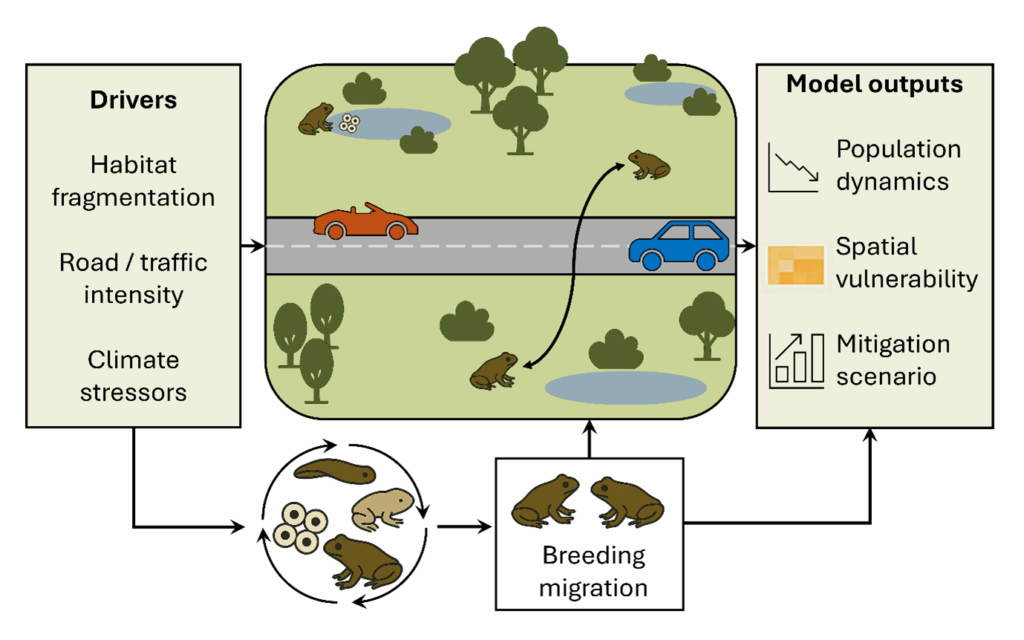
The model will simulate how amphibians navigate trade-offs between foraging, shelter, moisture, predation, plant protection product exposure and road-crossing risk. Agricultural management, including planting regimes, field margins, soil moisture dynamics, and chronic exposure to plant-protection products, will be integrated with climate-driven changes in hydroperiod, temperature and breeding phenology. Together, these components will allow the exploration of non-linear responses and mitigation scenarios across realistic European agricultural landscapes (illustrative example shown in Figure 1). There is also an opportunity to collect original movement and behavioural data from experimental field or semi-field trials in collaboration with project partners across the UK and Germany where knowledge gaps persist. These trials will provide rare empirical information to refine and parameterise mechanistic movement rules.
This PhD will equip you with a highly sought-after interdisciplinary skillset bridging ecological theory, modelling, field ecology, agricultural systems and applied environmental science. As a CASE-supported project with BASF, you will gain insight into ecological risk assessment, landscape-scale modelling and regulatory contexts. Cranfield University offers an advanced modelling environment, high-performance computing, and flexible working arrangements ideal for computational and field-integrated PhD research.
Figure 1. Example conceptual overview of a process-based population model for the common toad (Bufo bufo). The model integrates individual movement, habitat structure, stage-structured demography and density dependence, road-crossing mortality, and climate–hydrology drivers to predict population trajectories and evaluate mitigation scenarios.
This project is suitable for CASE funding
Each host has a slightly different application process.
Find out how to apply for this studentship.
All applications must include the CENTA application form.
Choose your application route
You will develop a process-based, spatially explicit population model for European amphibians using an individual-based framework in R and NetLogo with GIS integration. Individuals will make state- and context-dependent decisions, trading off energy gain, moisture balance, shelter, exposure to plant protection products and road-crossing risk. Movement rules will emerge from empirical or experimentally derived relationships between condition, habitat suitability, barrier effects and breeding phenology. Density dependence will link local crowding and resource limitation to egg viability, larval growth, juvenile recruitment and adult condition. Agricultural stressors will capture both chronic and acute effects of management practices and plant protection product exposure. Road mortality will be modelled from road structures and traffic intensity, while climate drivers will incorporate temperature, rainfall, sunshine and hydroperiod. Calibration will use partner datasets and new movement ecology observations collected from field trials. Scenario modelling will evaluate interventions including habitat networks, field-margin design and mitigation structures.
DRs will be awarded CENTA Training Credits (CTCs) for participation in CENTA-provided and ‘free choice’ external training. One CTC can be earned per 3 hours training, and DRs must accrue 100 CTCs across the three and a half years of their PhD.
You will gain advanced training in ecological modelling, movement ecology, landscape ecology, GIS, R and Netlogo programming and population viability analysis. They will develop skills in handling large ecological datasets, integrating landscape and climate data, conducting field or semi-field movement studies, modelling agricultural and pesticide stressors and designing mitigation scenarios. Professional development includes scientific writing, publishing, open science practice, communication with conservation practitioners, public engagement and presenting at conferences. The CASE partnership provides engagement with industry, data-driven environmental decision-making and applied modelling experience directly relevant to careers in academia, consultancy, regulatory science, conservation NGOs and environmental R&D.
BASF will support the studentship as the CASE partner, offering access to environmental datasets, industrial mentoring, experimental field platforms and opportunities for research placements. Their involvement enables the integration of agricultural management and plant protection product stressors into mechanistic population models. Partners will contribute amphibian ecology expertise, (semi-)field-method support and links with amphibian networks across the UK and Europe. Cranfield University will host the project within its Ecology group, offering modelling expertise, high-performance computing and a flexible, postgraduate-focused research environment ideal for computational–experimental PhD work.
Year 1 Literature review; data collation; individual-based modelling training (R and Netlogo), GIS and movement ecology; initial model framework and simple movement rules.
Year 2 Original (semi-) fieldwork on amphibian movement ecology (potentially conducted in year 3). Incorporate mechanistic movement rules, density dependence, road mortality and climate drivers in the model; model calibration and validation; first manuscript preparation.
Year 3 Full scenario simulations (habitat change, climate futures, road mitigation options); evaluation of mitigation scenarios; second manuscript.
Year 4 Synthesis, uncertainty analysis, stakeholder engagement; final manuscripts; thesis writing and submission.
Awkerman, J., Raimondo, S., Schmolke, A., Galic, N., Rueda-Cediel, P., Kapo, K., Accolla, C., Vaugeois, M., Forbes, V., 2020. Guidance for Developing Amphibian Population Models for Ecological Risk Assessment. Integr. Environ. Assess. Manag. 16, 223–233. https://doi.org/10.1002/ieam.4215
Johnston, A.S.A., 2024. Predicting emergent animal biodiversity patterns across multiple scales. Glob. Change Biol. 30, e17397. https://doi.org/10.1111/gcb.17397
Johnston, A.S.A., Boyd, R.J., Watson, J.W., Paul, A., Evans, L.C., Gardner, E.L., Boult, V.L., 2019. Predicting population responses to environmental change from individual-level mechanisms: towards a standardized mechanistic approach. Proc. R. Soc. B Biol. Sci. 286, 20191916. https://doi.org/10.1098/rspb.2019.1916
Luedtke, J.A., Chanson, J., Neam, K., Hobin, L., Maciel, A.O., Catenazzi, A., Borzée, A., Hamidy, A., Aowphol, A., Jean, A., Sosa-Bartuano, Á., Fong G., A., de Silva, A., Fouquet, A., Angulo, A., Kidov, A.A., Muñoz Saravia, A., Diesmos, A.C., Tominaga, A., Shrestha, B., Gratwicke, B., Tjaturadi, B., Martínez Rivera, C.C., Vásquez Almazán, C.R., Señaris, C., Chandramouli, S.R., Strüssmann, C., Cortez Fernández, C.F., Azat, C., Hoskin, C.J., Hilton-Taylor, C., Whyte, D.L., Gower, D.J., Olson, D.H., Cisneros-Heredia, D.F., Santana, D.J., Nagombi, E., Najafi-Majd, E., Quah, E.S.H., Bolaños, F., Xie, F., Brusquetti, F., Álvarez, F.S., Andreone, F., Glaw, F., Castañeda, F.E., Kraus, F., Parra-Olea, G., Chaves, G., Medina-Rangel, G.F., González-Durán, G., Ortega-Andrade, H.M., Machado, I.F., Das, I., Dias, I.R., Urbina-Cardona, J.N., Crnobrnja-Isailović, J., Yang, J.-H., Jianping, J., Wangyal, J.T., Rowley, J.J.L., Measey, J., Vasudevan, K., Chan, K.O., Gururaja, K.V., Ovaska, K., Warr, L.C., Canseco-Márquez, L., Toledo, L.F., Díaz, L.M., Khan, M.M.H., Meegaskumbura, M., Acevedo, M.E., Napoli, M.F., Ponce, M.A., Vaira, M., Lampo, M., Yánez-Muñoz, M.H., Scherz, M.D., Rödel, M.-O., Matsui, M., Fildor, M., Kusrini, M.D., Ahmed, M.F., Rais, M., Kouamé, N.G., García, N., Gonwouo, N.L., Burrowes, P.A., Imbun, P.Y., Wagner, P., Kok, P.J.R., Joglar, R.L., Auguste, R.J., Brandão, R.A., Ibáñez, R., von May, R., Hedges, S.B., Biju, S.D., Ganesh, S.R., Wren, S., Das, S., Flechas, S.V., Ashpole, S.L., Robleto-Hernández, S.J., Loader, S.P., Incháustegui, S.J., Garg, S., Phimmachak, S., Richards, S.J., Slimani, T., Osborne-Naikatini, T., Abreu-Jardim, T.P.F., Condez, T.H., De Carvalho, T.R., Cutajar, T.P., Pierson, T.W., Nguyen, T.Q., Kaya, U., Yuan, Z., Long, B., Langhammer, P., Stuart, S.N., 2023. Ongoing declines for the world’s amphibians in the face of emerging threats. Nature 622, 308–314. https://doi.org/10.1038/s41586-023-06578-4
Petrovan, S.O., Moor, H., Schmidt, B.R., 2025. Increasingly uncommon common toads: multidecadal, ongoing abundance decline of a widespread amphibian despite volunteer conservation action. Biodivers. Conserv. 34, 4235–4249. https://doi.org/10.1007/s10531-025-03150-6
Reading, C.J., Jofré, G.M., 2021. Declining common toad body size correlated with climate warming. Biol. J. Linn. Soc. 134, 577–586. https://doi.org/10.1093/biolinnean/blab101
For any enquiries related to this project please contact Alice Johnston, [email protected].
To apply to this project:
Applications must be submitted by 23:59 GMT on Wednesday 7th January 2026.