

During February 2022 the storm sequence ‘Dudley’, ‘Eunice’ and ‘Franklin’ inflicted flooding and extreme winds upon the UK and Northwest Europe (Mühr et al., 2022; Volonté et al., 2024a, 2024b), resulting in multi-sector impacts (e.g. road, power distribution) and £2.5-4.2 billion in insured losses, illustrating the importance of considering multi-hazard risk (Zscheischler et al., 2018). This project aims to develop new insights into what drives flooding and extreme wind to co-occur on timescales from (sub-)daily to seasonal (e.g., Bloomfield et al., 2023).
Recently (Manning et al., 2024; Hillier et al., 2025) attention has turned to the suggestion that the North Atlantic jet stream is critical (Hillier and Dixon, 2020), but distinct knowledge gaps remain about exactly what characterises a jet stream (e.g. waviness, temporal evolution) that will drive joint hazards. Also, the origin of triplets (i.e. >2 events in a limited time window) is essentially unexplored. Using state-of-the-art climate modelling (e.g. EUROCORDEX) and techniques to identity triplets (Hillier et al., 2025) offers the opportunity of dramatic new insights into extra-tropical cyclone hazard now and as climate changes. The findings will provide a window into the wider question of the impact of joint extremes, with real-world impact as flooding and wind risk are currently modelled separately by (re)insurance catastrophe models.
Outstanding questions, which you will refine and answer include:
Pilot work has compiled a dataset of episodes of co-occurring hazards, including triplets, in the UKCP18 climate projections (1981-1999, 2061-2079) offering a secure and rapid start to the work. This PhD will be an inter-disciplinary and applied team effort, combining expertise on fundamental meteorology and co-occurring hydro-meteorological hazards (Hillier, Bloomfield) with deep insurance industry knowledge (Brocklehurst). A 1-2 month placement at Impact Forecasting (Aon – https://www.aon.com/en/capabilities/reinsurance/catastrophe-model-insight) is anticipated (London or Prague).
Figure 1: A cartoon of the conceptual model from Hillier et al. (2025), which seeks to explain how the Atlantic jet stream influences the co-occurrence of flooding and extreme wind in the UK, and it will change in future (2061-2079).
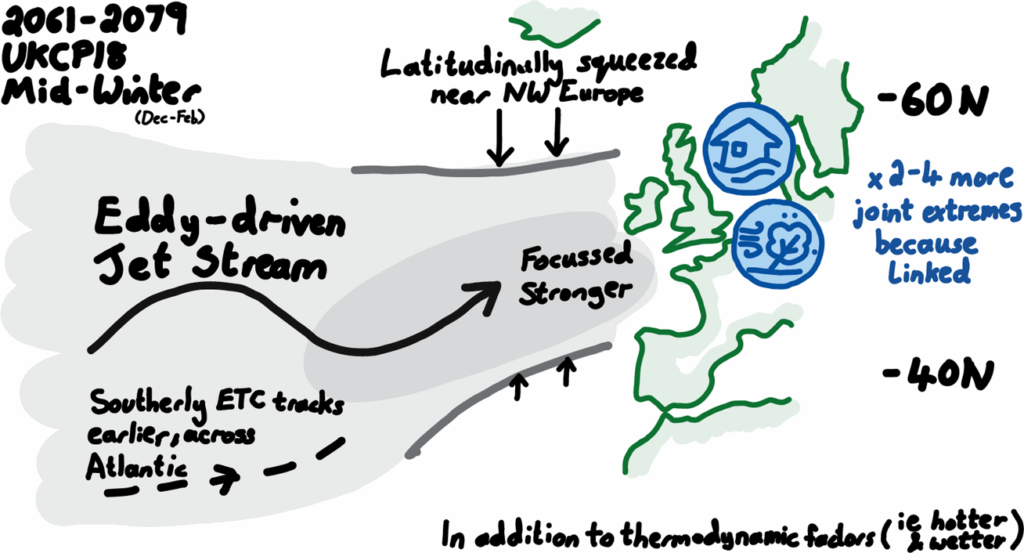
This project is not suitable for CASE funding
Each host has a slightly different application process.
Find out how to apply for this studentship.
All applications must include the CENTA application form.
Choose your application route
The project’s aim will be achieved through three main quantitative research methods,
In addition, to understand the implications of the insights, insurance-based catastrophe modelling and metrics (e.g. OEP/AEP) will be used.
DRs will be awarded CENTA Training Credits (CTCs) for participation in CENTA-provided and ‘free choice’ external training. One CTC can be earned per 3 hours training, and DRs must accrue 100 CTCs across the three and a half years of their PhD.
The successful PhD candidate will receive training in GIS and computer skills (e.g. R/python) to interrogate climate model outputs and to undertake statistical analyses. In addition to this, training will be given in the theory and methods for quantifying co-occurrence, understanding the jet stream and in risk assessment (e.g. using a catastrophe model).
This PhD will be an inter-disciplinary and applied team effort, combining expertise on fundamental meteorology (Leckebusch) and co-occurring hydro-meteorological hazards (Hillier, Bloomfield) with deep insurance industry knowledge (Brocklehurst). A 1-2 month placement at Impact Forecasting (Aon – https://www.aon.com/en/capabilities/reinsurance/catastrophe-model-insight) is anticipated (London or Prague).
Year 1: Use pilot data on storm triplets for the UK extracted from UKCP18 (1981-1999, 2061-2079) to (i) identify key indicative signatures that might be of use in identifying/predicting joint risks (e.g. jet characteristics, track geometry, Met Office weather patterns), and (ii) collate existing historic datasets (e.g. based on ERA5, PERILS/insured losses) to understand the wider utility of these signatures. Training in r and/or python.
Year 2: Simulation and investigation into a wider modelling suite (e.g. EUROCORDEX) to increase the dataset size (i.e. simulated years) and spatial extent (i.e. NW Europe). Placement in Aon (London or Prague) to better understand the implications of the research.
Year 3: Develop and synthesise a meteorological understanding of the processes driving joint flooding and extreme wind.
Bloomfield, H. et al. (2023) ‘Co-occurring wintertime flooding and extreme wind over Europe, from daily to seasonal timescales’, Weather Clim. Extremes, 39, p. 100550. Available at: https://doi.org/10.1016/j.wace.2023.100550.
De Luca, P. et al. (2017) ‘Extreme multi-basin flooding linked with extra-tropical cyclones’, Env. Res. Lett., 12(11), p. 114009. Available at: https://doi.org/10.3390/atmos10100577.
Hillier, J.K. et al. (2025) ‘Increasingly Seasonal Jet Stream Raises Risk of Co‐Occurring Flooding and Extreme Wind in Great Britain’, International Journal of Climatology, p. e8763. Available at: https://doi.org/10.1002/joc.8763.
Hillier, J.K. and Dixon, R. (2020) ‘Seasonal impact-based mapping of compound hazards’, Env. Res. Lett., 15, p. 114013. Available at: https://doi.org/10.1088/1748-9326/abbc3d.
Manning, C. et al. (2024) ‘Compound wind and rainfall extremes: Drivers and future changes over the UK and Ireland’, Weather Clim. Extremes, 44, p. 100673. Available at: https://doi.org/10.1016/j.wace.2024.100673.
Mühr, B. et al. (2022) Winter storm series: Ylenia, Zeynep, Antonia (int: Dudley, Eunice, Franklin) February 2022 (NW & Central Europe). 1. KIT, pp. 1–21. Available at: 10.5445/IR/1000143470 (Accessed: 1 August 2023).
Volonté, A. et al. (2024a) ‘Strong surface winds in Storm Eunice. Part 1: storm overview and indications of sting jet activity from observations and model data’, Weather, 79(2), pp. 40–45. Available at: https://doi.org/10.1002/wea.4402.
Volonté, A. et al. (2024b) ‘Strong surface winds in Storm Eunice. Part 2: airstream analysis’, Weather, 79(2), pp. 54–59. Available at: https://doi.org/10.1002/wea.4401.
Zscheischler, J. et al. (2018) ‘Future climate risk from compound events’, Nature Climate Change, 8, pp. 469–477. Available at: https://doi.org/10.1038/s41558-018-0156-3.
For more information about the project, please contact co-supervisor Dr John Hillier: [email protected]
To apply to this project:
Applications must be submitted by 23:59 GMT on Wednesday 7th January 2026.