

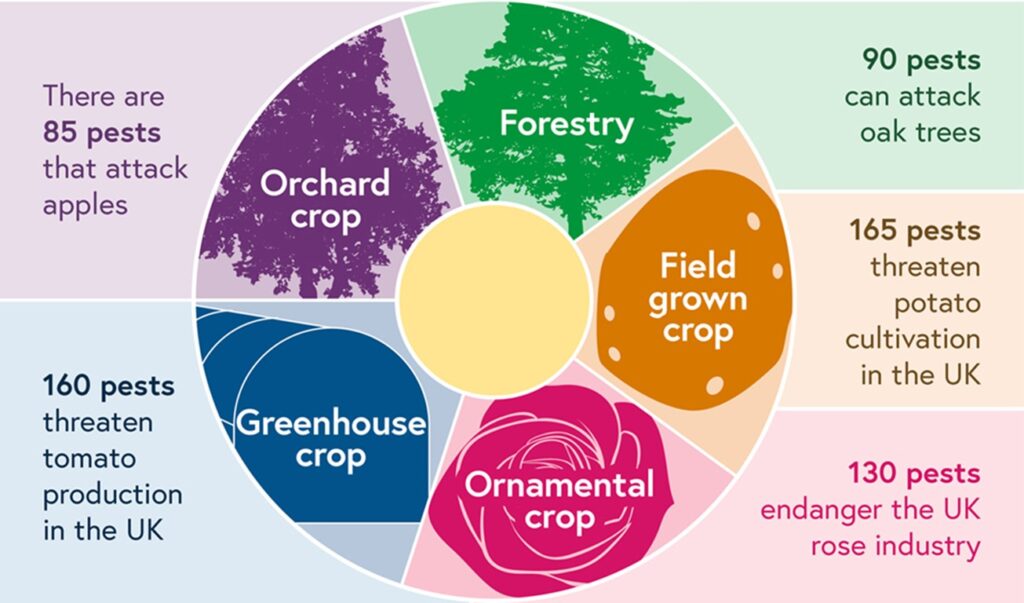
Plants and trees are vital to the UK, contributing £15.7 billion annually in economic, environmental, and social benefits, and playing a key role in achieving Net Zero by 2050. However, global plant trade and climate change pose significant threats to sectors such as agriculture and forestry. The UK Plant Health Risk Register has identified over 700 pests and pathogens as biosecurity risks (Fig. 1). Since 1976, pests and tree diseases have cost the UK between £5–13 billion. Ash dieback alone could kill up to 80% of UK ash trees, potentially costing £15 billion and severely impacting this iconic species.
In partnership with Plant Health at Defra, this project aims to develop AI, computer vision, and deep learning technologies to detect tree (e.g., broadleaves, conifers) and plant health issues (e.g., pests and diseases), supporting the UK Plant Biosecurity Strategy. The solution will protect Great Britain’s plants, enable effective risk management, optimize care practices, and facilitate safe trade.
To achieve cost-effective monitoring and disease detection, the project will develop advanced AI and deep learning tools for automated analysis of multimodal image data, ranging from large-scale satellite Earth observation to aircraft, drone, and ground-based imaging systems. Image data will include RGB, multispectral, and hyperspectral sensors. Multispectral and hyperspectral imaging can detect subtle plant stress or nutrient deficiencies invisible to the naked eye. Satellite images, such as Sentinel-2 from ESA Copernicus, provide 10–20 m resolution multispectral data (Visible, NIR, SWIR), offering large-scale aerial coverage to monitor vegetation health, detect plant stress, identify leaf discoloration, and enable early warning of disease hotspots and outbreaks
Deep learning has transformed digital image processing, surpassing traditional machine learning methods. By leveraging deep neural networks, the project can learn complex features directly from large volumes of multimodal spectral and image data collected from ground-based systems, drones, and satellites. Developed AI algorithms will analyse these images to detect symptoms such as discoloration, wilting, or spotting, classify plant health by species and disease, and assess damage severity. By combining advanced AI and deep learning, the project will enable accurate, automated plant health assessment, supporting sustainable management practices.
Fig1. Potential pest threats screened through the UK Plant Health Risk Register [5] https://www.gov.uk/government/publications/plant-biosecurity-strategy-for-great-britain-2023-to-2028/plant-biosecurity-strategy-for-great-britain-2023-to-2028
This project is a CENTA Flagship Project.
This project is suitable for CASE funding
Each host has a slightly different application process.
Find out how to apply for this studentship.
All applications must include the CENTA application form.
Choose your application route
The project will use data from Plant Health at Defra and public datasets, including high-resolution plant images and multispectral/hyperspectral satellite data, enhanced via augmentation, normalization, and spectral band extraction for robust AI training.
AI models, including compact and hybrid CNN-transformers, will leverage local and global context for precise disease detection. Attention mechanisms will focus on critical areas and subtle symptoms, while multimodal feature fusion of RGB, multispectral, and hyperspectral data captures both structural and physiological cues. Transfer learning and self/semi-supervised learning will enable adaptation to new diseases, and GANs will augment limited datasets, improving robustness. Explainable AI will provide interpretable outputs to guide plant health experts and build trust in real-world deployment.
Domain Knowledge Integration: Experts from Defra Plant Health will validate datasets, interpret model outputs, identify biases, and advise on feature selection, ensuring accurate, reliable, and operationally effective AI tools for plant health monitoring and management.
DRs will be awarded CENTA Training Credits (CTCs) for participation in CENTA-provided and ‘free choice’ external training. One CTC can be earned per 3 hours training, and DRs must accrue 100 CTCs across the three and a half years of their PhD.
Training provision: Student will receive in-depth training in deep learning, Python programming (TensorFlow, PyTorch), and statistical analysis, including data processing and evaluation metrics. They will gain skills in research methodology, experiment design, project management, and AI ethics, alongside communication and collaboration, including presenting research, writing papers, and engaging stakeholders.
Plant Health at Defra provides expertise and training in data validation, statistical analysis, plant/tree health, disease diversity, biosecurity, and sustainable practices, ensuring robust, multidisciplinary learning and real-world applicability.
Loughborough University offers AI modules, high-spec GPU A100 resources, and career training.
Plant Health at Defra will provide a 3–12 month placement, share relevant plant health and environmental data, and actively contribute to the co-design of activities and regular project meetings throughout the PhD. They will also engage in discussions on how project outcomes can be adopted to inform future activities. In addition, Defra will offer opportunities for policy training on environmental and biodiversity protection, ensuring that the research is aligned with policy needs and supports evidence-based decision making. Defra will also contribute £1,000 per year to cover minor expenses, including travel for fieldwork and data collection.
Year 1:
Year 2:
Year 3:
Year 4 (optional): Further refinement of research, publications and viva.
For further information about this project, please contact Professor Baihua Li ([email protected], https://www.lboro.ac.uk/departments/compsci/staff/baihua-li/ ) at Loughborough University.
To apply to this project:
Applications must be submitted by 23:59 GMT on Wednesday 7th January 2026.