

The rocky intertidal zone serves as a natural laboratory for studying the effects of abiotic stressors and species interactions on ecological patterns. Species here are accessible and provide early warning signals of anthropogenic and climate-driven change. Environmental and human-driven stressors vary widely, shaping populations locally and across latitudinal gradients from tropics to poles. Amid unprecedented human pressures on the oceans, gaps in understanding the processes shaping species’ biogeographic distributions limit our ability to predict ecological consequences and manage coastal systems effectively.
The Marine Biodiversity and Climate Change Project (MarClim), led by the Marine Biological Association of the UK (MBA) since 2001, has been monitoring rocky intertidal ecosystems at over 100 sites across the UK and northern France. Since 2002, annual surveys have generated a unique long-term dataset on the abundance of 87 invasive macroalgae and invertebrate species across boreal (cold-water) and Lusitanian (warm-water) regions.
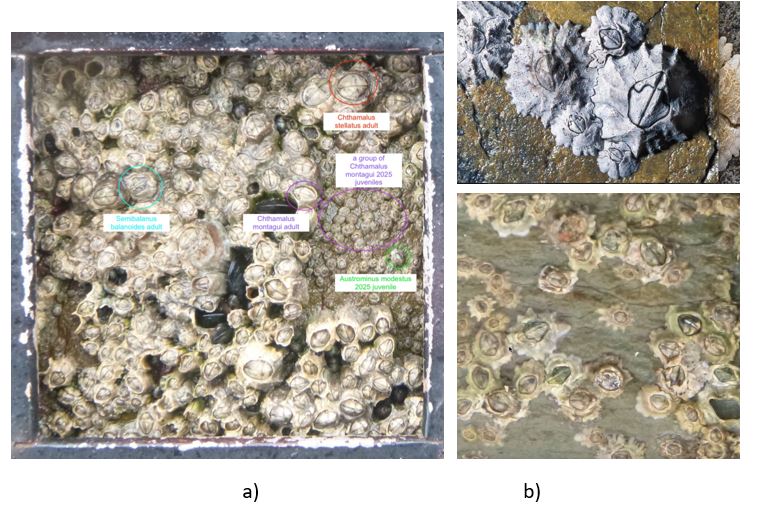
Currently juvenile and adult barnacles are visually counted in each image to generate abundance data across UK sites, revealing rapid climate-driven shifts in species distributions and highlighting intertidal species as early indicators of coastal ecosystem change. However, manually identifying and counting all species and life stages across the 3000 images (30 per site) collected annually by MarClim surveys is extremely time-consuming and prone to human error, even for expert taxonomists.
To tackle this challenge, this project will use the rocky intertidal as a testbed to develop novel AI- and deep learning–based computer vision tools that automatically identify and count barnacles, macroalgae, and other invertebrates from large image datasets. By leveraging advanced deep learning approaches—including convolutional neural networks, instance segmentation, vision transformers, attention mechanisms, and self- or few-shot learning—these tools will dramatically reduce manual effort and errors while enabling high-resolution, large-scale monitoring of complex intertidal communities
This research on AI for marine biodiversity and climate impacts will provide unprecedented insights into how intertidal species respond to multiple anthropogenic stressors, offering transformative potential for understanding ecosystem dynamics and informing the conservation and management of coastal environments in a rapidly changing world.
Fig1. a) Example of the current manual process for identifying, labelling, and categorizing barnacles across 87 species in 3,000 images per year. b) multi-species and life stage in one image.
This project is not suitable for CASE funding
Each host has a slightly different application process.
Find out how to apply for this studentship.
All applications must include the CENTA application form.
Choose your application route
This project will develop AI/deep learning–based computer vision tools to automatically identify and count barnacles, macroalgae, and other invertebrates. Training will use 3000 images per year from the 20-year UK MarClim survey, supplemented by public datasets. Advanced models—including CNNs, instance and panoptic segmentation, vision transformers, attention, and self- or few-shot learning—will address complex intertidal scenes. To handle challenges such as similar species, subtle differences, variable life stages, irregular, incomplete or unseen specimens, contrastive learning, anomaly detection, and synthetic data augmentation will be explored. The resulting AI framework will enable high-resolution, large-scale monitoring, providing robust abundance data and novel insights into species’ responses to anthropogenic and climate-driven stressors, supporting coastal ecosystem conservation and management.
Domain Knowledge: MBA experts will validate datasets, interpret outputs, identify biases, and ensure AI tools are accurate and reliable, providing actionable insights for marine biodiversity monitoring, climate impact assessment, and evidence-based policy.
DRs will be awarded CENTA Training Credits (CTCs) for participation in CENTA-provided and ‘free choice’ external training. One CTC can be earned per 3 hours training, and DRs must accrue 100 CTCs across the three and a half years of their PhD.
The student will be trained in advanced deep learning methods—including CNNs, panoptic segmentation, vision transformers, attention mechanisms, and self- or few-shot learning—alongside practical skills in image annotation, dataset curation, and model evaluation. Training by AI specialists and MBA experts will integrate ecological knowledge with computational methods.
Experts from MBA will train team members in species identification, life-stage recognition, and image annotation, guide AI output interpretation, identify biases, and advise on integrating AI tools into monitoring workflows to produce reliable and actionable data for evidence-based policy and management.
Loughborough provides AI modules, high-performance GPU-A100 access and ethical AI training.
Professor Baihua Li, an AI expert at Loughborough University with over 20 years’ experience in computer vision and machine learning, has published more than 120 papers and supervised 20+ PhDs. She leads AI research for environmental protection, including an EPSRC-funded £2.5M project, as well as several UKRI- and Innovate UK–funded initiatives.
Dr. Nova Mieszkowska at the Marine Biological Association leads large-scale MarClim, the world’s most extensive rocky intertidal dataset. Her research combines experimental ecology, genomics, and long-term monitoring to reveal rapid climate-driven species shifts, providing critical insights for marine biodiversity conservation and national and international policy.
Year 1: Foundations & Data Preparation
Year 2: Model Development & Refinement
Year 3: Integration, Impact & Dissemination
Year 4 (if needed): Improve results, prepare, submit, and revise journal publications, defend the PhD thesis (viva).
For further information about this project, please contact Professor Baihua Li ([email protected], https://www.lboro.ac.uk/departments/compsci/staff/baihua-li) at Loughborough University.
To apply to this project:
Applications must be submitted by 23:59 GMT on Wednesday 7th January 2026.