

This project responds to a three-year marine litter monitoring campaign on the Isle of Skye, Scotland, UK. It builds on Loughborough University’s 50 Years of Litter on Skye and associated research projects. Integrating environmental, engineering, and social science methods, the interdisciplinary team of researchers that this PhD will augment have identified, evaluated, and are evolving marine litter monitoring methods with community partners across Scotland’s west coast. The potential for drone and mobile phone imagery to enhance this work has been discussed with community groups, informing this project proposal.
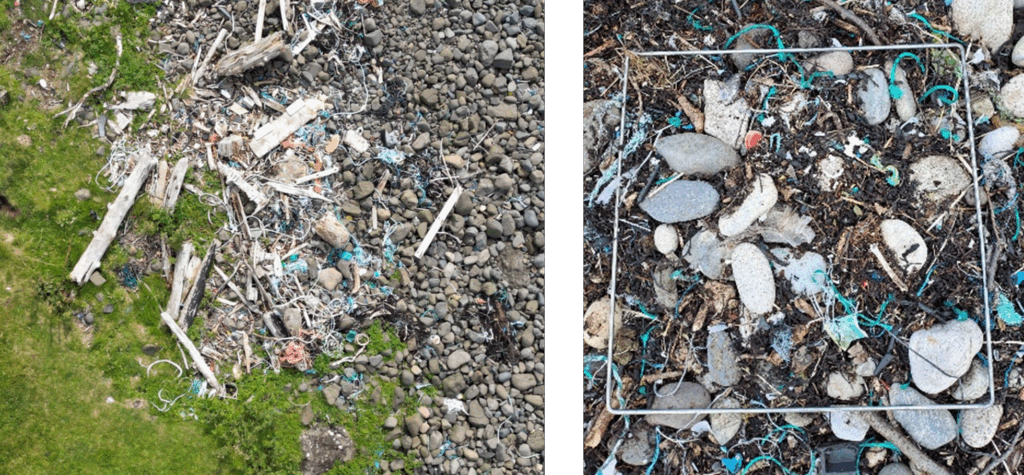
The aim of this interdisciplinary PhD is to evaluate the efficacy and suitability of digital image collection and analysis to understand beach litter populations on heavily-littered coastlines. This PhD will therefore collect drone and mobile phone imagery of beach litter (Figure 1) in partnership with community groups across Scotland’s west coast. It will evaluate the practicality of different image capture techniques using these technologies, and the potential of different sensor types (e.g., RGB, multispectral) to generate beach litter images. Analysis of images will investigate the efficacy of manual digital approaches (e.g., Dot Dot Goose) and the development of a marine litter characterisation and quantification algorithm for automated analysis (computer vision technologies).
Development and evaluation of these methods will consult community groups working to survey and clear beach litter across Scotland’s west coast with community collaborators. The interdisciplinary nature of this PhD will require the integration of environmental science, engineering, and community science methodologies.
Figure 1: Example drone (left) and mobile phone (right) imagery of heavily-littered beaches on the Isle of Skye, Scotland.
This project is not suitable for CASE funding
Each host has a slightly different application process.
Find out how to apply for this studentship.
All applications must include the CENTA application form.
Choose your application route
This PhD will involve field and desk-based methods. Drone images will be collected using commercially available systems following standardised drone-survey techniques. Mobile phone images will be acquired using basic mobile phone photography technology. These images will be collected during fieldwork on Scotland’s west coast, with additional imagery potentially sourced from community partners.
Image analysis will explore the potential of non-automated (e.g., Dot Dot Goose) and automated (algorithm-based) computer vision marine litter characterisation. A library of drone images of beach litter already exists for method development. Image analysis will be compared data generated from ground-based survey methods.
Community science methodologies (e.g., interviews, focus groups, surveys) will ensure the practicality of developed techniques for non-professional scientists is considered throughout the project development, informing the target audience of the techniques this project develops.
DRs will be awarded CENTA Training Credits (CTCs) for participation in CENTA-provided and ‘free choice’ external training. One CTC can be earned per 3 hours training, and DRs must accrue 100 CTCs across the three and a half years of their PhD.
This PhD will provide comprehensive experience of multiple field and analytical skills spanning geography, environmental science, engineering, and social science methodologies. Training in these methods will be provided by the supervisory team and project partners. This includes training in the flying of drones, image processing, beach litter survey techniques, community science / participatory research methods, and algorithm development. Beyond the research methods, science communication will be core to the dissemination of this PhD. Collectively, this training portfolio will equip the successful applicant with analytical and communication skills that are relevant far beyond the PhD’s focus.
This project will be co-supervised by Dr Nicholas Midgley, Nottingham Trent University and be supported and facilitated by the Marine Conservation Society, Scottish Islands Federation, and Scottish Coastal Cleanup (Balanced Horizon).
Year 1 will focus on training in core practical skills for this PhD (sampling, sample processing, sample analysis). Training will focus on methods for fieldwork (e.g., drone flying, ground-based beach litter surveys), image collection (e.g., mobile phone, drone in RGB, drone in multispectral), and image analysis (e.g., Dot Dot Goose, algorithm development). Training will also be provided in community science methodologies. Year 1 will identify sample locations, seek necessary permissions, and complete required training in health and safety and research risk assessments. Field season 1 will take place at the end of Year 1.
Year 2 will roll out a community-led image collection programme. Processing and analysis of images collected in field season 1 will take place during year 2, informing the methodological refinement ahead of further fieldwork in year 2. Training in statistical techniques will also be completed in year 2.
Year 3 will see the completion of the analysis of images collected through years 1 and 2. Evaluation of the and the evaluation of environmental samples, and the analysis and interpretation of the data generated. Science communication training in year 3 will ensure that the findings of this research are disseminated across relevant audiences (academic, public, industry, government).
Journal:
Allison, N.L., Dale, A.C., Turrell, W.R. and Narayanaswamy, B.E., 2023. Modelled and observed plastic pollution on remote Scottish beaches: the importance of local marine sources. Marine Pollution Bulletin, 194, p.115341.
Buckingham, J., Capper, A. and Bell, M., 2020. The missing sink-quantification, categorisation and sourcing of beached macro-debris in the Scottish Orkney Islands. Marine Pollution Bulletin, 157, p.111364.
Gonçalves, G., Andriolo, U., Gonçalves, L.M., Sobral, P. and Bessa, F., 2022. Beach litter survey by drones: Mini-review and discussion of a potential standardization. Environmental Pollution, 315, p.120370.
Scarrica, V.M., Aucelli, P.P., Cagnazzo, C., Casolaro, A., Fiore, P., La Salandra, M., Rizzo, A., Scardino, G., Scicchitano, G. and Staiano, A., 2022. A novel beach litter analysis system based on UAV images and Convolutional Neural Networks. Ecological Informatics, 72, p.101875.
For any enquiries related to this project please contact Dr Thomas Stanton, [email protected].
To apply to this project:
Applications must be submitted by 23:59 GMT on Wednesday 7th January 2026.