

The staggering diversity of life on Earth finds its greatest expression in insects. With one million described species, they constitute over half of all known animals, varying enormously in size, shape, colour, and behaviour. This variety enables them to carry out functions such as pollination, nutrient cycling, and pest control in ecosystems across every continent, making their importance unparalleled throughout the terrestrial animal kingdom. This variety is most remarkable in the Amazon Rainforest; however, our understanding of the mechanisms that generated this critical biodiversity hotspot is being outpaced by accelerating threats such as deforestation and climate and land use change.
Most of today’s insect species belong to families that appeared during rapid diversification in the Cretaceous (Benton et al., 2022; Misof et al., 2014), an event that has previously been attributed to co-evolution with angiosperms – or, flowering plants – which diversified equally rapidly at this time. However, recent studies have questioned the strength of this interaction prior to the mass extinction event at the end of the period (Asar et al., 2022; Kergoat et al., 2017). Most well-known for ending the reign of the non-avian dinosaurs, the end-Cretaceous mass extinction also coincided with a transformation of climate and ecosystems around the world. In the Neotropics, it was the beginning of closed-canopy tropical rainforest akin to what we see today (Carvalho et al., 2021), and it has been proposed that co-evolution wasn’t truly kickstarted until this point (Asar et al., 2022).
Disagreement on the strength or timing of these interactions could be attributed to the use of over-simplified correlative approaches – describing relationships between variables such as richness or traits, without explaining the underlying causal mechanisms – and insufficient temporal depth in climate data, which limits analysis to timescales that are too short to account for many evolutionary processes. However, this project represents a unique chance to use the cutting-edge mechanistic model of evolution ‘Gen3sis’ (Hagen et al., 2021) and novel deep-time paleoclimatic data to reveal the processes that may have driven co-evolution between insects and angiosperms.
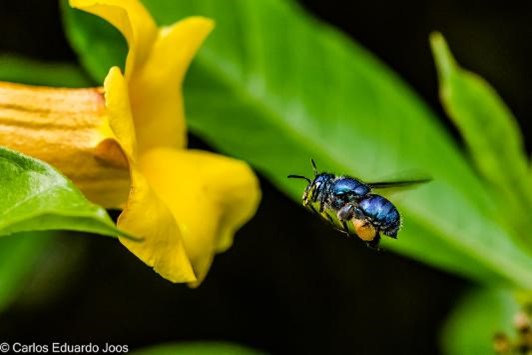
Figure 1: Euglossine bees are a tribe of Neotropical bees thought to have co-evolved with orchids, but some research suggests that this dependency was one-sided (Ramírez et al., 2011) (“Euglossini” by Carlos Eduardo Joos, CC BY 2.0).
This project is not suitable for CASE funding
Each host has a slightly different application process.
Find out how to apply for this studentship.
All applications must include the CENTA application form.
Choose your application route
The spatially-explicit eco-evolutionary model ‘Gen3sis’ will first be used to establish the relative importance of ecological and evolutionary processes that best captures known diversification of insects and angiosperms in the Amazon, making use of paleoclimate datasets currently being developed by the supervisory team. These increase the temporal depth and precision of available climate data, and also integrate landscape changes from shifting tectonics and millennial timescale climate variability driven by variations in Earth’s orbit.
The student will then work alongside collaborators at the Goethe University Frankfurt and Kew Science to integrate multi-taxa interactions in ‘Gen3sis’ for the first time. The project aims to answer questions such as: how did climate impact diversification dynamics through the Cretaceous and subsequent Paleogene? How have angiosperms driven processes of diversification and extinction in other taxa? Did co-evolution happen at the same rate throughout the Amazon and what characteristics of hotspots were the driving factors?
DRs will be awarded CENTA Training Credits (CTCs) for participation in CENTA-provided and ‘free choice’ external training. One CTC can be earned per 3 hours training, and DRs must accrue 100 CTCs across the three and a half years of their PhD.
Extensive training will be provided through the Open University graduate school and STEM Faculty programmes including core research and outreach skills in the first year and more specifically targeted training at later stages. These will include communicating research to different audiences, through various channels from academic publication to social media, and transferrable scientific skills useful in both academia and industry, including programming and numerical, statistical, and data processing and visualisation methods.
This project involves collaboration with Prof. Oskar Hagen who leads the Computational Integrative Biodiversity (CIB) research group at Goethe University Frankfurt’s Centre for Critical Computational Studies (C³S). Prof. Hagen developed the evolutionary model that will be used, and the student will have the opportunity to travel to Frankfurt to collaborate on model development.
The project also involves collaboration with Dr. Alex Monro from the Royal Botanic Gardens Kew, who will provide expertise and data on angiosperms in the Americas.
Year 1:
Year 2:
Year 3:
Asar, Y., Ho, S.Y.W., Sauquet, H., 2022. Early diversifications of angiosperms and their insect pollinators: were they unlinked? Trends Plant Sci. 27, 858–869. https://doi.org/10.1016/j.tplants.2022.04.004
Benton, M.J., Wilf, P., Sauquet, H., 2022. The Angiosperm Terrestrial Revolution and the origins of modern biodiversity. New Phytol. 233, 2017–2035. https://doi.org/10.1111/nph.17822
Carvalho, M.R., Jaramillo, C., De La Parra, F., Caballero-Rodríguez, D., Herrera, F., Wing, S., Turner, B.L., D’Apolito, C., Romero-Báez, M., Narváez, P., Martínez, C., Gutierrez, M., Labandeira, C., Bayona, G., Rueda, M., Paez-Reyes, M., Cárdenas, D., Duque, Á., Crowley, J.L., Santos, C., Silvestro, D., 2021. Extinction at the end-Cretaceous and the origin of modern Neotropical rainforests. Science 372, 63–68. https://doi.org/10.1126/science.abf1969
Hagen, O., Flück, B., Fopp, F., Cabral, J.S., Hartig, F., Pontarp, M., Rangel, T.F., Pellissier, L., 2021. gen3sis: A general engine for eco-evolutionary simulations of the processes that shape Earth’s biodiversity. PLOS Biol. 19, e3001340. https://doi.org/10.1371/journal.pbio.3001340
Kergoat, G.J., Meseguer, A.S., Jousselin, E., 2017. Evolution of Plant–Insect Interactions, in: Advances in Botanical Research. Elsevier, pp. 25–53. https://doi.org/10.1016/bs.abr.2016.09.005
Misof, B., Liu, S., Meusemann, K., Peters, R.S., Donath, A., Mayer, C., Frandsen, P.B., Ware, J., Flouri, T., Beutel, R.G., Niehuis, O., Petersen, M., Izquierdo-Carrasco, F., Wappler, T., Rust, J., Aberer, A.J., Aspöck, U., Aspöck, H., Bartel, D., Blanke, A., Berger, S., Böhm, A., Buckley, T.R., Calcott, B., Chen, J., Friedrich, F., Fukui, M., Fujita, M., Greve, C., Grobe, P., Gu, S., Huang, Y., Jermiin, L.S., Kawahara, A.Y., Krogmann, L., Kubiak, M., Lanfear, R., Letsch, H., Li, Yiyuan, Li, Z., Li, J., Lu, H., Machida, R., Mashimo, Y., Kapli, P., McKenna, D.D., Meng, G., Nakagaki, Y., Navarrete-Heredia, J.L., Ott, M., Ou, Y., Pass, G., Podsiadlowski, L., Pohl, H., Von Reumont, B.M., Schütte, K., Sekiya, K., Shimizu, S., Slipinski, A., Stamatakis, A., Song, W., Su, X., Szucsich, N.U., Tan, M., Tan, X., Tang, M., Tang, J., Timelthaler, G., Tomizuka, S., Trautwein, M., Tong, X., Uchifune, T., Walzl, M.G., Wiegmann, B.M., Wilbrandt, J., Wipfler, B., Wong, T.K.F., Wu, Q., Wu, G., Xie, Y., Yang, S., Yang, Q., Yeates, D.K., Yoshizawa, K., Zhang, Q., Zhang, R., Zhang, W., Zhang, Yunhui, Zhao, J., Zhou, C., Zhou, L., Ziesmann, T., Zou, S., Li, Yingrui, Xu, X., Zhang, Yong, Yang, H., Wang, Jian, Wang, Jun, Kjer, K.M., Zhou, X., 2014. Phylogenomics resolves the timing and pattern of insect evolution. Science 346, 763–767. https://doi.org/10.1126/science.1257570
Ramírez, S.R., Eltz, T., Fujiwara, M.K., Gerlach, G., Goldman-Huertas, B., Tsutsui, N.D., Pierce, N.E., 2011. Asynchronous Diversification in a Specialized Plant-Pollinator Mutualism. Science 333, 1742–1746. https://doi.org/10.1126/science.1209175
Boasting an interdisciplinary team including both climate and ecology modellers, this project could be suited to candidates from diverse academic backgrounds including biology, geography, and earth or computer sciences. If you are interested in finding out more about this project, please contact Bryony Blades ([email protected]) or Neil Edwards ([email protected]).
To apply to this project:
Applications must be submitted by 23:59 GMT on Wednesday 7th January 2026.