

Great Britain is host to a series of chemically diverse and unique waters, the microbiology of which has never been defined. These include springs enriched in calcite (CaCO3) or Chalybeate springs enriched in iron, many of which that are historically or religiously significant and were considered to have healing properties – these proposed properties were often a consequence of the unusual chemistry of the waters, representing a selective pressure that was bactericidal to many microbes. Consequently, the distinct chemical compositions are expected to have profoundly shaped the resident microbiomes, influencing both the viability of specific taxa and the metabolic pathways required for survival in these environments. Furthermore, ecological interactions within these environments is equally undefined, with the atypical chemistries potentially playing a role in inter-cell communication and the production and cycling of volatiles and metabolites.
At the same time, the global rise of antimicrobial resistance is driving a growing need for novel bioactive compounds with potential medical applications. The microbes inhabiting these chemically unusual environments are likely to possess unique physiological and metabolic adaptations driven by their extreme or/and selective conditions. As these ecosystems remain largely uncharacterised, they represent an untapped resource for exploring the chemical space of metabolites and for identifying novel antimicrobials. This investigation would integrate advanced metabolomic and analytical chemistry approaches, identifying compounds involved in microbial communication, survival, and competition, with particular emphasis on those exhibiting potential antibiotic activity. This studentship will explore the microbial and chemical diversity of distinctive waters across a range of British heritage sites and locations of historical significance. Beyond advancing our understanding of an unexplored aspect of Great Britain’s biodiversity, the project also seeks to uncover metabolites with potential medical applications, offering insights that could inform strategies to address pressing societal challenges. The project will involve: (i) exploring the microbial diversity of chemically unique waters across Britain, (ii) identify and isolate keystone microbial species from these environments, (iii) characterise the chemical diversity of the metabolites produced by these organisms, and (iv) exploring potential therapeutic use.
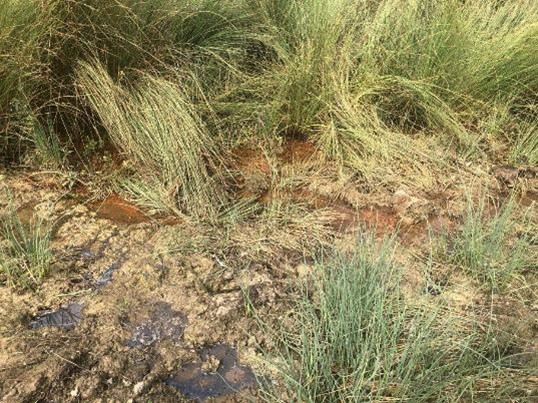
Figure 1: An iron enriched spring in Nash, Buckinghamshire, that used to feed the historical Bretch Well.
This project is a CENTA Flagship Project.
This project is not suitable for CASE funding
Each host has a slightly different application process.
Find out how to apply for this studentship.
All applications must include the CENTA application form.
Choose your application route
A combination of microbiological and chemical techniques will be applied to investigate the diversity and ecology of microbiomes of diverse, unique British environments. The microbiology experiments will identify the taxonomic and functional diversity, informing cultivation-dependant techniques to isolate keystones species in the community (e.g., performing key metabolisms or possessing unique biosynthetic gene clusters). Detailed analytical chemical techniques – such as Liquid chromatography, high resolution mass spectrometry and spectroscopic methods such as NMR and infrared – will be used to identify the diversity of metabolites produced by both the individual strains and total communities. State of the art drug screening facilities will then be used to assess the potential antimicrobial activity and therapeutic potential of these metabolites. The student will have access to a range of additional techniques at the partner organisations that can be used to identify microbial interactions.
DRs will be awarded CENTA Training Credits (CTCs) for participation in CENTA-provided and ‘free choice’ external training. One CTC can be earned per 3 hours training, and DRs must accrue 100 CTCs across the three and a half years of their PhD.
The student will be trained in specific laboratory-based techniques in organic chemistry characterisation, molecular biology (e.g., DNA extraction, PCR, library preparation, and DNA sequencing), in vitro screening (microscopy and cytotoxicity assays) and culture-based microbiology (plate reader screening assays) by members of the research team. The student will also be trained in computer-based techniques, including bioinformatic analysis of sequencing and analysis of geochemical data and ecological modelling, to identify environmental factors driving community diversity and interactions. The student will benefit from skills development opportunities offered by The Open University and NHM, e.g., communication skills, statistical analysis, public talks, and academic writing.
Dr. Anne Jungblut is a microbiologist at the Natural History Museum with expertise in the genomics of unusual and low-biomass environments. She will advise on DNA extraction, cultivation, and the bioinformatic analysis used to identify microbial species and biosynthetic pathways from the environmental samples.
Tim Goodall is a Molecular Ecologist at the UK Centre for Ecology & Hydrology who researches UK microbial communities. He will contribute expertise in cell flow cytometry and DNA-based profiling. His input will support the analysis of how the microbial communities interact with their environment and contribute to biogeochemical processes.
Year 1: Perform a literature review of atypical environments and heritage sites across the United Kingdom. Complete training in microbiological methods, molecular techniques, bioinformatics, and statistical analysis of large-scale datasets. Undertake preliminary field work collecting samples and performing initial chemical and biological surveys.
Year 2: Undertake CENTA placement. Perform metagenomic and genomic analysis of the environmental samples and cultures to generate an inventory of the diversity species and biosynthetic gene clusters. Isolation and characterisation of metabolites. Present in-progress results at a national conference (e.g., Microbiology Society annual conference).
Year 3: Screen metabolite compounds against an array of microbial and eukaryotic organisms. Refine experimental activities towards preparing and submitting a manuscript. Present data at an international conference (e.g., Gordon Applied and Environmental Microbiology). Write and submit thesis.
This project will benefit from access to various key research infrastructure from The Open University and NHM, including: (i) existing chemical and microbiological datasets from diverse environments, (ii) a robust array of relevant analytical chemistry equipment, (iii) facilities for screening of metabolite compounds. This access to key experimental and digital research infrastructure bolsters project resiliency, as research work can be initiated rapidly. Moreover, in the instance of any potential restrictions to fieldwork or laboratory access, the supervisory team has multiple contingency strategies to support the student’s progress via the extensive virtual tools available.
Macey, M.C., Pratscher, J., Crombie, A.T. et al. Impact of plants on the diversity and activity of methylotrophs in soil. Microbiome 8, 31 (2020). https://doi.org/10.1186/s40168-020-00801-4
Tim Goodall, Susheel Bhanu Busi, Robert I Griffiths, Briony Jones, Richard F Pywell, Andrew Richards, Marek Nowakowski, Daniel S Read, Soil properties in agricultural systems affect microbial genomic traits, FEMS Microbes, Volume 6, 2025, xtaf008, https://doi.org/10.1093/femsmc/xtaf008
Greco C, Andersen DT, Yallop ML, Barker G, Jungblut AD. Genome-resolved metagenomics reveals diverse taxa and metabolic complexity in Antarctic lake microbial structures. Environ Microbiol 2024; 26:1–15
Binita Maharjan, Daniel T. Payne, Irene Ferrarese, Maria Giovanna Lupo, Lok Kumar Shrestha, Jonathan P. Hill, Katsuhiko Ariga, Ilaria Rossi, Shyam Sharan Shrestha, Giovanni Panighel, Ram Lal (Swagat) Shrestha, Stefania Sut, Nicola Ferri, Stefano Dall’Acqua, Evaluation of the effects of natural isoquinoline alkaloids on low density lipoprotein receptor (LDLR) and proprotein convertase subtilisin/kexin type 9 (PCSK9) in hepatocytes, as new potential hypocholesterolemic agents, Bioorganic Chemistry, Volume 121,2022,https://doi.org/10.1016/j.bioorg.2022.105686.
Wang, C., Wang, H., Liu, D., & Wang, H. (2024). Geographical distribution of iron redox cycling bacterial community in peatlands: Distinct assemble mechanism across environmental gradient. Science of The Total Environment, 912, 169094. https://doi.org/10.1016/j.scitotenv.2023.169094
Kounatidis, I., & Mpamhanga, C. D. (2017). The utility of Drosophila melanogaster as a fungal infection model. Frontiers in Immunology, 8, 99. https://doi.org/10.3389/fimmu.2017.00099
For any enquiries related to this project please contact Michael Macey, [email protected].
To apply to this project:
Applications must be submitted by 23:59 GMT on Wednesday 7th January 2026.