

Ecosystem restoration and nature recovery efforts, often framed as rewilding, are gaining increasingly prominence in the UK and worldwide. Woodland restoration can provide multiple benefits, including enhancing biodiversity by providing habitat for wildlife, invertebrates and understory plants; sequestering carbon; stabilising soils and improving water regulation, reducing flood risk downstream.
Woodland restoration can range from more interventionist tree planting, where seed sources are limited, to allowing natural processes of seed dispersal or recovery from seedbanks to drive ecosystem development on land retired from previous land use. In the UK, significant opportunities lie in restoring woodlands on retired farmland, particularly upland areas long shaped by intensive sheep grazing.
While increasing areas are being directed to nature recovery, most efforts are still on their early phases so quantification of the long-term responses of ecosystem restoration remain rare. At the Nettlecombe Court Field Studies Council centre in Somerset, a 6-ha area of land under sheep grazing was fenced off in 1972 to exclude the grazing and left to allow woodland to regenerate naturally (Crowthers 2014). The adjacent land has continued to be grazed, providing a rare opportunity to explore the response of ecosystem restoration after over half a century of transition.
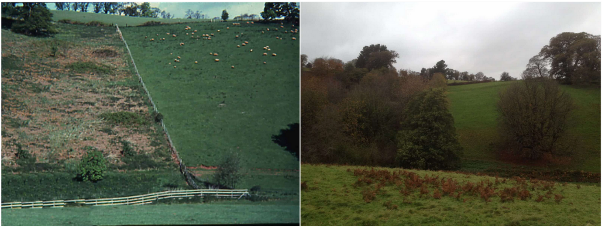
The area also forms part of the upper reach of the Monksilver stream catchment. Over the period since exclusion there has been rapid recolonisation by trees along the lower slope of the area (Figure 1), while the upper part has become dominated by bracken.
This project will use the long-term Nettlecombe Court restoration site as the focus for research into ecosystem responses to woodland restoration. Research will focus on the changes to biogeochemistry, biodiversity and/or carbon storage (above and belowground) of the system. Being adjacent to Monksilver Stream catchment also provides the opportunity to investigate the influence of the restoration on catchment hydrology. Additional work at other sites, using remote sensing and GIS approaches, and/or modelling will place the focus research into the wider landscape context of woodland restoration on upland grazing land. There are also opportunities to develop an engagement component to the thesis through the FSC and the OpenLiving Lab at the OU.
Figure 1: Photos of the downstream boundary of the restoration site in the first years after it was established (left) and a recent view of the same area showing some of the extensive tree recolonisation (right). CREDIT: Field Studies Council.
This project is a CENTA Flagship Project.
This project is suitable for CASE funding
Each host has a slightly different application process.
Find out how to apply for this studentship.
All applications must include the CENTA application form.
Choose your application route
Depending on the interests of the student, a range of methods are available for broad biogeochemical and ecological investigations. These include soil carbon, chemistry and physical properties and soil carbon fluxes, and above-ground carbon estimates from mensuration, allometry, UAV imagery and tissue carbon analysis, as well as plant photosynthesis and ecophysiological responses of the colonising vegetation. Floral biodiversity responses can be investigated through botanical surveys, and camera traps, audio sensors and malaise trapping is available for faunal biodiversity. Soil water analysis can be used to investigate the influence on stream chemistry and hydrology, and in situ monitoring can be used to investigate microclimate implications. Additional sites will be sourced through, for example, the Ecological Continuity Trust and the Woodland Creation and Ecological Networks registers.
DRs will be awarded CENTA Training Credits (CTCs) for participation in CENTA-provided and ‘free choice’ external training. One CTC can be earned per 3 hours training, and DRs must accrue 100 CTCs across the three and a half years of their PhD.
You will gain experience in several biogeochemical, ecophysiological and/or biodiversity techniques, including plant survey and identification, plant trait assessment, physiological and flux measurements, microclimate monitoring and sample element analysis. You will also gain experience in geospatial analysis and coding. You will receive the necessary training in all analytical techniques and instruments, and will develop experimental design, data analysis and statistical skills. A varied training programme is available to OU PG students, which includes academic writing, research design, data management, communicating your research, as well as opportunities to get involved in public engagement, media and remote digital teaching.
The Field Studies Council are a CASE partner on this project. The focal research site is on the scenic estate where the Nettlecombe field centre is located in Somerset, and where you will be based for your field work. Restoration activities at other Field Studies centres as part of the FSC nature recovery programme may also be included in the research. Through the CASE partnership you will have the opportunity to work at different FCS centres. Internship work will include field surveys and NVC classification work at various sites around the country.
Year 1: Literature review, familiarisation with site and field techniques, first season data collection. Survey of other potential comparator sites.
Year 2: Ongoing data collection and analysis. Extension to other sites/landscape perspective. National conference presentation (e.g. British Ecological Society annual meeting).
Year 3: Final data collection and analysis and writing up. International conference presentation (eg. European Geophysical Union).
Journal:
Ashwood, F., Watts, K., Park, K., Fuentes-Montemayor, E., Benham, S. and Vanguelova, E.I. (2019) Woodland restoration on agricultural land: long-term impacts on soil quality. Restoration Ecology, 27, pp 1381-1392. https://doi.org/10.1111/rec.13003
Broughton RK, Bullock JM, George C, Hill RA, Hinsley SA, Maziarz M, et al. (2021) Long-term woodland restoration on lowland farmland through passive rewilding. PLoS ONE 16(6): e0252466. https://doi.org/10.1371/journal.pone.0252466
Crothers, J. (2014) Tree Regeneration in Court Field, Nettlecombe, Somerset Archaeology and Natural History, 158, pp 233-252. Available at https://sanhs.org/crothersb/
We invite applications from students with a strong background or interest in plant, woodland or soil ecology, biogeochemistry or biodiversity with an enthusiasm for field work and independent research. A clean driving licence for accessing UK field sites is desirable.
If you’re not sure whether your academic background is suitable, please contact Kadmiel Maseyk ([email protected]) or [email protected]. We’d be happy to hear from you.
The successful student will join well-established teams researching environmental and ecosystem processes and a vibrant postgraduate community at the Open University.
To apply to this project:
Applications must be submitted by 23:59 GMT on Wednesday 7th January 2026.