

Background
Wildfires are increasing in frequency and severity in many regions as a consequence of climate change1. In addition to releasing large quantities of carbon dioxide, wildfires generate atmospheric trace gases including carbon monoxide (CO), methane (CH₄) and volatile organic compounds (VOCs)2,3. The fate of these gases after deposition to soils is poorly understood, despite the potential importance of microbial trace-gas oxidation for atmospheric chemistry, soil carbon cycling and ecosystem recovery.
Wildfire substantially alters soil physicochemical properties and microbial communities through the loss and transformation of organic matter, formation of pyrogenic carbon, changes in pH and nutrient availability, and alterations in soil moisture and structure. These changes may strongly influence the capacity of soil microbial communities to consume atmospheric trace gases. Early studies have shown that organic amendments can increase soil atmospheric methane uptake in agricultural soils4. However, we lack a mechanistic understanding of how wildfire severity and post-fire recovery affect microbial trace-gas oxidation.
This PhD will investigate how wildfire alters the capacity of soils to act as microbial sinks for atmospheric trace gases and whether this function can be enhanced during ecosystem recovery. It will examine interactions between fire severity, soil properties, pyrogenic carbon and trace-gas-oxidising microbial communities.
The research will employ a combination of gas measurements, soil mesocosm, and cutting-edge molecular techniques. DNA sequencing and metagenomic analyses will identify functional genes responsible for trace gas oxidation. Mesocosm experiments will test the effects of organic amendments on microbial activity and trace gas consumption, providing critical data on soil recovery and greenhouse gas mitigation.
Overall outputs:
The project will establish how wildfire affects soil trace-gas consumption and identify the microbial and environmental mechanisms underpinning this process. It will generate datasets linking fire severity, soil properties, microbial community composition and trace-gas oxidation, and provide a platform for future research on microbial ecosystem services and restoration of soil biogeochemical functions.
References:
[1] Kumar et al. 2019. Atmos Res 227:41-51. [2] Ciccioli et al 2014. Plant Cell Environ 37:1810-1825. [3] Gilman et al. 2015. Atmos Chem Phys 15:13915-13938. [4] Brenzinger et al. 2021. Biol Fertil Soils 57:1053-1074.
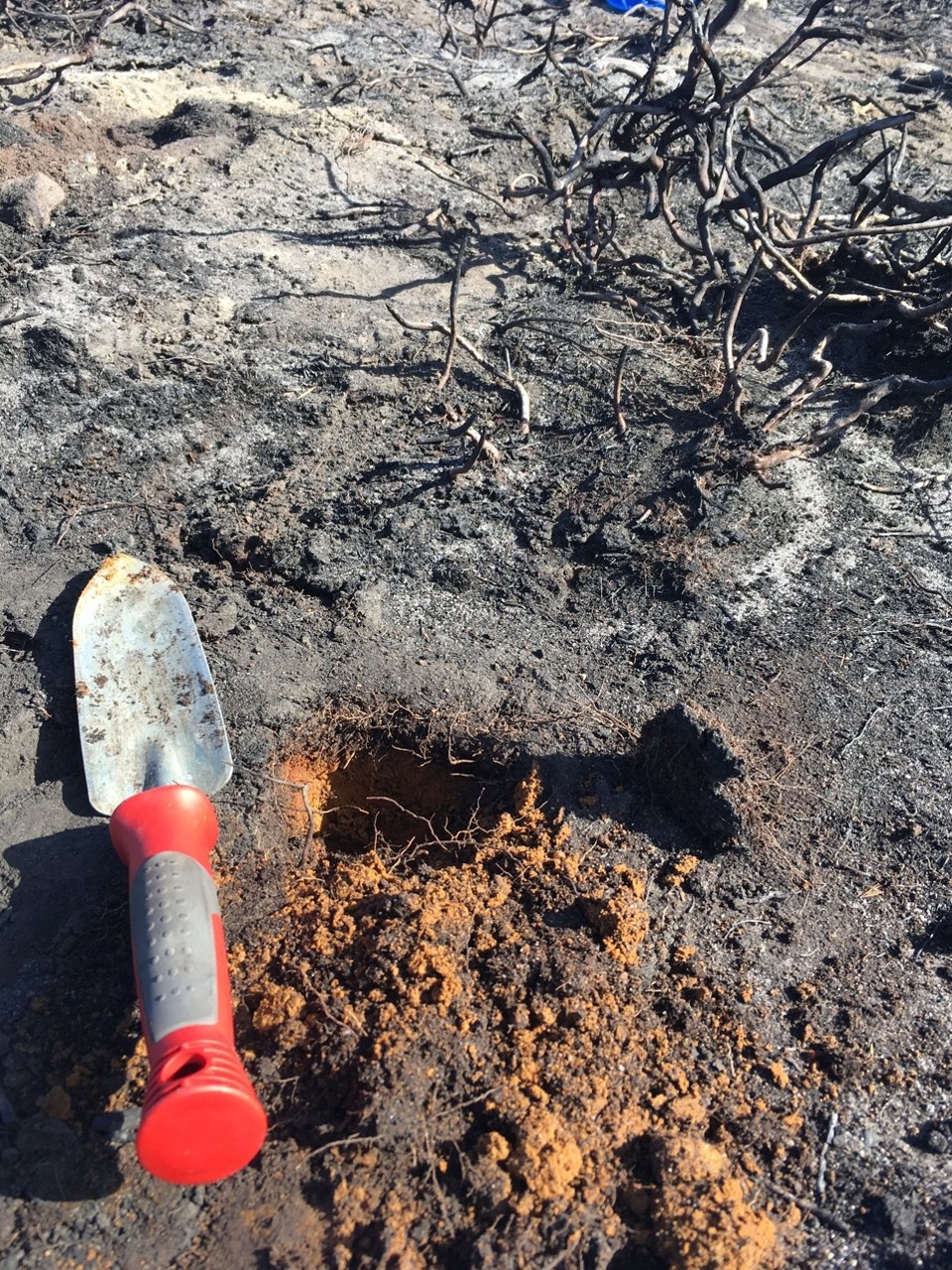
Figure 1: Wildfire-affected soil showing ash, charred organic matter and visible changes to the soil surface following fire disturbance
This project does not offer a CASE studentship
Each host has a slightly different application process.
Find out how to apply for this studentship.
All applications must include the CENTA application form.
Choose your application route
Soils representing different wildfire severities and stages of post-fire recovery will be characterised for carbon content, pH, moisture and nutrient availability. CO and CH₄ consumption will be quantified using controlled incubations and gas chromatography, with selected VOCs investigated where appropriate. Soil mesocosms will test how pyrogenic carbon and selected organic amendments influence trace-gas oxidation and recovery of microbial activity. DNA sequencing, targeted molecular analyses and metagenomics will characterise microbial communities and functional potential for trace-gas oxidation. Stable-isotope probing will, where appropriate, identify microbial populations actively incorporating trace-gas-derived carbon and link microbial identity with function.
DRs will be awarded CENTA Training Credits (CTCs) for participation in CENTA-provided and ‘free choice’ external training. One CTC can be earned per 3 hours training, and DRs must accrue 100 CTCs across the three and a half years of their PhD.
The student will receive training in soil microbiology, gas chromatography, metagenomics, bioinformatics and microbial cultivation. Hernández will provide practical training in trace-gas measurements, molecular approaches and data analysis. The student will develop interdisciplinary skills through regular supervisory meetings and collaboration with UKCEH. Supervision will be facilitated by regular meetings with the supervisory team and additional meetings between student and specific supervisors as required.
We have wide experience in microbial physiology, ecology, and soil carbon cycling, which is integral to this proposed research. The project will develop expertise in microbial ecology, biogeochemistry, soil carbon cycling, gas measurements and bioinformatics.
Dr Susheel Bhanu Busi (UKCEH) will contribute expertise in soil and ecosystem processes, metagenomics, and support project co-development and supervision. The collaboration provides complementary environmental science expertise and strengthens the project’s links to a NERC Research Centre. The student will benefit from interaction across microbial ecology, soil biogeochemistry and ecosystem science.
Year 1: Establish field/site sampling strategy; collect and characterise post-wildfire soils; optimise trace-gas measurements and mesocosm experiments; begin microbial community analyses.
Year 2: Conduct experiments on wildfire severity, pyrogenic carbon and organic amendments; quantify trace-gas consumption; undertake metagenomic and functional analyses; initiate stable-isotope probing.
Year 3: Complete isotope-probing and validation experiments; integrate microbial, gas and soil datasets; assess implications for post-fire ecosystem recovery; publish findings and complete thesis.
García-Carmona M, et al. Organic amendments as a tool to restore soil microbial diversity after wildfires in native Mediterranean forests. J Environ Manage. 2026. 397:128261.
Hu M, et al. Global recovery patterns of soil microbes after fire. Soil Biol Biochem. 2023. 183:109057
Lopez AM, et al. Molecular insights and impacts of wildfire-induced soil chemical changes. Nat Rev Earth Environ. 2024. 5:431–446.
Nelson AR, et al. Wildfire-dependent changes in soil microbiome diversity and function. Nat Microbiol. 2022. 7:1419-1430.
Soares M, et al. Wildfire and post-fire management reshape soil microbial guilds and carbon dynamics at a boreal forest site in Sweden. Biogeochemistry. 2026. 169:28.
Woolet J, Whitman T. Pyrogenic organic matter effects on soil bacterial community composition. Soil Biol Biochem. 2020. 141:107678.
For any enquiries related to this project please contact Dr Marcela Hernández García, [email protected] .
To apply to this project:
Applications must be submitted by 23:59 GMT on Wednesday 6th January 2027.