

Antimicrobial resistance (AMR) is a major public health threat. The environment plays an important role as resistant microorganisms are transmitted between people and animals through the environment; they also survive or thrive there and exchange genes.
One of the big debates is whether the low concentrations of antibiotics in the environment are selecting for resistance.
One approach to experimentally test this is to compete a ‘special pair’ of sensitive and resistant bacteria at a range of antibiotic concentrations in the lab, where their only difference is resistance so they share the same ecological niche. This is an accurate and sensitive method, but the conditions in the lab do not mimic the environment.
An alternative approach is to bring a complex sample from the environment into the lab and measure whether resistance genes are increasing at different antibiotic concentrations. This would seem to mimic the environment as a diverse community of bacteria is used, but the inevitable shifts in microbial community composition when incubating in rich media can result in increased resistance levels in the absence of selection.
We have a different idea, to use mathematical models based on results from simple lab experiments and then create the complexity in the model by including the effects of diversity, predation, low substrate concentrations etc, ultimately predicting at which concentration selection happens in the environment and also understanding the effects of the complications. This will be coupled with experiments under natural conditions to test and validate the model, in flume mesocosms that can mimic river conditions in the lab at UKCEH Wallingford and also in situ in rivers. For this, we will put the special pair in ‘cages’ (dialysis bags) so they cannot escape but are immersed in the environment and experience the same nutrient concentrations etc. as the other bacteria in the surrounding environment.
Such a validated mathematical model that can predict the risk of selection under environmental conditions is hugely important because it is impossible to expose thousands of different pathogenic and environmental bacteria with various (combinations) of resistances to many levels of hundreds of potentially selective antibiotics and other compounds under a variety of relevant environmental conditions.
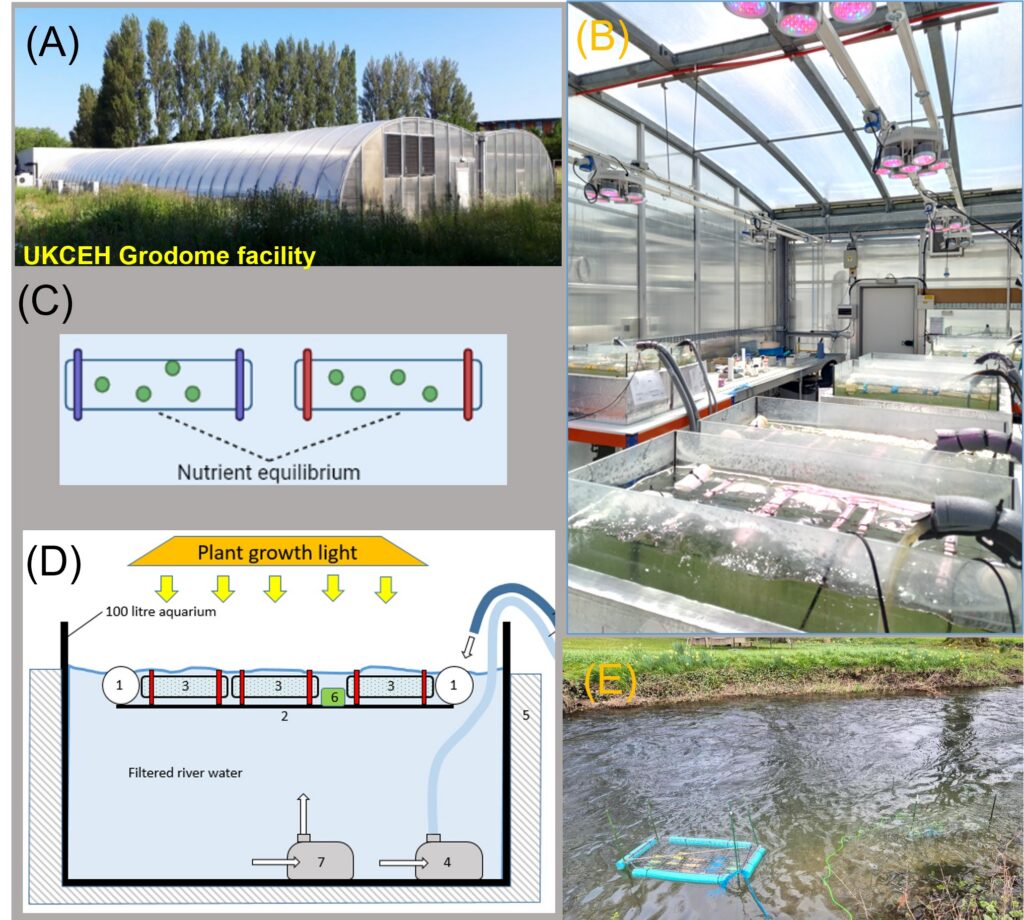
Figure 1: (A, B) The AQUA-REP mesocosm facility at UKCEH Wallingford. (C) Dialysis bag ‘cages’ physically separate bacteria from the environment but allowing nutrients and antibiotics to equilibrate. (D) Schematic of dialysis bag setup in aquarium mesocosm including (1) floats, (2) wire mesh platform, (3) dialysis bags, (4) pump to chiller unit, (5) insulation/shading, (6) temperature & light logger and (7) pump for mixing. (E) Immersing dialysis bag racks in a river, floating and submerged.
This project does not offer a CASE studentship
Each host has a slightly different application process.
Find out how to apply for this studentship.
All applications must include the CENTA application form.
Choose your application route
Guided by our experience with modelling selection for resistance in wastewater treatment plants, the doctoral researcher (DR) will build mathematical models simulating the fate of sensitive and resistant bacteria in rivers, including competition with a background microbial community, predation and other relevant processes, based on mechanisms and parameters from simple lab experiments. The DR will initially use differential equation models and then individual-based models that are better suited to understand the effect of biodiversity and stochasticity on outcomes.
The experimental part will be mostly based at UKCEH, where the DR will compete resistant with sensitive bacteria in dialysis bags to physically separate them from the background microbial community and enable their recovery for analysis, while exposing them to the same environment. In the UKCEH mesocosm facility, bacteria in the dialysis bags can be exposed to antibiotics and background community under environmentally relevant conditions. A similar dialysis bag set up can be immersed in natural rivers to match environmental conditions better but loosing experimental control over them (Figure 1).
DRs will be awarded CENTA Training Credits (CTCs) for participation in CENTA-provided and ‘free choice’ external training. One CTC can be earned per 3 hours training, and DRs must accrue 100 CTCs across the three and a half years of their PhD.
This project is highly interdisciplinary and will enable the DR to gain a strong quantitative skills set including different types of mathematical modelling, statistical data analysis, programming, appropriate use of GAI as well as laboratory skills, enhanced by working with different supervisors. Laboratory skills will cover a range of molecular microbial ecology skills.
Moreover, the PhD student will have the opportunity for public outreach activities to inform the AMR debate with the results of our project. Project management and communication skills will also be gained.
The UK Centre for Ecology & Hydrology (UKCEH) will host the doctoral researcher at Wallingford, providing supervision in molecular microbial ecology, freshwater science and environmental antimicrobial resistance. The collaboration brings together UKCEH’s experimental expertise and the flume mesocosm facility which will enable controlled experiments under realistic river conditions, complemented by in situ river experiments to test model predictions. Joint supervision by Susheel Bhanu Busi, Mike Bowes and Daniel Read will support training in experimental design, molecular methods and environmental data interpretation, connecting mechanistic understanding with the assessment of antimicrobial resistance selection in rivers.
Year 1:
Mostly modelling at Birmingham. Building and exploring mathematical models of selection in river ecosystems. Running the model to produce predictions and design experiments to test these predictions. Start setting up the experimental system, e.g. a special pair of resistant and isogenic sensitive E. coli. Paper 1.
Year 2:
Running experiments at UKCEH and analysis: Exposing the special pair in dialysis bags to different concentrations of antibiotic in the mesocosms, while varying also other conditions such as background community diversity, to be decided based on the modelling. Additionally, exposures in a natural river to test whether mesocosm results are representative. Also data analysis and comparison with the model predictions. Paper 2.
Year 3:
Mixed: Refining the modelling based on experimental results and additional experiments as needed to improve model predictions and validation. Paper 3.
Read DS, Gweon HS, Bowes MJ, Anjum MF, Crook DW, Chau KK, Shaw LP, Hubbard A, AbuOun M, Tipper HJ, Hoosdally SJ, Bailey MJ, Walker AS, Stoesser N (2024). Dissemination and Persistence of Antimicrobial Resistance (AMR) along the Wastewater-River Continuum. Water Research 264: 122204 https://doi.org/10.1016/j.watres.2024.122204
Uluseker C, Raguideau S, Quince C, Kreft JU (2025). Inferring antibiotic resistance selection in the environment can be confounded by correlations between resistance genes and unrelated functional traits. 2025.10.12.681873 https://doi.org/10.1101/2025.10.12.681873
Sonkar V, Kashyap A, Pallares-Vega R, Sasidharan SS, Modi A, Uluseker C, Jambu SC, Mohapatra PK, Larsen J, Graham DW, Thatikonda S, Kreft JU (2026). Hydraulic modelling reveals untreated sewage, not pharmaceutical waste, drives antimicrobial resistance in a small river running through a big city. 2024.12.21.629897 https://doi.org/10.1101/2024.12.21.629897
Elliott RO, Busi SB, Newbold LK, Bowes M, Armstrong LK, Nicholls DJE, Gweon HS, Kasprzyk-Hordern B, Read D, Tipper HJ (2026). Wastewater treatment attenuates ecological and human health resistome risk. 2026.09.12.26362900 https://doi.org/10.64898/2026.09.12.26362900
Any queries welcome, please contact Jan on [email protected]
Dr Jan-Ulrich Kreft
School of Biosciences & Institute of Microbiology and Infection
The University of Birmingham
Edgbaston, Birmingham, B15 2TT, UK
Tel: +44 (0)7947812897
Email: [email protected]
Web pages:
https://www.birmingham.ac.uk/research/centres-institutes/kreft-lab
https://more.bham.ac.uk/amrflows/
https://scholar.google.com/citations?user=hLRsYpsAAAAJ&hl=en&oi=ao
Dr Susheel Bhanu Busi
Head of Molecular Ecology
UK Centre for Ecology & Hydrology
Maclean Building, Benson Lane, Crowmarsh Gifford, Wallingford, OX10 8BB, UK
P: +44 (0)7407405176
Professor Mike J Bowes
Head of River Water Quality & Ecology
UK Centre for Ecology & Hydrology
Maclean Building, Benson Lane, Crowmarsh Gifford, Wallingford, OX10 8BB, UK
P: +44 (0)1491 692255
Dr Daniel Read
Science Director for the Environmental Pressures & Responses
UK Centre for Ecology & Hydrology
Maclean Building, Benson Lane, Crowmarsh Gifford, Wallingford, OX10 8BB, UK
P: +44 (0)1491 692644
To apply to this project: