

Insect populations are declining worldwide, and agrochemical pollution is a principal driver. Current insecticide safety assessments underestimate environmental harm because they rely mainly on short-term mortality tests on a few surrogate species, most often honeybees, and overlook sublethal and community-level effects. The central environmental problem this project will solve is evolutionary: broad-spectrum insecticides—pyrethroids, neonicotinoids, organophosphates, carbamates and diamides—act on molecular targets conserved across the arthropod phylogeny, so pests, pollinators, natural predators and parasitoids share vulnerability through ‘toxicity by descent’. This project will deliver a predictive, evolution-informed molecular docking framework that protects beneficial insects by quantifying how sequence and structural divergence in insecticide target proteins translates into differential susceptibility across species. Key research questions are: (1) How does target-site divergence across arthropod phylogenies predict insecticide binding and toxicity? (2) Can molecular docking of representative insecticides against structurally modelled target proteins recapitulate documented resistance and species-sensitivity data? (3) Can the resulting framework guide selection of chemistries that spare vulnerable nontarget species and reduce environmental pollution?
To answer these questions, the project will compile target-protein sequences for five major insecticide classes across a phylogenetically representative panel of pests and beneficial arthropods, generate and refine structural models using homology modelling and AlphaFold, and run validated molecular docking pipelines against a panel of environmentally relevant insecticides. Predictions will be benchmarked against empirical resistance and sensitivity data from the literature and validated experimentally in Drosophila melanogaster and cell-based assays.
The outcomes are oriented directly to solving an environmental problem: a species-risk prioritisation framework and a cheminformatics tool that enable regulators and industry to identify at-risk species, avoid harmful chemistries and design safer insecticides, informing evidence-based risk assessment under the precautionary principle and contributing to halting insect declines.
The project will run over 3.5 years: Year 1 will focus on phylogenomic data assembly and structural modelling; Year 2 on docking pipeline development and benchmarking; Year 3 on experimental validation and case-study application with the industrial partner; the final six months on integration, thesis writing and dissemination.
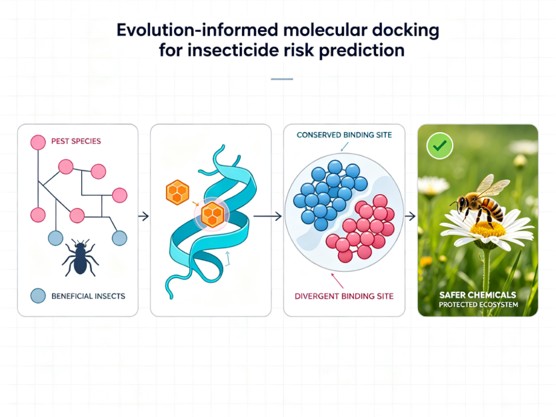
Figure 1: Evolution-informed molecular docking for predicting insecticide risk. Left, an arthropod phylogeny interweaving pest and beneficial species; centre, an insecticide molecule docked into a conserved insecticide target protein; right, conserved versus divergent binding-site residues that determine cross-species susceptibility; far right, the intended environmental solution—safer chemicals and protected ecosystems. The framework translates ‘toxicity by descent’—shared ancestry leading to shared chemical vulnerability—into prioritised predictions of nontarget risk, enabling proactive protection of biodiversity from insecticide pollution.
This project does not offer a CASE studentship
Each host has a slightly different application process.
Find out how to apply for this studentship.
All applications must include the CENTA application form.
Choose your application route
Target proteins of five major insecticide classes—voltage-gated sodium channels, nicotinic acetylcholine receptors, ryanodine receptors, acetylcholinesterase and chitin synthase—will be retrieved for a phylogenetically representative panel of pests, pollinators, predators and parasitoids. Orthology and sequence-divergence analyses will map target-site variation onto the arthropod phylogeny. Structural models will be generated by homology modelling and AlphaFold, and molecular docking (e.g., AutoDock Vina, Glide) will quantify binding of representative insecticides, with scoring calibrated against known resistance mutations (e.g., ace-1, kdr, ryanodine receptor) and empirical sensitivity data. Predictions will be validated using in vivo insects and in vitro bioassays where feasible. Outputs will be integrated into a species-risk prioritisation framework linking binding divergence to predicted susceptibility, giving regulators and industry an actionable, evolution-based tool to reduce insecticide harm to the environment.
DRs will be awarded CENTA Training Credits (CTCs) for participation in CENTA-provided and ‘free choice’ external training. One CTC can be earned per 3 hours training, and DRs must accrue 100 CTCs across the three and a half years of their PhD.
The student will receive interdisciplinary training in environmental toxicology, evolutionary genomics, structural biology and computational chemistry. Practical skills will include phylogenomics, homology modelling and AlphaFold-based structure prediction, molecular docking and cheminformatics, alongside experimental validation using in vivo and in vitro assays. Training in high-performance computing and reproducible data science will underpin rigorous, auditable predictions. Through collaboration with Bayer Crop Science, the student will learn to translate computational findings into regulatory and industrial decision-making, preparing them for careers in which these skills can directly help solve environmental pollution problems.
Dr Steve Short and Dave Spurgeon (UK Centre for Ecology & Hydrology, UKCEH) will act as Co-Investigator, providing expertise in insecticide toxicology and regulatory risk assessment. UKCEH will advise on chemical selection, share toxicological data, and host a CASE placement (Year 2/3) offering hands-on experience in pesticide registration and computational safety assessment. Collaboration will involve co-supervision and quarterly project reviews, ensuring outputs align with OECD/EFSA data requirements. This partnership strengthens regulatory relevance and provides the student with direct insight into how evolution-informed tools can reduce the environmental impact of insecticide use.
Colbourne JK, Shaw JR, Sostare E, Rivetti C, Derelle R, Barnett R, Campos B, LaLone C, Viant MR, Hodges G. 2022. Toxicity by descent: A comparative approach for chemical hazard assessment. Environmental Advances 9: 100287.
Gandara L, et al. 2024. Pervasive sublethal effects of agrochemicals on insects at environmentally relevant concentrations. Science 386: 446–453.
Glaberman S, Spatz K, Colbourne JK. 2025. The evolutionary dilemma of broad-spectrum insecticides. BioScience 75: 799–802.
LaLone CA, et al. 2023. From protein sequence to structure: The next frontier in cross-species extrapolation for chemical safety evaluations. Environmental Toxicology and Chemistry 42: 463–474.
Weston DP, Poynton HC, Wellborn GA, Lydy MJ, Blalock BJ, Sepulveda MS, Colbourne JK. 2013. Multiple origins of pyrethroid insecticide resistance across the species complex of a nontarget aquatic crustacean, Hyalella azteca. Proceedings of the National Academy of Sciences 110: 16532–16537.
Project contact: Dr Pu Xia, University of Birmingham ([email protected]).
To apply to this project: