

Forests emit large amounts of volatile organic compounds (VOCs). In the atmosphere these are oxidised to form large, oxygenated gases which then form secondary organic aerosol (SOA): tiny particles that scatter sunlight and form cloud droplets. The effect of aerosol on clouds is the largest single source of uncertainty in how much humans have changed the climate. Forest emissions therefore feed back on climate, but we do not know how this feedback will change as atmospheric CO2 rises.
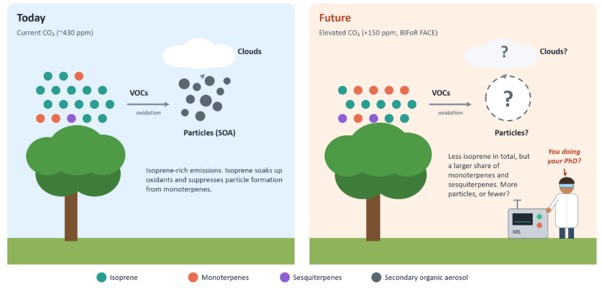
Trees respond to high CO2 by changing both how much they emit and what they emit. Isoprene is the most abundant VOC emitted by plants, and its emission from many species, including oak, falls under elevated CO₂, while monoterpene and sesquiterpene responses are more variable. These compounds differ enormously in how well they make particles. Isoprene makes little SOA itself, and it actively suppresses particle formation from monoterpenes by interfering with the chemistry that builds oxygenated gases. A forest that emits less isoprene but similar or more monoterpene could therefore make more aerosol, even though its total emissions have fallen (Figure 1).
This project will test that idea in a real forest. The Birmingham Institute of Forest Research (BIFoR) FACE facility has exposed a mature oak woodland to CO2 150 ppm above ambient since 2017, alongside control plots at current CO2. It is one of very few places in the world where the emissions of a future forest can be measured directly.
The doctoral researcher (DR) will measure the VOC mixtures emitted under current and elevated CO₂, recreate those mixtures in the laboratory to measure how much aerosol they form, and use a chemical box model to work out which compounds cause any difference. Part of the laboratory work will take place at the University of Eastern Finland (UEF) with Dr Angela Buchholz, within the ACE-Forest Centre of Excellence, a leading group in aerosol formation from real plant emissions.
The outcome will be the first direct, mechanistic estimate of how CO2 fertilisation changes the aerosol-forming potential of a mature temperate forest, something climate models currently have to assume.
Figure 1: The hypothesis. (left) Today, trees emit gases which form aerosol particles, which influence the climate. (right) under elevated CO₂, this mixture of emissions may be different in a way that forms more, or less particles.
This project does not offer a CASE studentship
Each host has a slightly different application process.
Find out how to apply for this studentship.
All applications must include the CENTA application form.
Choose your application route
Field: the DR will sample VOCs onto Tenax sorbent tubes at leaf, branch and canopy level in the forest with elevated and regular CO2 across the growing season, and analyse them by comprehensive two-dimensional gas chromatography mass spectrometry (GCxGC-ToF-MS) at Birmingham. An intensive campaign with a deployable GC-EI-ToF-MS on loan from the University of East Anglia will capture the diurnal cycle of emissions under each treatment.
Laboratory: measured mixtures will be recreated and oxidised in flow tube reactors at UEF and Birmingham, measuring SOA yield (particle sizers, aerosol mass spectrometry), highly oxygenated molecules (nitrate CIMS) and particle volatility (FIGAERO-CIMS).
Modelling: an explicit chemical box model constrained by these data will be run with individual compounds switched in and out, isolating which changes in the mixture drive the difference in SOA.
DRs will be awarded CENTA Training Credits (CTCs) for participation in CENTA-provided and ‘free choice’ external training. One CTC can be earned per 3 hours training, and DRs must accrue 100 CTCs across the three and a half years of their PhD.
The DR will be trained in VOC sampling and thermal desorption GCxGC-ToF-MS, chemical ionisation and aerosol mass spectrometry, and flow tube SOA experiments, with specialist training on FIGAERO-CIMS and volatility analysis during research visits to UEF. They will learn chemical box modelling (Master Chemical Mechanism) and scientific programming in Python for large mass spectrometry datasets. Fieldwork at BIFoR includes site induction and forest safety training. The DR will join the BIFoR and ACE-Forest research communities, present at international conferences (e.g. European Aerosol Conference, EGU), and gain experience of international collaboration.
The project is a collaboration with Dr Angela Buchholz (University of Eastern Finland), part of the Research Council of Finland Centre of Excellence ACE-Forest (Anthropocenic Chemical Ecology of Forests, 2026 to 2033), which studies how human activity alters the chemistry of forests and the particles they produce. The DR will make research visits to UEF for flow tube and FIGAERO-CIMS experiments. BIFoR provides access to the FACE facility and its long-term ecological and meteorological data. The University of East Anglia will lend a deployable GC-EI-ToF-MS for the intensive field campaign.
Year 1: Literature review; training in GCxGC-ToF-MS, CIMS and box modelling; method development for Tenax sampling; first growing-season VOC sampling campaign at BIFoR (May to September). First research visit to UEF to learn flow tube and FIGAERO-CIMS methods.
Year 2: Second growing season including the intensive GC-EI-ToF-MS campaign to resolve diurnal cycles. Flow tube SOA experiments with reconstructed ambient and elevated CO₂ mixtures at Birmingham and during an extended visit to UEF. First paper on the effect of elevated CO₂ on the VOC mixture.
Year 3: Box modelling constrained by field and laboratory data to attribute SOA differences to individual compound classes. Second paper on SOA formation potential. Presentation at an international conference.
Final 6 months: Implications for climate models; third paper; thesis writing and submission.
An overview of the BiFOR facility:
Hart, K. M. et al. (2020) ‘Characteristics of free air carbon dioxide enrichment of a northern temperate mature forest’, Global Change Biology, 26(2), pp. 1023–1037. doi: 10.1111/gcb.14786.
Some background about the complex relationship between CO2 and VOCs:
Rosenstiel, T. N. et al. (2003) ‘Increased CO2 uncouples growth from isoprene emission in an agriforest ecosystem’, Nature, 421, pp. 256–259. doi: 10.1038/nature01312.
How does the mixture of organic molecules alter the ability to form particles?:
Heinritzi, M. et al. (2020) ‘Molecular understanding of the suppression of new-particle formation by isoprene’, Atmospheric Chemistry and Physics, 20, pp. 11809–11821. doi: 10.5194/acp-20-11809-2020.
McFiggans, G. et al. (2019) ‘Secondary organic aerosol reduced by mixture of atmospheric vapours’, Nature, 565, pp. 587–593. doi: 10.1038/s41586-018-0871-y.
For informal enquiries please contact Dr James Brean ( j.brean@bham.ac.uk).
To apply to this project:
Applications must be submitted by 23:59 GMT on Wednesday 6th January 2027.