

Persistent organic pollutants, toxic metals and dyes threaten water quality, while discarded products and industrial residues contain valuable critical minerals. Sorbents can lose performance or release their own components as water chemistry changes. This project will develop greener metal–organic framework (MOF) nanogels and determine how their transformations govern remediation, resource recovery and environmental safety.
MOFs are porous solids with tunable binding sites. We will test whether confinement within hydrated biopolymer networks limits framework release while preserving accessible binding sites. You will prepare a small set of formulations using aqueous or reduced-solvent routes, then examine capture under different pH, dissolved organic matter and competing-ion conditions. Screening will cover persistent PFAS, represented by PFOA/PFOS, heavy metals and dyes. Detailed studies will focus on the most promising combinations. A separate pathway will test recovery of rare-earth elements, including neodymium and dysprosium, from secondary aqueous resources.
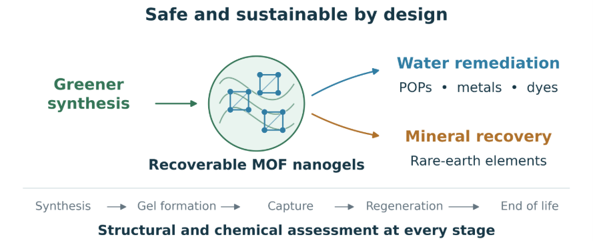
Building on our MOF remediation and transformation research, the project will connect structural and chemical changes to performance throughout synthesis, gelation, capture, regeneration and end-of-life ageing. Metal and linker release measurements, combined with pollutant mass balances, will identify potential secondary contamination. Mineral recovery will be assessed through desorption yield and product purity.
Safe and sustainable by design (SSbD) will guide material selection. You will compare treatment performance, aquatic effects, chemical and energy inputs, waste generation and reuse against relevant commercial sorbents. The outcome will be experimentally supported design rules for water treatment and resource recovery, identifying conditions that preserve useful performance while limiting environmental harm.
Figure 1. Proposed MOF nanogel pathways for remediation and mineral recovery, with structural and chemical assessment throughout the material life cycle.
This project does not offer a CASE studentship
Each host has a slightly different application process.
Find out how to apply for this studentship.
All applications must include the CENTA application form.
Choose your application route
Prepare up to four Fe/Zr/Cu MOF–biopolymer formulations using aqueous or reduced-solvent routes, retaining nanogel domains in recoverable carriers. Screen PFOA/PFOS, Pb/Cd and contrasting dyes; select two formulations for detailed studies on one organic pollutant and one metal. Study Nd/Dy recovery separately in synthetic feeds and a representative secondary-resource matrix. Track synthesis, gelation, conditioning, capture, regeneration and end-of-life ageing using diffraction, microscopy, vibrational spectroscopy, selected solid-state NMR and XAS where access permits. Quantify contaminants and metal/linker release by ICP-MS and validated chromatography. Include polymer-only, MOF-only, ion, commercial-sorbent and precipitation controls, independent batches and mass balances. Measure release and performance across five reuse cycles, together with mineral desorption and product purity. Algal and Daphnia screens, chemical, water and energy inventories, and a screening life-cycle comparison will guide SSbD decisions.
DRs will be awarded CENTA Training Credits (CTCs) for participation in CENTA-provided and ‘free choice’ external training. One CTC can be earned per 3 hours training, and DRs must accrue 100 CTCs across the three and a half years of their PhD.
The student will receive training in MOF and nanogel synthesis, trace-organic analysis, ICP-MS, diffraction, microscopy and spectroscopy. Targeted solid-state NMR and synchrotron methods will develop skills in resolving local chemical changes. Training will also cover aquatic ecotoxicology, experimental design, mass balance, reproducible data analysis and screening life-cycle assessment. Joint supervision across environmental science and chemistry will connect these methods to treatment performance. CENTA and University training will support research integrity, scientific writing, communication, inclusive teamwork and career development. The student will gain experience presenting findings and discussing their relevance with water-treatment and resource-recovery researchers.
The supervisory team combines Chakraborty’s expertise in environmental nanoscience, MOF transformation and SSbD, Abdallah’s expertise in persistent pollutants and trace-organic analysis, and Kubicki’s expertise in materials chemistry and solid-state NMR. Collaboration between GEES and Chemistry at University of Birmingham will connect environmental performance with molecular understanding. Targeted synchrotron measurements will be pursued through competitive access routes; laboratory characterisation will support the core programme. Engagement with water-treatment and recycling organisations will be explored for practical feedback.
Year 1 — Establish analytical methods, quality controls and the data-management plan. Prepare a limited formulation library and verify nanogel dimensions, containment and chemical stability. Complete initial pollutant and mineral-binding screens, assess synthesis inputs and select two formulations. Begin release measurements and aquatic bioassays.
Year 2 — Resolve how pH, dissolved organic matter and competing ions affect pollutant capture and material transformation. Compare framework, polymer and transformation-product contributions using matched controls and mass balances. Validate selected conditions in representative water samples and define provisional operating limits.
Year 3 — Evaluate rare-earth capture, selective desorption and product purity, followed by five reuse cycles and validation in a characterised secondary-resource matrix. Integrate transformation, release, aquatic-effect and resource-use data into the SSbD comparison. Complete the main experimental programme and prepare manuscripts.
Months 37–42 — Complete essential validation, integrate the findings and finish the thesis and publications. For part-time study, agree equivalent milestones and scheduled laboratory blocks that preserve continuity of time-sensitive experiments.
The reading list brings together the group’s published remediation and transformation studies, wider MOF research and reviews, and current SSbD guidance. References are in Harvard style; DOI links open the source records.
MOF remediation and critical mineral recovery
Bhadane, P. and Chakraborty, S. (2025) ‘Cellulose acetate-nanoMOF beads: a safe, sustainable and scalable solution for Pb remediation in complex water systems’, Environmental Science: Nano 12, pp. 3329–3341. doi: 10.1039/D5EN00056D
Bhadane, P. and Chakraborty, S. (2025) ‘Cross-material synergies of carbon nanomaterials, MOFs, and COFs: Innovative approaches for sustainable environmental remediation and resource recovery’, Coordination Chemistry Reviews 535, 216669. doi: 10.1016/j.ccr.2025.216669
Bhadane, P. et al. (2024) ‘Hydrolytically stable nanosheets of Cu–imidazolate MOF for selective trapping and simultaneous removal of multiple heavy metal ions’, Environmental Science: Nano 11, pp. 2385–2396. doi: 10.1039/D3EN00754E
Bhadane, P. et al. (2025) ‘A two-dimensional metal-organic framework for efficient recovery of heavy and light rare earth elements from electronic wastes’, Separation and Purification Technology 360, 130946. doi: 10.1016/j.seppur.2024.130946
Bhadane, P., Dhumal, P., Brun, E., Britton, A., Lynch, I. and Chakraborty, S. (2025) ‘Safe and Sustainable by Design MOF Beads for Selective Entrapment and Recovery of Rare Earth Elements’, Environmental Science & Technology 59, pp. 16379–16391. doi: 10.1021/acs.est.5c03112
Chakraborty, S. et al. (2026) ‘Freeze-drying enables resource-efficient isolation of copper imidazolate metal–organic framework nanosheets for transformation-aware lead capture’, Green Chemistry. Advance online publication, 13 July 2026. doi: 10.1039/D6GC03068H
Chaudhary, M. L. (2025) ‘Metal–Organic Frameworks for PFAS Remediation and Sensing: From Molecular Design to Real-World Implementation’, Industrial & Engineering Chemistry Research 64, pp. 13536–13556. doi: 10.1021/acs.iecr.5c01041
Hu, Q.-H. et al. (2024) ‘Rationally designed nanotrap structures for efficient separation of rare earth elements over a single step’, Nature Communications. doi: 10.1038/s41467-024-45810-1
Kobielska, P. A., Howarth, A. J., Farha, O. K. and Nayak, S. (2018) ‘Metal–organic frameworks for heavy metal removal from water’, Coordination Chemistry Reviews 358, pp. 92–107. doi: 10.1016/j.ccr.2017.12.010
Wen, Y., Zhang, P., Sharma, V. K., Ma, X. and Zhou, H.-C. (2021) ‘Metal-organic frameworks for environmental applications’, Cell Reports Physical Science 2, 100348. doi: 10.1016/j.xcrp.2021.100348
Xiao, F., Fu, J., Jiang, G., Cui, X., Bu, D. and Zhang, Q. (2026) ‘Metal–organic frameworks for the removal of per- and polyfluoroalkyl substances: design strategies, adsorption performance, and mechanistic insights’, Chemical Engineering Journal 544, 178608. doi: 10.1016/j.cej.2026.178608
MOF gels and polymer composites
Fu, Q., Wen, L., Zhang, L., Chen, X., Pun, D., Ahmed, A., Yang, Y. and Zhang, H. (2017) ‘Preparation of Ice-Templated MOF–Polymer Composite Monoliths and Their Application for Wastewater Treatment with High Capacity and Easy Recycling’, ACS Applied Materials & Interfaces 9, pp. 33979–33988. doi: 10.1021/acsami.7b10872
Hou, J., Sapnik, A. F. and Bennett, T. D. (2020) ‘Metal–organic framework gels and monoliths’, Chemical Science 11, pp. 310–323. Available online
Lin, H. et al. (2023) ‘Recent advance of macroscopic metal-organic frameworks for water treatment: A review’, Surfaces and Interfaces 36, 102564. doi: 10.1016/j.surfin.2022.102564
Miao, Q., Jiang, L., Yang, J., Hu, T., Shan, S., Su, H. and Wu, F. (2022) ‘MOF/hydrogel composite-based adsorbents for water treatment: A review’, Journal of Water Process Engineering 50, 103348. doi: 10.1016/j.jwpe.2022.103348
Pander, M., Gil-San-Millan, R., Delgado, P., Perona-Bermejo, C., Kostrzewa, U., Kaczkowski, K., Kubicki, D. J., Navarro, J. A. R. and Bury, W. (2023) ‘MOF/polymer hybrids through in situ free radical polymerization in metal-organic frameworks’, Materials Horizons 10, pp. 1301–1308. doi: 10.1039/D2MH01202B
Zhu, H., Zhang, Q. and Zhu, S. (2016) ‘Alginate Hydrogel: A Shapeable and Versatile Platform for in Situ Preparation of Metal–Organic Framework–Polymer Composites’, ACS Applied Materials & Interfaces 8, pp. 17395–17401. doi: 10.1021/acsami.6b04505
Zhuang, Y., Kong, Y., Wang, X. and Shi, B. (2019) ‘Novel one step preparation of a 3D alginate based MOF hydrogel for water treatment’, New Journal of Chemistry 43, pp. 7202–7208. doi: 10.1039/C8NJ06031B
Environmental transformation and safety
Chakraborty, S. and Lynch, I. (2025) ‘Biomolecular Transformations Shape the Environmental Fate of Nanoscale and Emerging Materials’, Accounts of Chemical Research. doi: 10.1021/acs.accounts.5c00587
Chakraborty, S. (2025) ‘Environmental hierarchy as the third dimension of nanomaterial transformation science’, Eco-Environment & Health 4, 100195. doi: 10.1016/j.eehl.2025.100195
Chakraborty, S. (2026) ‘A Transformation-First Roadmap for Safe and Sustainable Emerging Advanced Materials’, Accounts of Materials Research. doi: 10.1021/accountsmr.5c00370
Chakraborty, S. (2026) ‘Accounting for dynamic nanomaterial behavior in toxicological study design’, Cell Reports Physical Science 7, 103450. doi: 10.1016/j.xcrp.2026.103450
Chakraborty, S. (2026) ‘Environmental transformation of covalent organic frameworks’, Nature Reviews Materials. doi: 10.1038/s41578-026-00908-4
Chakraborty, S. (2026) ‘Failure windows and commit points of engineered nanomaterials in the environment’, Environmental Science and Ecotechnology, 100685. doi: 10.1016/j.ese.2026.100685
Chakraborty, S. et al. (2025) ‘Biotic Transformation of Abiotically Stable Nanoscale UiO-66 Metal–Organic Framework by Daphnia magna Results in Chronic Reproductive Toxicity’, ACS Nano. doi: 10.1021/acsnano.5c16532
Chakraborty, S. et al. (2026) ‘Hierarchical Environmental Exposure Transforms Zeolitic Imidazolate Framework-8 and Increases Toxicity in Daphnia magna’, ACS Nano. Advance online publication, 26 May 2026. doi: 10.1021/acsnano.6c01107
Chakraborty, S. et al. (2026) ‘Mapping the Hierarchical Environmental Transformations of Nanoscale UiO-66 Metal–organic Framework’, Environmental Science & Technology. Advance online publication, 2 January 2026. doi: 10.1021/acs.est.5c14487
Chakraborty, S., Britto, S., Gomez-Gonzalez, M., Buzanich, A. G. and Mikulska, I. (2025) ‘Synchrotrons, neutron sources, and XFELs guiding the future of safe and sustainable nanomaterials’, Cell Reports Physical Science, 102806. doi: 10.1016/j.xcrp.2025.102806
Chakraborty, S., Guilherme Buzanich, A., Bhadane, P., Kitaguchi, H., Pham, S. and Mikulska, I. (2026) ‘Structural Persistence Masks Commit-Point Chemical Transformation in Copper–Imidazolate Nanosheet Metal–Organic Frameworks’, ACS Nano. Advance online publication, 23 June 2026. doi: 10.1021/acsnano.6c06011
Chakraborty, S., Misra, S. K., Lead, J. R. and Lynch, I. (2025) ‘Capturing rapid nanomaterial transformations with cross-platform operando characterization’, Nature Reviews Materials. doi: 10.1038/s41578-025-00844-9
Chakraborty, S., Valsami-Jones, E. and Misra, S. K. (2025) ‘Characterising Dissolution Dynamics of Engineered Nanomaterials: Advances in Analytical Techniques and Safety-by-Design’, Small, 2500622. doi: 10.1002/smll.202500622
Dhumal, P., Chakraborty, S. and Lynch, I. (2026) ‘Biomolecular coronas govern the environmental fate of metal–organic frameworks’, Nature Reviews Chemistry. Advance online publication, 2 January 2026. doi: 10.1038/s41570-025-00789-1
Safe and sustainable by design
Chakraborty, S., Menon, D., Mikulska, I., Pfrang, C., Fairen-Jimenez, D., Misra, S. K. and Lynch, I. (2025) ‘Make metal–organic frameworks safe and sustainable by design for industrial translation’, Nature Reviews Materials. doi: 10.1038/s41578-025-00774-6
Dhumal, P., Bhadane, P., Ibrahim, B. and Chakraborty, S. (2025) ‘Evaluating the path to sustainability: SWOT analysis of safe and sustainable by design approaches for metal–organic frameworks’, Green Chemistry 27, pp. 3815–3850. doi: 10.1039/D5GC00424A
Garmendia Aguirre, I. et al. (2025) Safe and Sustainable by Design Chemicals and Materials. Revised framework. European Commission Joint Research Centre, JRC143022. doi: 10.2760/5103785
European Commission (2026) Safe and sustainable by design. Available at: https://research-and-innovation.ec.europa.eu/research-area/industrial-research-and-innovation/chemicals-and-advanced-materials/safe-and-sustainable-design_en (Accessed: 19 September 2026).
For informal enquiries, contact Dr Swaroop Chakraborty, School of Geography, Earth and Environmental Sciences, University of Birmingham, Edgbaston, Birmingham B15 2TT, UK. Email: [email protected]. Applicants with interests in environmental science, chemistry, materials science or related disciplines are encouraged to enquire. The project is suitable for full-time or part-time study, with laboratory arrangements agreed individually.
To apply to this project:
Applications must be submitted by 23:59 GMT on Wednesday 6th January 2027.