
2027-B10 A Multi-Scale Quantitative Investigation of Micro- and Nanoplastic Disruptions in Algal Physiology, Trophic Dynamics, and Carbon Sequestration

PROJECT HIGHLIGHTS

  • Quantify how micro- and nanoplastics (MNPs) are taken up by different plankton groups and assess their effects on nutrient uptake, photosynthesis, and growth. 
  • Determine how MNPs are transferred across trophic levels in planktonic food webs and evaluate consequences for energy flow. 
  • Evaluate how MNP-plankton interactions alter carbon export efficiency and the functioning of the biological carbon pump. 

Overview

Plastic pollution has introduced vast quantities of micro- and nanoplastics (MNPs) into aquatic ecosystems, raising urgent questions about their impacts on biodiversity and global biogeochemical cycles. Among the most critical but poorly understood aspects is how MNPs interact with plankton communities, which form the foundation of food webs and drive the ocean’s biological carbon pump-a key regulator of atmospheric CO₂.  

Emerging studies show that MNPs can impair nutrient uptake, photosynthesis, and growth in algae, while also reshaping community composition by favouring opportunistic species. These changes cascade through ecosystems: plastics can alter carbon export by binding with algal cells into fast-sinking aggregates or, conversely, reducing sinking when attached to buoyant particles. Moreover, predators often ingest MNPs indirectly through contaminated prey, with transfer efficiencies up to an order of magnitude higher than direct uptake. Yet despite these findings, our understanding of how MNPs affect plankton-driven processes and carbon cycling remains fragmented, with few quantitative datasets under realistic ecological conditions. 

This PhD project will bridge that gap by combining field surveys, laboratory experiments, and advanced analytical tools. Water and plankton samples from UK coastal waters will be analysed to quantify MNP types, sizes, and concentrations, correlated with plankton community metrics. Using innovative labelling and state-of-the-art techniques, the student will investigate species-specific uptake across representative algae, linking particle properties to cellular physiology and nutrient assimilation. Controlled feeding experiments will trace trophic transfer into zooplankton and higher consumers, generating quantitative coefficients for ecological risk models. Finally, the project will integrate these data into a predictive framework to assess how MNPs disrupt plankton community dynamics and the efficiency of the biological carbon pump. 

The research will provide fundamental insights into the ecological and climate implications of plastic pollution, with outcomes directly relevant to environmental agencies, fisheries managers, and international policy. Training will be highly interdisciplinary, spanning environmental nanoscience, plankton ecology, analytical chemistry, and ecological modelling, equipping the student with cutting-edge skills and an outstanding platform for career development in environmental science. 

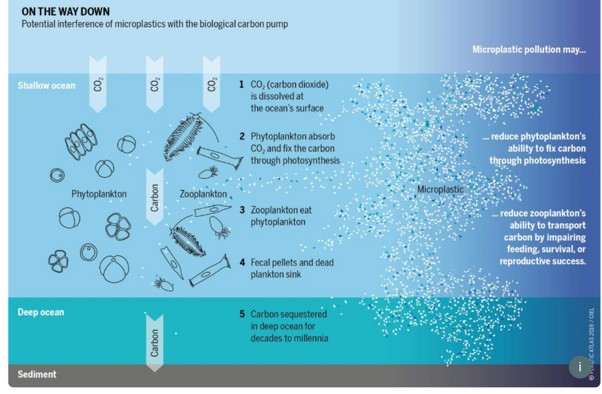
Figure 1 Pollution by microplastics may put the biological carbon pump at risk (https://oceaninfo.com/ocean/conservation/the-biological-carbon-pump/). 

Infographic showing how microplastics may disrupt the ocean’s biological carbon pump. The diagram illustrates carbon dioxide being absorbed by phytoplankton, transferred through zooplankton, and carried to the deep ocean, while microplastic pollution reduces phytoplankton carbon fixation and impairs zooplankton's ability to transport carbon to deeper waters.

Case Projects

This project does not offer a CASE studentship

Host

Theme

Supervisors

Project investigator

Co-investigators

How to apply

Each host has a slightly different application process.
Find out how to apply for this studentship.

All applications must include the CENTA application form.
Choose your application route

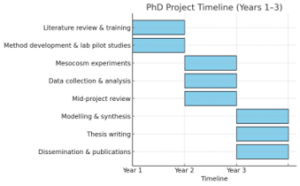
This project will combine controlled mesocosm experiments, advanced analytical techniques, and ecological modelling to unravel how MNPs influence plankton-mediated carbon sequestration. Laboratory mesocosms will be used to expose phytoplankton and zooplankton communities to environmentally relevant concentrations and types of MNPs, quantifying effects on primary production, grazing efficiency, and particulate organic carbon (POC) export. High-resolution techniques such as flow cytometry, single-particle ICP-MS, and FTIR/Raman spectroscopy will track MNP uptake, aggregation, and interactions with plankton. Stable isotope labelling will trace carbon flow through trophic levels under MNP exposure. Parallel microbial and molecular analyses will identify changes in biofilm formation and enzymatic pathways that regulate organic matter degradation. Experimental findings will be integrated into ecological models of the biological carbon pump to predict long-term consequences of MNP pollution for carbon sequestration, providing mechanistic insight into a critical but poorly understood dimension of global change. 

DRs will be awarded CENTA Training Credits (CTCs) for participation in CENTA-provided and ‘free choice’ external training. One CTC can be earned per 3 hours training, and DRs must accrue 100 CTCs across the three and a half years of their PhD.  

The student will gain interdisciplinary expertise spanning experimental ecology, environmental chemistry, and data modelling. Training will include mesocosm design and operation, advanced analytical techniques, and molecular tools for microbial and enzymatic profiling. Skills in stable isotope tracing and ecological modelling will be developed through hands-on supervision and workshops. The project also provides training in coding, statistical analysis, and machine learning for predictive modelling. Transferable skills such as scientific writing, presentation, project management, and international collaboration will be fostered through engagement with the supervisory team, CENTA cohort activities, and global project partners. 

Journal:

Jambeck, J.R., et al., 2015. Plastic waste inputs from land into the ocean. Science, 347(6223), pp.768–771.

Rillig, M.C., et al., 2020. Microplastic effects on plants. Science, 368(6498), pp.1430–1431.

Wieczorek, A.M., et al., 2019. Toxicity of microplastics to marine zooplankton. Environmental Science & Technology, 53(9), pp.5387–5395.

Gao, L., et al., 2023. Effects of microplastics on aquatic organisms. Aquatic Toxicology, 255, p.106395.

Binda, G., et al., 2024. Microplastics in freshwater ecosystems. Communications Earth & Environment, 5(1), p.545.

Su, Y., et al., 2020. Microplastic pollution in the environment. Chemosphere, 244, p.125485.

Zhu, R., et al., 2025. Impacts of nanoplastics on marine biota. Proceedings of the National Academy of Sciences, 122(11), p.e2423957122.

Parrella, F., et al., 2024. Microplastics and ecosystem resilience. Nature Water, 2(6), pp.541–552.

Hasegawa, T., et al., 2021. Ecological impacts of microplastics. Environmental Pollution, 273, p.116468.

Browne, M.A., Crump, P., Niven, S.J., Teuten, E., Tonkin, A., Galloway, T. & Thompson, R.C., 2011. Accumulation of microplastic on shorelines worldwide: sources and sinks. Environmental Science & Technology, 45(21), pp.9175–9179.

Harris, P.T., 2020. The fate of microplastic in marine environments. Marine Pollution Bulletin, 158, p.111398.
Further details and How to Apply

 For any enquiries related to this project please contactDr Zhiling Guo, [email protected].

 To apply to this project:  

  • You must include a CV with the names of at least two referees (preferably three) who can comment on your academic abilities.  
  • Please submit your application and complete the host institution application process via: https://admissions.bham.ac.uk/course-finder-landing-page/?code=LES068 Please select the PhD in Geography (CENTA) 2027 entry year Apply Now button. The CENTA Studentship Application Form 2027 and CV can both be uploaded to the Personal Statement section of the online form.  In the funding section of the online form please select Research Council Funding and then choose Natural Environment Research Council (NERC).  Please quote ***insert project code here*** when completing the application form.  

 Applications must be submitted by 23:59 GMT on Wednesday 6th January 2027.   

you are here:
Skip to content