

Understanding and forecasting airborne pollen is essential for improving operational environmental prediction across the UK. While daily pollen forecasts have improved substantially in recent years, one of the greatest remaining challenges is predicting the overall magnitude of each pollen season. For example, total birch pollen concentrations can vary by a factor of eight between consecutive years, driven by complex interactions between previous-season pollen production, meteorological conditions during the preceding summer, and weather during the flowering season itself. These processes remain poorly understood and are not currently represented within operational forecasting systems.
This project will harness a unique UK-wide pollen reanalysis (2000–2025), developed by the UK Met Office under the stewardship of Co-I Lucy Neal, together with long-term pollen observations and meteorological datasets, to develop next-generation machine learning approaches for predicting seasonal pollen magnitude. The resulting models will improve understanding of the environmental drivers of interannual variability while providing practical tools to enhance the operational Met Office NAME pollen forecast.
With only 8 active regulatory-grade pollen monitoring sites across the UK, equivalent to approximately one site per eight million people, long-term pollen observations are extremely sparse. The pollen reanalysis provides an unprecedented spatially and temporally complete dataset for developing and validating artificial intelligence methods. The student will investigate how biological memory, antecedent weather conditions and environmental variables combine to determine pollen production, developing interpretable machine learning models capable of predicting seasonal severity months in advance.
This PhD will be embedded in a vibrant interdisciplinary research environment at the University of Birmingham, combining expertise in environmental science, artificial intelligence and applied mathematics. Joint supervision from Environmental Sciences, the School of Mathematics, and the UK Met Office will provide outstanding training in machine learning, environmental modelling and operational forecasting. The research will directly address a major limitation in current pollen forecasting systems, delivering new scientific understanding alongside AI tools with clear operational impact for the UK Met Office and wider environmental forecasting community.
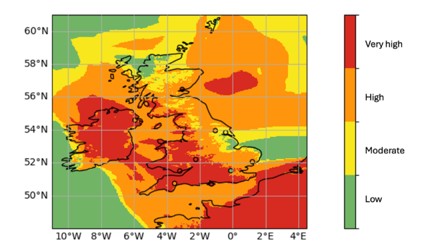
Figure 1: Example output from the Met Office NAME model showing the daily pollen index for the UK on the 14th June 2023. The circles represent the official UK pollen monitoring sites with the local observations overplotted on the NAME model data.
This project is a CENTA Flagship Project.
This project offers a CASE studentship
Each host has a slightly different application process.
Find out how to apply for this studentship.
All applications must include the CENTA application form.
Choose your application route
This project will combine long-term pollen observations, the UK Met Office pollen reanalysis, and meteorological datasets to investigate the drivers of interannual variability in pollen season magnitude. The student will develop and evaluate machine learning methods, including modern deep learning and hybrid statistical approaches, to predict seasonal pollen magnitude in advance of the flowering season. Particular emphasis will be placed on incorporating previous-season biological memory, antecedent meteorological conditions, and other environmental drivers into predictive models. Model explainability techniques will be used to identify the key environmental controls on pollen production and quantify forecast uncertainty. The developed models will be validated against historical observations and assessed for their potential integration into the operational Met Office NAME pollen forecasting system. The project will deliver both improved scientific understanding of interannual pollen variability and practical AI tools to enhance operational pollen forecasting.
DRs will be awarded CENTA Training Credits (CTCs) for participation in CENTA-provided and ‘free choice’ external training. One CTC can be earned per 3 hours training, and DRs must accrue 100 CTCs across the three and a half years of their PhD.
The student will receive interdisciplinary training in machine learning, scientific computing (e.g. Python, R), atmospheric science, and environmental modelling. They will attend University of Birmingham MSc modules and short courses through the Birmingham Institute for Sustainability and Climate Action (BISCA), the Institute for Interdisciplinary Data Science & AI, the Birmingham Environment for Academic Research (BEAR), and the School of Mathematics, including training in explainable AI, scientific machine learning, and high-performance computing. Through joint supervision and placements with the UK Met Office, the student will gain real-world experience in operational environmental forecasting, machine learning, and translating research into operational forecasting systems.
The Met Office will act as the CASE partner, providing supervision, access to unique pollen observations and reanalysis datasets, and expertise in operational pollen forecasting. Professor Francis Pope will provide expertise in atmospheric science and environmental modelling, while Dr Christian Offen will contribute expertise in machine learning and computational mathematics. Building upon the AIPS (Artificial Intelligence for Pollen and Spore Detection) initiative, the student will benefit from collaborations across the University of Birmingham and the Met Office, with strategic input from the Birmingham Institute for Sustainability and Climate Action (BISCA) and the Institute for Interdisciplinary Data Science & AI.
Year 1: Literature review; data preparation; analysis of interannual variability; establish baseline statistical and machine learning models.
Year 2: Develop advanced machine learning models; investigate environmental drivers; Met Office placement; assess forecast skill and investigate integration into the operational NAME pollen forecasting system.
Year 3: Optimise and interpret models; investigate operational implementation within the NAME forecasting system; publications and thesis.
Pollen related papers from the groups of Francis Pope and Lucy Neal:
For any enquiries related to this project please contact Prof. Francis Pope [email protected].
, To apply to this project:
Applications must be submitted by 23:59 GMT on Wednesday 6th January 2027.