

Extreme heat and air pollution are among the leading environmental threats to human health. They frequently occur together, yet their health impacts are still commonly assessed independently. This is important because simultaneous exposure may produce health effects greater than expected from either hazard alone. As climate change intensifies heat extremes and alters patterns of PM2.5 and ozone, understanding these interacting risks is increasingly important for climate adaptation, air-quality management and public-health protection.
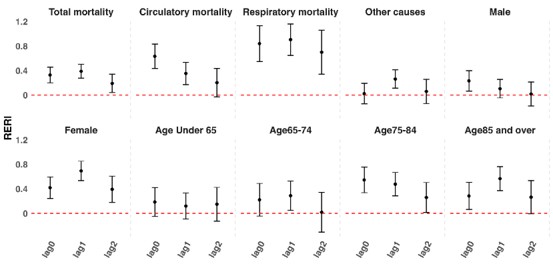
Our recent analysis across England and Wales provides compelling evidence of this interaction. In London, when temperature and PM2.5 simultaneously exceeded their 97.5th percentiles, the relative risk of all-cause mortality reached 1.51, with a relative excess risk due to interaction of 0.33. Synergistic effects were particularly strong for respiratory mortality, while older adults and females showed greater susceptibility (Fig. 1). Importantly, applying London’s higher absolute PM2.5 thresholds to other regions revealed similar synergistic effects where sufficient co-exposure occurred, suggesting that interactions may become especially important once pollution exceeds critical concentrations.
These findings raise an urgent wider question: how important are synergistic heat–air-pollution health risks globally, and how will they change as the climate warms? Existing studies have examined historical interactions or projected future compound events, but a globally consistent framework linking observed synergistic mortality effects with future climate and air-pollution change is currently missing.
This studentship will address this gap through four linked objectives:
By connecting observed health responses with emerging CMIP7 projections, the project will provide a global assessment of compound heat–air-pollution risks from the past through the twenty-first century. It will identify emerging hotspots and vulnerable populations and establish where integrated climate and air-quality interventions can deliver the greatest public-health benefits.
Figure 1. The Relative excess risk due to interaction (RERI) between extreme heat and PM2.5 (97.5th percentile) in London. Results are presented for lags of 0–2 days. Higher RERI estimates were observed for respiratory mortality, for females, and for older age groups, suggesting greater susceptibility in these subpopulations.
This project does not offer a CASE studentship
Each host has a slightly different application process.
Find out how to apply for this studentship.
All applications must include the CENTA application form.
Choose your application route
DRs will be awarded CENTA Training Credits (CTCs) for participation in CENTA-provided and ‘free choice’ external training. One CTC can be earned per 3 hours training, and DRs must accrue 100 CTCs across the three and a half years of their PhD.
Dr Steven Turnock (Met Office Hadley Centre) brings expertise in climate–air-quality interactions, atmospheric composition modelling and the health impacts of air pollution. His recent work has quantified future PM2.5- and ozone-related health burdens under alternative mitigation pathways and examined historical drivers of ozone-related mortality. He is also a contributor to AerChemMIP2, the atmospheric chemistry component of CMIP7, which will provide key future air-quality and climate simulations for this project. Collaboration with the Met Office will provide expertise in CMIP7 interpretation, model evaluation and translation of climate–air-quality projections into policy-relevant health evidence.
Year 1 – Historical synergistic health effects
Compile and harmonise global mortality, temperature, PM2.5 and ozone datasets. Develop and validate the epidemiological framework for estimating individual and synergistic mortality effects, including analyses by age, sex, cause of death and region. Extend the England and Wales analysis to multi-country datasets and identify geographical variation in susceptibility when available. Complete relevant statistical, epidemiological and climate-data training. Output: first paper on historical global heat–air-pollution interactions.
Year 2 – Future compound heat and air pollution
Acquire and evaluate daily temperature, PM2.5 and ozone output from CMIP7. Bias-correct model simulations against observations and characterise historical model performance. Quantify changes in the frequency, intensity, duration and spatial distribution of compound heat–PM2.5 and heat–ozone events under contrasting climate and emission pathways. Output: second paper on future global compound exposure.
Year 3 – Future synergistic mortality risks
Combine CMIP7 projections with epidemiological exposure–response relationships, population projections, demographic change and baseline mortality. Quantify future mortality attributable to heat, air pollution and their interaction, and determine how much risk is missed when hazards are assessed independently. Identify future hotspots and vulnerable populations. Output: third paper on future compound health burdens.
Year 4 – Mitigation, synthesis and policy implications
Evaluate climate, air-quality and integrated mitigation pathways in terms of avoided compound exposure and premature mortality. Where suitable data are available, assess mitigation costs alongside monetised or quantified health benefits to identify cost-effective strategies. Integrate findings across historical and future analyses, undertake uncertainty and sensitivity analyses, engage with relevant stakeholders, and complete thesis writing and dissemination. Output: mitigation/policy paper and PhD thesis.
For any enquiries related to this project please contact:
Zongbo Shi
School of Geography Earth and Environmental Sciences
University of Birmingham
Birmingham
B15 2TT
United Kingdom
Email: [email protected]
Telephone: 01214149128
To apply to this project:
Applications must be submitted by 23:59 GMT on Wednesday 6th January 2027.