

Sharks are a diverse, ecologically important, and vulnerable group of fishes with an ancient history. Although the word shark tends to conjure the image of a primeval apex predator, living elasmobranchs live in open ocean, nearshore, and freshwater habitats worldwide, with ecological roles as diverse as bottom-dwelling suction feeders, open ocean filter feeders, and flat-bodied shell-crunchers. Moreover, far from being primitive this rich biodiversity is rooted in a unique feeding system. Highly mobile jaws made from a specialised calcified cartilage and lined with ever-replacing tooth tows are linked to the skull via ligaments and a rod-like hyoid cartilage which allows them to swing outwards during feeding (Wroe et al. 2008). There is great variation in the shape of shark jaws and presumably their function.
The fossil record of isolated teeth shows that this feeding system extends back least 400 million years, and it has rich potential for understanding the relationship between ecology and evolution (López-Romero et al. 2023). However, understanding it is hindered in living sharks by the difficulty of studying anything but small, shallow-water species, and in extinct sharks by the sparse record of fossilised cartilages. Most functional studies have either focussed on specific taxa with specialised feeding mechanics (e.g. Wroe et al. 2008) or looked at the shape of individual parts of the feeding apparatus across the group (e.g. López-Romero et al. 2023, Griffin et al. 2025). Our understanding of how different jaw arrangements in both living and extinct shark relates to their function is very limited.
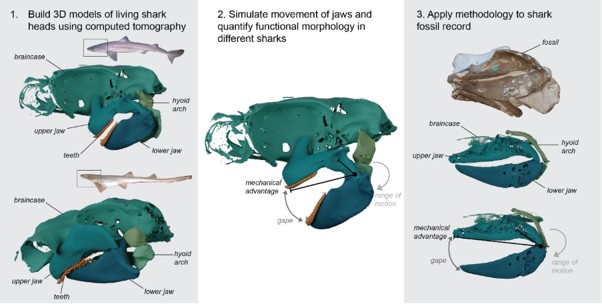
Recently surging use of tomographic methods has seen a huge increase in datasets on the skeletal anatomy of sharks both living and extinct (e.g. Dearden et al. 2025). This presents the opportunity to carry out quantitative, comparative functional morphological studies across the sweep of fossil and living sharks to understand their feeding apparatus as a multipart system. Using computed tomographic data on fossil and living elasmobranchs and multibody dynamics approaches (Lautenschlager 2020, Dearden et al. 2023) this project will investigate how different forms of the living shark feeding system affect its function throughout their long evolutionary history.
Figure 1: Project workflow applied to living and fossil sharks: 1. CT is used to visualise the cranial skeletons in living sharks: a dogfish, Squalus (top), and a bamboo shark, Chiloscyllium (bottom). 2. The Squalus model is used to simulate the mouth opening and measure functional traits. 3. The same approach is applied to the extinct Cretaceous shark Synechodus usimulated. Braincase in turquoise, upper and lower jaws in blue, hyoid arch in green, and teeth in orange.
This project is a CENTA Flagship Project.
This project does not offer a CASE studentship
Each host has a slightly different application process.
Find out how to apply for this studentship.
All applications must include the CENTA application form.
Choose your application route
DRs will be awarded CENTA Training Credits (CTCs) for participation in CENTA-provided and ‘free choice’ external training. One CTC can be earned per 3 hours training, and DRs must accrue 100 CTCs across the three and a half years of their PhD.
The student will be trained in:
Opportunities may also be available to gain teaching and project supervision experience through the undergraduate programmes in Earth Sciences at Birmingham.
NHM will provide access to collections for study, some fossil specimens will be CT scanned at the NHM funded by the RTSG. One of the Co-Is is based at the NHM (fossil fish curator), is expert in the collections there, and will be able to provide logistical help.
Year 1: Data collection and trips to selected museums. Training in fossil anatomy and digital reconstruction techniques. Work on digital reconstructions of cartilages and soft-tissues. Proof-of-concept analysis of subset of shark dataset. Possible conferences: ProgPal (UK), EAVP (Europe).
Year 2: Further digital reconstructions of cartilages and generation of biomechanical models. Collection of comparative anatomical, ecological, and environmental information from published literature and relevant databases. Possible submission of first publication. Work on disparity and PCM analyses. Possible conferences: PalAss Annual meeting (UK), EAVP (Europe).
Year 3: Final biomechanical analyses and compilation of results. Completion of diversity and disparity analyses. Compilation of biomechanical, ecological, and environmental results. Ongoing publication of results. Write up and submission of thesis. Conferences: PalAss Annual meeting (UK), SVPCA (UK), SVP (USA).
Dearden, R.P., Herrel, A. and Pradel, A. (2023) Evidence for high-performance suction feeding in the Pennsylvanian stem-group holocephalan Iniopera, Proceedings of the National Academy of Sciences of the United States of America, 120(4), pp. 1–8. https://doi.org/10.1073/pnas.2207854119.
Dearden R.P., Johanson, Z., O’Neill, H.L., Miles, K., Bernard, E.L., Clark, B., Underwood, C., and Rücklin, M. (2025) Three-dimensional fossils of a Cretaceous collared carpet shark (Parascylliidae, Orectolobiformes) shed light on skeletal evolution in galeomorphs, Royal Society Open Science, 12(4). https://doi.org/10.1098/rsos.242011.
Griffin B.W., Keating J.N., Carmona P.M., Johanson Z., Dearden R.P., Donoghue P.C.J., and Rayfield E.J. (2025) Evolution of chondrichthyan jaw morphology, from ecological generalists to specialists, Paleobiology. https://doi.org/10.1017/pab.2025.10077.
Lautenschlager, S. (2020) Multibody dynamics analysis as a numerical modelling tool to reconstruct the function and palaeobiology of extinct organisms, Palaeontology, pp. 1–13. https://doi.org/10.1111/pala.12501.
López-Romero, F.A. , Stumpf, S., Kamminga, P., Böhmer, C., Pradel, A., Brazeau, M., Kriwet, J. (2023) Shark mandible evolution reveals patterns of trophic and habitat-mediated diversification, Communications Biology, 6(1), pp. 1–13. https://doi.org/10.1038/s42003-023-04882-3.
Wroe, S., Huber, D., Lowry, M., McHenry, C., Moreno, K., Clausen, P., Ferrara, T., Cunningham, E., Dean, M., Summers, A. (2008) Three-dimensional computer analysis of white shark jaw mechanics: How hard can a great white bite?, Journal of Zoology, 276(4), pp. 336–342. https://doi.org/10.1111/j.1469-7998.2008.00494.x.
For any enquiries related to this project please contact Richard Dearden, [email protected]k.
To apply to this project:
Applications must be submitted by 23:59 GMT on Wednesday 6th January 2027.