

Ray-finned fishes (Actinopterygii) are the most diverse group of vertebrates, accounting for over half of the >60,000 living vertebrate species. Although the group originated in the Devonian, most taxa from this period are morphologically conservative in overall size and shape, with very few exceptions. Ray-finned fishes exploded in taxonomic and morphological diversity in the Carboniferous, after the End-Devonian Mass Extinction, including the proliferation of diverse feeding strategies. This increase in morphological diversity and taxonomic richness has been interpreted as an adaptive radiation. Notable among these new forms are predatory, large-bodied, large-toothed ‘macrodont’ forms, an ecological category that is very rare in the Devonian. Despite an abundance of three-dimensional fossils, the anatomy and relationships of these macrodonts is poorly understood, presenting a barrier to understanding the evolutionary history of this specialised ecological role. A confused picture of relationships between lineages before and after the End-Devonian Mass Extinction also obscures patterns of survivorship and radiation. CT scanning will be used to target key taxa in order to resolve questions of phylogenetic affinity, clarifying whether the macrodont morphotype arose multiple times during the Palaeozoic diversification of actinopterygians and the innovations leading to their radiation. Although united by a common morphotype, different macrodont taxa show different specialisations of the teeth, jaws and internal cranial skeleton, hinting at varied ecological roles. Compilation of important geographic and environmental data will be used to investigate macroevolutionary patterns of dispersal and ecological expansion, including the contribution of macrodont actinopterygians to global trophic networks. In addition to resolving the long-standing puzzle of macrodont relationships, this project will have implications for understanding the radiation of actinopterygians in the aftermath of the End-Devonian Mass Extinction, building on the emerging picture of a more complicated pattern of extinction and recovery than previously thought.
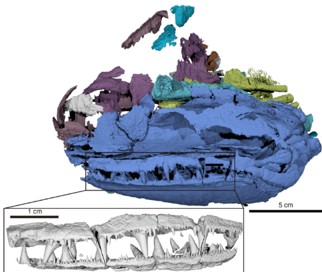
Figure 1: CT scan render of the skull and jaws of a Carboniferous macrodont actinopterygian.
This project does not offer a CASE studentship
Each host has a slightly different application process.
Find out how to apply for this studentship.
All applications must include the CENTA application form.
Choose your application route
This project incorporates descriptive, phylogenetic and quantitative techniques. Fossil taxa will be examined through a combination of traditional description and computed tomography (CT) scanning. The latter allows the internal and external anatomy of specimens to be investigated in a non-destructive manner. Three-dimensionally and exceptionally preserved taxa will be investigated using CT scanning. This new anatomical data will be incorporated into recent schemes of actinopterygian phylogeny, with maximum parsimony and Bayesian analysis used to investigate their position in the ray-finned fish tree of life. Macroevolutionary methods will be used to investigate broader patterns of evolution and dispersal.
DRs will be awarded CENTA Training Credits (CTCs) for participation in CENTA-provided and ‘free choice’ external training. One CTC can be earned per 3 hours training, and DRs must accrue 100 CTCs across the three and a half years of their PhD.
The student will be trained in CT scanning and segmentation, comparative anatomy and description, systematics and phylogenetic techniques (including parsimony and Bayesian analyses), quantitative techniques and comparative biology. The student will also receive training in how to write and illustrate scientific papers, apply for grants and prizes, present work at conferences and scientific meetings, and network with peers and other scientists. There may also be opportunities for undergraduate teaching and research supervision. These form the basis of an outstanding skill set, combining traditional and state- of-the-art techniques, that will facilitate a successful research career for an outstanding student.
This project will be carried out in collaboration with the University of Michigan. Prof Matt Friedman will provide additional supervision. Prof Friedman has extensive experience of CT scanning and anatomical interpretation and will assist the student in these areas.
Year 1: Literature review, CT scanning and segmenting, comparative anatomy
Year 2: Phylogenetic analysis, databasing of traits and biogeography.
Year 3:, synthesis, completing thesis, writing manuscripts (although manuscripts will be written throughout project).
Giles, S., Feilich, K., Warnock, R. C. M., and Friedman, M. (2023) ‘A Late Devonian actinopterygian suggests high lineage survivorship across the end-Devonian mass extinction’. Nature Ecology & Evolution, 7(1), pp.10-19.
Figueroa, R. T., and Andrews, J. V. (2023). Fitting fangs in a finite face: A novel fang accommodation strategy in a 280‐million‐year‐old ray‐finned fish. Journal of Anatomy, 242(3), pp. 525-534.
Friedman, M., Figueroa, R. T., Hodnett, J. P. M., Lucas, S. G., Higgins, R. R., Pierce, S., and Giles, S. (2024). A new genus and species of large macrodont actinopterygian from the Pennsylvanian (Kasimovian/Missourian) Atrasado Formation of New Mexico. Contributions from the Museum of Paleontology, 36(2), 8-42.
For any enquiries related to this project please contact Sam Giles, [email protected].
To apply to this project:
Applications must be submitted by 23:59 GMT on Wednesday 6th January 2027.