

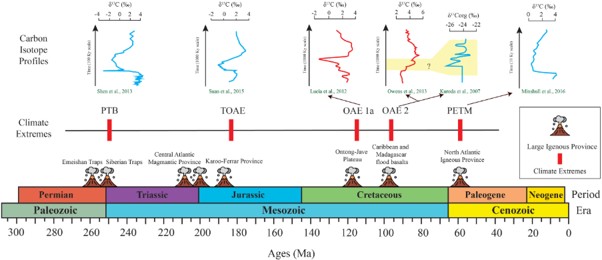
Past rapid climate change events like the end-Permian mass extinction, the end-Triassic mass extinction, the Paleocene-Eocene Thermal Maximum, and many of the Mesozoic Oceanic Anoxic Events constitute some of the best analogues we have for anthropogenic climate change. These events feature some combination of rising atmospheric CO2, global warming, ocean acidification, and a negative carbon isotope excursion – all the hallmark signs of massive rapid emissions of carbon-based greenhouse gases to the atmosphere. The suspected trigger for these events is the coincident emplacement of large igneous provinces (LIPs); the intrusion of LIP magma into sedimentary rock is thought to be capable of generating massive quantities of greenhouse gases like thermogenic methane. However, when magma intrudes into sedimentary rock of various compositions it is still uncertain exactly which greenhouse gases are produced (e.g., methane vs. CO2) and in what quantities. Furthermore, the carbon isotopic composition of these gases is very poorly constrained. Carbon isotopes records (e.g. Fig. 1) show the net behaviour of the global carbon cycle across these past carbon cycle perturbation events. Knowing the mass and isotopic composition of LIP carbon emissions are critical to constraining Earth’s carbon cycle response – e.g., the short-term release of additional carbon as a response to the warming climate (positive feedbacks) and the longer-term subsequent carbon burial, cooling and restoring the climate (negative feedbacks).
In this project, you will conduct laboratory experiments subjecting a range of sedimentary host rocks to artificial thermal maturation to recreate the temperature and pressure conditions caused by magmatic intrusion. Your samples will include real exemplars of the host rocks into which the aforementioned LIPs were actually intruded. You will collect the thermogenic gases that result from this experimental maturation and measure the yields of the various gas types as well as their carbon isotopic compositions. Lastly, using numerical modelling, you will use your experimental results to make some predictions of the carbon emissions from several past LIPs, thereby constraining the Earth system carbon cycle response. Depending on the interests of the appointed candidate, the project could lean more heavily towards hands-on laboratory work or applying numerical modelling techniques.
Figure 1: Hyperthermal events, coincident large igneous provinces, and their typical seawater carbon isotope pattern from the Mesozoic to Paleogene. Zhang et al., 2023. https://doi.org/10.3389/fevo.2023.1226349
This project does not offer a CASE studentship
Each host has a slightly different application process.
Find out how to apply for this studentship.
All applications must include the CENTA application form.
Choose your application route
The British Geological Survey (BGS) has extensive samples of actual host rocks intruded by various LIPs. Working with the BGS, you will identify appropriate samples, including measuring vitrinite reflectance to ascertain thermal maturity. There is also the possibility of collecting additional samples in the field to supplement that which you find at the BGS. At the University of Nottingham, you will perform the pyrolysis experiments to mimic the temperature and pressure conditions of magma intrusion and collect the resulting thermogenic carbon-based gases; the carbon isotopic composition of these gases will be determined at the BGS. At the University of Birmingham, you will learn numerical modelling techniques to turn these hard-won laboratory data into predictions of the carbon emissions from past LIPs and/or the resulting carbon cycle feedbacks. This project could lean more towards hands on experimental work or numerical modelling, depending on the interests of the successful applicant.
DRs will be awarded CENTA Training Credits (CTCs) for participation in CENTA-provided and ‘free choice’ external training. One CTC can be earned per 3 hours training, and DRs must accrue 100 CTCs across the three and a half years of their PhD.
The supervisory team will provide training to undertake all aspects of this PhD. The lab techniques include measuring vitrinite reflectance, conducting pyrolysis experiments, measuring bulk rock carbon content and isotopic composition and the carbon isotopic composition of thermogenic gases. We can also provide training in various types of numerical modelling to interpret and extract maximum value from hard-won laboratory data. There are also opportunities to develop skills in science communication, public engagement, and community organising by getting involved in ongoing projects in the lead supervisor’s lab group as well as ample opportunities for developing classroom and field-based teaching skills.
The supervisory team includes Prof Sarah Greene and Dr Stephen Jones at the University of Birmingham, Dr Will Meredith, Prof Colin Snape, and Dr Clement Uguna at the University of Nottingham, and Jan Hennissen and Andrew Smith at the British Geological Survey.
Year 1: Identify appropriate samples at BGS and collect background geochemical composition data ahead of thermal maturation.
Year 2: Experimental maturation (pyrolysis) of selected samples. Possible fieldwork to collect any additional samples as needed.
Year 3: Apply numerical modelling techniques to interpret laboratory thermal maturation data. Writing up of results and presenting at conferences.
Clapham, M.E. and Renne, P.R., 2019. Flood basalts and mass extinctions. Annual Review of Earth and Planetary Sciences, 47(1), pp.275-303.
Jones, S.M., Hoggett, M., Greene, S.E. and Dunkley Jones, T., 2019. Large Igneous Province thermogenic greenhouse gas flux could have initiated Paleocene-Eocene Thermal Maximum climate change. Nature communications, 10(1), p.5547.
Vervoort, P., Adloff, M., Greene, S.E. and Kirtland Turner, S., 2019. Negative carbon isotope excursions: an interpretive framework. Environmental Research Letters, 14(8), p.085014.
Prospective applicants please contact me (Sarah Greene – [email protected]) in advance of applying. You are very welcome to ask questions about the project, to discuss whether working with me on this project at the University of Birmingham is a good fit for you, or to ask advice about putting together a strong application. I am also happy to put you in contact with my current and former students to ask questions about their experiences.
To apply to this project:
Applications must be submitted by 23:59 GMT on Wednesday 6th January 2027.