

Throughout Earth’s history, episodic Large Igneous Provinces (LIPs) coincide with environmental crises including mass extinction, global warming and oceanic anoxia events. We cannot explain this coincidence because we do not know how LIPs that span 10 million years can trigger environmental crises that span 10 to 100 thousand years. Consequently, short environmental crises are often attributed to climate system tipping behaviour, when slow LIP magma and greenhouse gas emissions build to some critical threshold. This project investigates the alternative proposition that LIP magma and greenhouse gas emissions occur fast enough to explain the environmental crises directly, without climate system tipping.
Growing evidence suggests that LIP activity is strongly pulsed. The Birmingham-led IMPULSE project recently presented the most compelling evidence to date for pulsing within the Icelandic mantle plume from its inception to the present (Jones et al. 2026). A strong pulse of magma generated by the same mantle convection system could explain the Paleocene-Eocene Thermal Maximum global climate change event that accompanied the North Atlantic LIP (Jones et al. 2019; Voosen 2026). In parallel, high-resolution radiometric dating of the Deccan Traps LIP shows that a pulse of volcanic eruption spanning approximately 100 thousand years occurred immediately before the end-Cretaceous mass extinction (Schoene et al. 2019).
Figure 1: Conceptual model for how mantle plume pulsing might generate a short burst of greenhouse gas emissions. The sharpness of the leading edge of the hot blob is a key control on the timeframe of magma generation and consequent emissions. Modified from Jones et al. (2019).
This project does not offer a CASE studentship
Each host has a slightly different application process.
Find out how to apply for this studentship.
All applications must include the CENTA application form.
Choose your application route
The project will begin by gathering a comprehensive database to constrain temporal variations in volcanism within multiple LIPs. Datasets will include radiometric ages from LIP continental flood basalt lavas and shallow intrusions, as well as seismic records of variation in oceanic crustal thickness. We will use stochastic modelling techniques to calculate curves of magma volume through time for each LIP with uncertainty bounds, and compare the time-volume curves for different LIPs to establish the fundamental timescale(s) of volcanic pulsing.
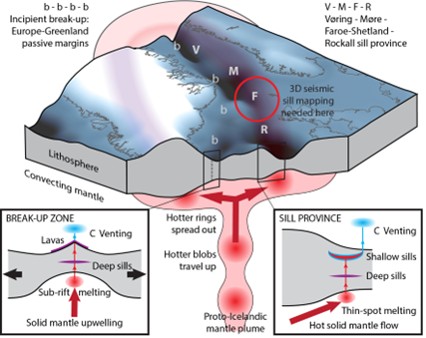
The second stage consider the process which generates the pulses. We will focus on developing a numerical model for lithospheric thin spot melting to test whether observed pulsing trends can be explained by this mechanism (Figure 1). We will also consider alternative hypotheses that pulsing trends result from magma transport or eruption processes.
DRs will be awarded CENTA Training Credits (CTCs) for participation in CENTA-provided and ‘free choice’ external training. One CTC can be earned per 3 hours training, and DRs must accrue 100 CTCs across the three and a half years of their PhD.
The project would suit a graduate with a range of physical science backgrounds including (but not limited to) Geology, Physical Geography, Geophysics, Physics. This is primarily a desk-based project involving computer modelling: enthusiasm for coding is essential, and prior experience (especially in Python) is advantageous, though training will be provided as required. To balance the desk-based day-to-day work, we also offer the opportunity to participate in ship-based fieldwork on several forthcoming expeditions to Iceland and the surrounding seas, providing experience in a range of geophysical, oceanographical and sedimentological techniques, as well as science communication and outreach.
Year 1: Additional training in coding if needed. Assemble LIP age / volume database for multiple LIPs. Stochastic modelling to calculate uncertainty-bounded volume-time curves. Compare curves from different LIPs to establish global trends.
Year 2: Draft paper on characteristic timescales of LIP volcanic pulsing, and associated conference presentations. Training in ASPECT mantle convection software. Development of numerical thin-spot melting model.
Year 3: Assess hypotheses to explain global pulsing patterns. Draft paper and associated conference presentations. Prepare and submit PhD dissertation.
Jones, S.M., Dhabaria, N., Henstock, T., White, N. (2026) ‘The IMPULSE experiment: New oceanic crustal record of thermal plume pulsing of Earth’s strongest mantle plume’. EGU General Assembly 2026, Vienna, Austria, 3–8 May 2026, EGU26-14092, https://doi.org/10.5194/egusphere-egu26-14092.
Jones S.M., Hoggett, M., Greene S., Dunkley Jones, T. (2019) ‘Large Igneous Province thermogenic greenhouse gas flux could have initiated Paleocene-Eocene Thermal Maximum climate change’. Nature Communications 10, 5547 (2019) https://doi.org/10.1038/s41467-019-12957-1.
Schoene, B., Eddy, M.P., Samperton, K.M., Keller, C.B., Keller, G., Adatte, T., Khadr, S.F. (2019) ‘U-Pb constraints on pulsed eruption of the Deccan Traps across the end-Cretaceous mass extinction’. Science 363, 862–866, https://doi.org/10.1126/science.aau2422.
Voosen, P. (2026) ‘Surveys capture the pulsing of mantle plumes—a potential cause of mass extinctions’. Science, news article published online 27 May 2026, https://doi.org/10.1126/science.zp9oqd6.
Prospective applicants are positively encouraged to contact Steve Jones ([email protected]) in advance of applying to ask questions about the project, discuss whether working with us on this project at the University of Birmingham is a good fit for you, or to ask questions about putting together a strong application. We are also happy to put you in contact with current and former students to ask questions about their experiences.
To apply to this project:
Applications must be submitted by 23:59 GMT on Wednesday 6th January 2027.