

Global air temperatures and the occurrence of heatwaves are increasing and set to continue over the coming century. Plant physiological processes such as photosynthesis are highly temperature sensitive and therefore there are significant potential consequences of climate change for plant function. Tropical forests are essential ecosystems for the safe operating of the planet due to their role in the carbon and water cycles and high biodiversity. Long-lived species such as trees will be exposed to extreme climatic conditions within their lifetimes. This project will assess the thermal sensitivity of tropical tree species in West Africa using an array of novel methods, to inform on the potential future functioning of tropical forest systems.
The objectives of this project are:
O1 To determine seasonal change in canopy temperature and thermal sensitivity of leaf physiology of West African moist tropical tree species, including assessing the importance of leaf and crown traits on canopy temperatures.
O2 To assess the acclimation of West African tree species to climatic change over the past decades in leaf temperature regulation traits and estimated leaf temperatures.
O3 To assess change in tree species composition of West African forests in relation to measured thermal sensitivity.
The project benefits from planned and previous data collection, including 1 year of continuous canopy temperature monitoring data from 2023 and field campaigns measuring thermal physiology and drone-based canopy temperature in two sites in autumn 2026. This PhD project will have access to and extend these datasets to assess seasonal change in thermal vulnerability. It is envisaged that the student will carry out one extended trip to Ghana, during which they will undertake field campaigns under differing seasonal conditions (dry and wet), and spend time analysing locally stored herbarium samples.
This project will offer the opportunity to develop skills in the use of environmental sensors including drones, field measurements of tree physiology, and use of historical archived plant material. The student will work with experts from a range of institutions enabling development of a broad research network and will be supported by the Birmingham Institute for Forest Research (BIFoR).
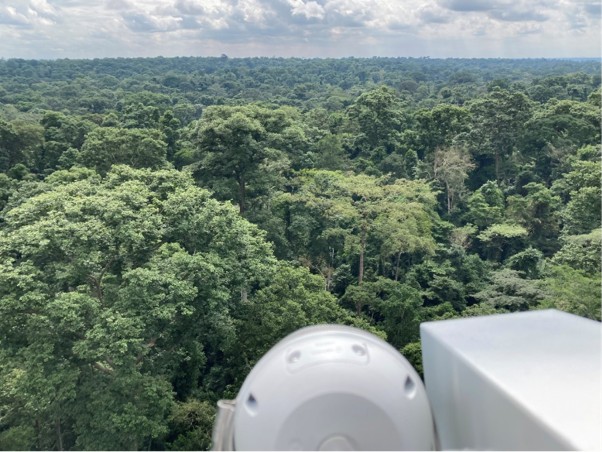
Figure 1: View of Bobiri Forest Reserve, Ghana, with thermal and visible light cameras (W. Hagan Brown).
This project does not offer a CASE studentship
Each host has a slightly different application process.
Find out how to apply for this studentship.
All applications must include the CENTA application form.
Choose your application route
To assess patterns of canopy temperature, thermal imaging will be used. This will be captured using both a fixed camera to assess temporal patterns, and drone surveys to assess the canopy temperatures of a larger number of individuals of the study species. Drone surveys will also measure canopy structure to assess the relative importance of crown and leaf traits for controlling canopy temperature.
To assess long-term response to warming conditions, archived leaf samples will be measured for key traits of leaf size and stomatal morphology. Collections from RBG Kew and local collections at the Forestry Research Institute of Ghana and Ghana Herbarium will be used for the study, with collections dating back to the early 1900s.
Forest inventory data dating back to the early 1990s will be used to assess if there have been measurable changes in the abundance of species or functional groups related to their thermal vulnerability.
DRs will be awarded CENTA Training Credits (CTCs) for participation in CENTA-provided and ‘free choice’ external training. One CTC can be earned per 3 hours training, and DRs must accrue 100 CTCs across the three and a half years of their PhD.
The student will be trained in the use of environmental sensors including a thermal camera and weather station that can be accessed remotely, and drones for environmental research. The student will develop skills in plant physiological measurements including gas exchange and plant functional traits. The student will spend time at RBG Kew to learn how to access and analyse archived plant material. Data analysis training will be provided to cover the range of data used in the PhD. This will include programming to analyse large image datasets and detailed meteorological datasets, as well as the analysis of forest inventory data.
The project is supported by multiple institutions giving the student access to a range of experts and research communities. Key partners are the CSIR-Forestry Research Institute of Ghana (CSIR-FORIG) which manage the research area of Bobiri Forest Reserve, a key field site, and host their own herbarium. CSIR-FORIG will host the student and assist with provision of a field team. Kew will host the student and provide access and training on the use of archived plant material, prior to the extended field visit to Ghana which will include time spent working with local herbarium samples.
Year 1: Literature review, training visit to RBG Kew and begin archival data collection, training on field methods, request forest inventory data via ForestPlots.net and with Ghanaian collaborators.
Year 2: One extended field visit to Ghana to conduct field campaigns and work with local herbaria.
Year 3: Data analysis and write up.
Docherty et al. 2022 Long-term drought effects on the thermal sensitivity of Amazon forest trees. Plant Cell Environment, 6:185–198 DOI: https://doi.org/10.1111/pce.14465
Doughty et al. 2023. Tropical forests are approaching critical temperature thresholds. Nature 621:105–111. DOI: 10.1038/s41586-023-06391-z
Fortier et al. 2026. Individual Trees Respond to 40 Years of Climate Change Through Leaf Functional Trait Acclimation. Global Change Biology, 32:e70978 DOI: 10.1111/gcb.70978
Hagan Brown et al. 2025 Elevated CO2 Increases the Canopy Temperature of Mature Quercus robur (Pedunculate Oak). Global Change Biology, 31, e70565 DOI: 10.1111/gcb.70565
For any enquiries related to this project please contact Sophie Fauset, [email protected].
To apply to this project:
Applications must be submitted by 23:59 GMT on Wednesday 6th January 2027.