

Climate change is accelerating sea-level rise, increasing saltwater intrusion into coastal wetlands and exposing mangrove ecosystems to increasingly saline conditions (Acosta-Motos et al., 2017; Dessu et al., 2018). Mangroves occupy the interface between terrestrial and marine environments, making them particularly vulnerable to changes in hydrology driven by rising sea levels and reduced freshwater inflows. Although most mangrove species are naturally salt-tolerant, increasing salinity can alter soil water availability and threatens the ecological functioning of these ecosystems. These changes may reduce forest productivity and impact the ecosystem services mangroves provide, including carbon sequestration, coastal protection, and nursery habitat for marine biodiversity. Thus, understanding how mangroves respond to increasing salinity is essential for predicting the resilience of coastal ecosystems.
Salinity directly affects plant water relations by reducing the osmotic potential of soil water (Parihar et al., 2015), making water uptake increasingly difficult. To maintain water transport, mangroves employ a range of physiological adaptations, including osmotic adjustment, allowing leaves to maintain turgor under saline conditions (Suárez & Sobrado, 2000). However, these adjustments often come at a physiological cost: declining leaf water potential increases the risk of hydraulic failure, which can lead stomata to close to minimise water loss and prevent embolism. In turn, stomatal closure reduces CO2 uptake, limiting growth. The balance between maintaining hydraulic function and sustaining carbon gain therefore represents a key challenge for mangroves exposed to increasing salinity.
Responses to salinity vary considerably among mangrove species, developmental stages, concentration and the duration of exposure. Seedlings are particularly vulnerable due to their limited root systems while mature trees possess more developed hydraulic systems and greater physiological plasticity. Yet, they may still experience reductions in gas exchange and carbon assimilation under prolonged salinity stress (Clough & Sim, 1989). Despite growing recognition of salinity as a major consequence of climate change, understanding how increasing salinity influences leaf-level carbon and water dynamics across different life stages of mangroves remains a critical gap. This PhD project aims to address this gap by investigating how salinity alters leaf physiology in both mangrove seedlings and mature trees, improving predictions of mangrove resilience, restoration and future carbon storage under rising sea levels.
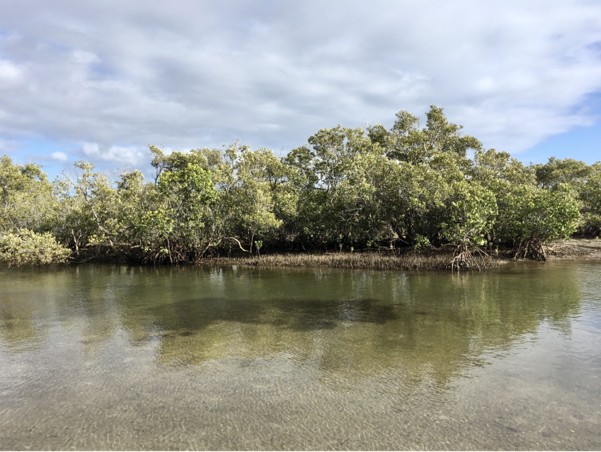
Figure 1: View of mangrove forest in Australia (credit: Alice Gauthey) showing Rhizophera spp. growing close to the water using aerial roots.
This project does not offer a CASE studentship
Each host has a slightly different application process.
Find out how to apply for this studentship.
All applications must include the CENTA application form.
Choose your application route
Gas exchange (carbon uptake/photosynthesis and water loss/stomatal conductance) will be measured with a LI-6800 at the mangrove forests in the Everglades at the FCE-LTER on (1) adult trees and (2) newly planted seedlings. These measurements will be used to quantify how salinity affects carbon gain and water use across different life stages. Concomitantly, measurements of canopy temperature and spectral reflectance will be taken through drone imaging. These measurements will then assess whether physiological responses to salinity can be detected at the canopy scale to detect thermal and drought stress.
In a second part, a glasshouse experiment will be performed. Seedlings of different mangrove species exhibiting contrasting water-use strategies will be grown under different salinity, temperatures and water regimes. Photosynthesis and stomatal conductance will be measured and be supplemented by measurements of leaf morphological and anatomical traits to determine mechanisms underlying differences in salinity tolerance.
DRs will be awarded CENTA Training Credits (CTCs) for participation in CENTA-provided and ‘free choice’ external training. One CTC can be earned per 3 hours training, and DRs must accrue 100 CTCs across the three and a half years of their PhD.
The student will be trained in (1) methods used to measure plant physiological traits (i.e. gas exchange), (2) plant hydraulic traits and water relations and (3) remote sensing techniques including UAV-based thermal and hyperspectral imaging. Both PIs are experts in plant ecophysiology and plant hydraulics and have established collaborations with colleagues managing or working on remote field sites. The student will benefit from this international research network, developing skills in fieldwork, experimental design, data analysis and scientific communication, alongside experience working with interdisciplinary and international collaborators.
Year 1:
Year 2:
Year 3:
Acosta-Motos JR, Ortuño MF, Bernal-Vicente A, Diaz-Vivancos P, Sanchez-Blanco MJ, Hernandez JA. 2017. Plant Responses to Salt Stress: Adaptive Mechanisms. Agronomy 7: 18.
Clough BF, Sim RG. 1989. Changes in gas exchange characteristics and water use efficiency of mangroves in response to salinity and vapour pressure deficit. Oecologia 79: 38–44.
Dessu SB, Price RM, Troxler TG, Kominoski JS. 2018. Effects of sea-level rise and freshwater management on long-term water levels and water quality in the Florida Coastal Everglades. Journal of Environmental Management 211: 164–176.
Parihar P, Singh S, Singh R, Singh VP, Prasad SM. 2015. Effect of salinity stress on plants and its tolerance strategies: a review. Environmental Science and Pollution Research 22: 4056–4075.
Suárez N, Sobrado MA. 2000. Adjustments in leaf water relations of mangrove (Avicennia germinans) seedlings grown in a salinity gradient. Tree Physiology 20: 277–282.
For any enquiries related to this project please contact Dr. Alice Gauthey ([email protected]); Dr. Anna Gardner ([email protected]).
To apply to this project:
Applications must be submitted by 23:59 GMT on Wednesday 6th January 2027.