

Climate change is exacerbating high river water temperature extremes by increasing energy (heat) inputs and drought (low flow) severities (1), which has significant implications for nature and people (2,3). Groundwater resources are more buffered from warm climatic conditions, and when these feed into rivers can provide critical cooler refuges required by instream flora and fauna (1). While these subsurface inputs can promote the resilience of freshwater ecosystems to hydroclimate changes, the warming of groundwater-dominated river systems could threaten species dependent on cooler waters – including salmonids (e.g., Brown trout, Atlantic salmon) of high socioeconomic importance (1,3).
This PhD will develop a detailed understanding of river temperature dynamics across studied watercourses and how this shapes ecological health. This will be achieved by combining long-term secondary datasets and fieldwork monitoring and embedding this information within process-based and statistical modelling capabilities. The candidate will design models under supportive supervision that will predict thermal changes to hypothetical scenarios (e.g., climate change, planting designs) and ecological responses to this.
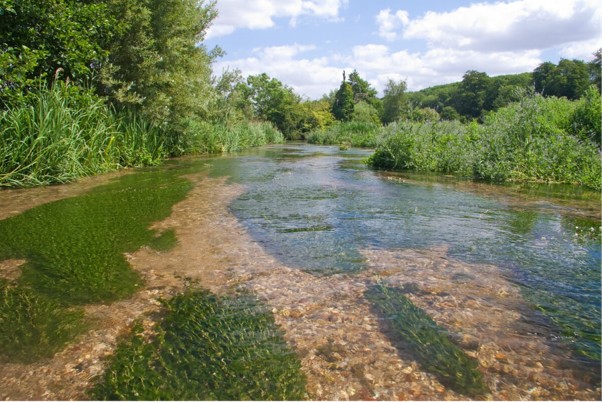
This research will take place in “chalk” (a fine-powdered limestone) rivers across the Chilterns ‘Area Of Outstanding Natural Beauty’. Over 80% of the world’s chalk rivers are located in England and are internationally recognised due to their “gin clear” waters that creates distinct ecological communities (4). Cool waters facilitated by groundwater inputs regionally are being masked by anthropogenic pressures like sewage treatment works and urban runoff, and management interventions like tree planting are being considered to help offset warming influences (4).
The successful candidate will draw on the expertise of the interdisciplinary supervisory team, who specialise in river-based processes and translating scientific research to management solutions (5, 6). The project will benefit from long-term temperature and ecological datasets provided by project partners, which the student would complement with tailored fieldwork campaigns in these iconic and “beautiful” river environments. This applied research will have real-world implications, where the student would work with the Chilterns National Landscape to help guide management interventions.
Figure 1: A chalk river with their characteristic clear waters and macrophyte assemblages. (Photo credit: Chiltern Chalk Streams Project).
This project is a CENTA Flagship Project.
This project does not offer a CASE studentship
Each host has a slightly different application process.
Find out how to apply for this studentship.
All applications must include the CENTA application form.
Choose your application route
Long-term river temperature and ecological datasets will be leveraged from the Chilterns Chalk Streams Project and the Environment Agency (‘Surface Water Temperature Archive’, ‘Ecology and Fish Data Explorer’). The candidate will complement these with a bespoke fieldwork monitoring strategy. From these observations, they will develop a river temperature model for chalk streams in the Chiltern area, where a process-based approach incorporating heat energy exchanges will be used alongside statistical techniques (e.g., AI approaches like neural networks) to optimise their effectiveness and transferability (1). Statistical models will be constructed using state-of-the-art (e.g., machine learning) techniques to quantify the sensitivity of different c to changing thermal dynamics. UKCP18 climate change scenarios will be fed in to both thermal and statistical models, the outcomes of which will be shared with regional stakeholders to help ‘future proof’ management interventions capable of conserving these fragile watercourses.
DRs will be awarded CENTA Training Credits (CTCs) for participation in CENTA-provided and ‘free choice’ external training. One CTC can be earned per 3 hours training, and DRs must accrue 100 CTCs across the three and a half years of their PhD.
The supervisory team will equip the candidate with an interdisciplinary knowledgebase and skillset. Training will be provided in skills relating to ‘big data’ processing and management, complex statistical analyses, environmental modelling and fieldwork skills centred on monitoring river temperature, water chemistry and ecological communities. The skillset that the student will assimilate during the PhD and the applied research they will deliver will be beneficial for both academic and industrial career pathways. The supervisory team will support activities such as writing peer reviewed journals or reports for regional stakeholders that the student can prioritise in accordance with their career aspirations.
The Centre for Ecology and Hydrology will provide invaluable expertise and guidance on hydrological processes and modelling that will help capture flow-related effects on river temperature. The research will align with CEH’s ‘Floods and Drought Research Infrastructure’ that is also examining the Chess catchment in the Chilterns area. The Chilterns National Landscape will support the project by providing long-term data and regional expertise, and also help translate the findings into real world action.
Year 1:
Year 2:
Year 3:
Year 4 (half year):
(1) White, J. C., Khamis K., Dugdale S., Jackson, F. L., Malcolm, I. A., Krause, S. and Hannah, D. M. (2023) Drought impacts on river water temperature: a process-based understanding from temperate climates. Hydrological Processes, 37(10), e14958.
(2) Ficklin, D.L., Hannah, D.M., Wanders, N., Dugdale, S.J., England, J., Klaus, J., Kelleher, C., Khamis, K. and Charlton, M.B. (2023) Rethinking river water temperature in a changing, human-dominated world. Nature Water, 1(2), pp.125-128.
(3) Johnson, M.F., Albertson, L.K., Algar, A.C., Dugdale, S.J., Edwards, P., England, J., Gibbins, C., Kazama, S., Komori, D., MacColl, A.D. and Scholl, E.A. (2024) Rising water temperature in rivers: Ecological impacts and future resilience. Wiley Interdisciplinary Reviews: Water, 11(4), p.e1724.
(4) Heppell, K. (2022) A baseline assessment of water quality in the River Chess. Retrieved online via <https://chesssmarterwatercatchment.org/wp-content/uploads/sites/7/2023/07/Water-quality-baseline-assessment-FINAL-signed-compressed-2.pdf> [Accessed 18/09/2026].
(5) Jackson, F.L., Hannah, D.M., Ouellet, V. and Malcolm, I.A. (2021) A deterministic river temperature model to prioritize management of riparian woodlands to reduce summer maximum river temperatures. Hydrological Processes, 35(8), p.e14314.
(6) England, J., Naura, M., Mant, J. and Skinner, K. (2020) Seeking river restoration appraisal best practice: Supporting wider national and international environmental goals. Water and Environment Journal, 34, pp.1003-1011.
For any enquiries related to this project please contact Prof. David Hannah ([email protected]).
To apply to this project:
Applications must be submitted by 23:59 GMT on Wednesday 6th January 2027.