

Peatlands are among the UK’s most important carbon stores. However, many peatlands have been degraded, leaving them vulnerable to drought and wildfire. Indeed, 2026 saw some of the most severe wildfires ever recorded in the UK, burning through peatland landscapes and pushing wildfire to the top of the environmental policy agenda. At the same time, peatland rewetting is being rolled out across the UK as a flagship nature-based solution, promoted as a means of improving ecosystem resilience, shifting peatland community composition, protecting carbon stores and reducing wildfire risk. Yet there is substantial debate about how effective rewetting is at reducing wildfire risk during the very conditions when fires occur: severe droughts and heatwaves, when water tables may be deep below the peat surface and the moss, litter and canopy fuels may still become dry.
Current debate has focused heavily on peat water tables, Sphagnum and ground fuel moisture. These are critical for peat combustion and fire severity, but they do not fully explain wildfire spread in heather-dominated peatlands. In many UK peatland landscapes, wildfires are carried predominantly through the heather canopy. Therefore, the key question is not only whether rewetting keeps the peat wet, but whether it keeps the rooting zone wet enough for heather to maintain live canopy moisture during extreme fire weather.
Recent observations during the July 2022 heatwave and subsequent drought experiments show that live heather canopy moisture can fall to levels well below critical ignition thresholds. Evidence also suggests that chronic soil drought, rather than short-lived atmospheric heat alone, may be a major atmospheric control on live heather moisture. This raises a critical and unresolved question that REWET-FIRE will address: can rewetting maintain sufficient soil water availability within the heather rooting zone to prevent extreme declines in live fuel moisture during severe summer drought? This is a rare opportunity to shape the evidence base behind one of the UK’s biggest land management interventions at a critical turning point for wildfire management in the UK.
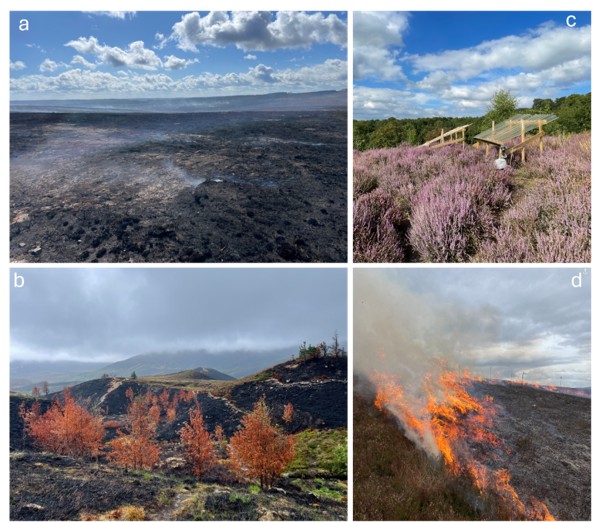
Fig 1: Post-wildfire landscape photos of Langdale Moor (a) and Cairngorms (b) wildfires; Heather drought shelter experiment (c); Experimental burn on moorland (d).
This project is a CENTA Flagship Project.
This project offers a CASE studentship
Each host has a slightly different application process.
Find out how to apply for this studentship.
All applications must include the CENTA application form.
Choose your application route
REWET-FIRE will integrate laboratory, field and modelling approaches, developed to fit the interests and expertise of the successful candidate. Controlled glasshouse experiments will expose heather grown in peat/soil cores to contrasting water table depths, rooting-zone moisture and heatwave/drought treatments, isolating causal drivers of live canopy fuel moisture. Field monitoring across paired drained and rewetted peatland sites at different stages of post-rewetting vegetation change will track fuel moisture, water table depth and soil moisture through spring, summer and drought periods, with rapid-response sampling during forecast extreme fire weather. Root distribution surveys and stable isotope analysis of xylem and pore water will determine where heather sources its water. These strands will feed into HYDRUS-based hydrological modelling coupled to a live fuel moisture model, generating practical thresholds and landscape conditions under which rewetting can reduce wildfire risk, where it may be insufficient alone, and where additional fuel management may also be required.
DRs will be awarded CENTA Training Credits (CTCs) for participation in CENTA-provided and ‘free choice’ external training. One CTC can be earned per 3 hours training, and DRs must accrue 100 CTCs across the three and a half years of their PhD.
You will receive training to develop your field, laboratory and modelling analytical skills, giving you a desirable, well-rounded skill set for future employment. You will benefit from joining a team of experienced researchers, land managers and technicians across the UK as part of the IDEAL UK Fire project. Collaboration with external project partner Natural England will give you experience in partner engagement for research impact and policy decision-making. Additionally, you will be part of a cohort of new PhDs across Environmental Sciences at University of Birmingham.
Alice Noble is a Senior Specialist in Upland Habitats with Natural England, with expertise in peatland ecology and wildfire. Henrietta Appleton is a Policy Officer for the Game and Wildlife Conservation Trust (GWCT), with expertise in upland conservation and land and wildfire management. Andrew Hoodless is the Director of Research for GWCT, who manages eight research teams (c. 56 scientists) working on conservation and upland management. You will have the opportunity to learn from and work with Alice, Henrietta and Andrew as part of your supervisory team, including completing a placement at GWCT.
Year 1 Literature review and refinement of hypotheses; establish glasshouse experimental setup and begin controlled drought/heatwave trials on heather cores; identify and secure access to paired rewetted/drained field sites with restoration partners; training in fire behaviour science, isotope methods and HYDRUS modelling.
Year 2 Complete main glasshouse experiments and analyse moisture thresholds; run full seasonal field sampling campaign (spring fire risk, summer drying, opportunistic drought/heatwave events); begin root distribution surveys and stable isotope sampling of xylem and peat pore water; initial HYDRUS model parameterisation using field and glasshouse data; present early findings at a national conference.
Year 3 Intensified field sampling during drought/heatwave events; complete isotope and rooting analyses; couple hydrological and live fuel moisture models and run restoration/climate scenario simulations; synthesise thresholds into practical guidance with stakeholder input (land managers, fire and rescue services, conservation agencies)
Belcher, C.M., Brown, I., Clay, G.D. et al. ‘UK Wildfires and their Climate Challenges’. Expert Led Report Prepared for the third Climate Change Risk Assessment (2021).
Ivison, K., Little, K., Orpin, A. et al. ‘Unprecedented UK Heatwave Harmonised Drivers of Fuel Moisture Creating Extreme Temperate Wildfire Risk’. Communications Earth & Environment 6, no. 1 (2025): 727. https://doi.org/10.1038/s43247-025-02746-8.
Little, K., Ivison, K., Belcher, C.M. et al. ‘Chronic Drought, Not Acute Heatwave, Drives Record Summer Live Fuel Moisture Lows in Temperate Heathland’. Preprint, Research Square (2026) https://doi.org/10.21203/rs.3.rs-9589835/v1.
For any enquiries related to this project please contact Nicholas Kettridge, [email protected].
https://www.birmingham.ac.uk/staff/profiles/gees/kettridge-nick
https://www.birmingham.ac.uk/staff/profiles/gees/little-kerryn
To apply to this project:
Applications must be submitted by 23:59 GMT on Wednesday 6th January 2027.