

Environmental plastic pollution is now ubiquitous globally, with high concentrations detected in indoor and outdoor environments that are of increasing concern for human and environmental health1,2. Most research on plastic pollution sources to date have been biased towards densely populated urban areas, but dramatic knowledge gaps in understanding how plastic pollution is transported across terrestrial and aquatic environments still remain – particularly for remote areas3,4. Microplastic particles (<5mm in size) have been transported to even the remotest areas on the planet4, where snowpacks can accumulate high microplastic concentrations via atmospheric transport3. Climate change enhancing snow ablation is thus a key threat to microplastic concentrations within river (and subsequently marine) environments4.We need to understand the mechanisms that control their dispersal and accumulation in order to determine exposure risk in sparsely populated, but highly remote environments5.
This interdisciplinary project is going to deploy advanced field and laboratory analytical sampling techniques to sample, identify and characterise microplastic particle accumulation in the build-up of snow cover and its release during snow melt. This research will take place in international experimental catchments in the North of Sweden and the Himalayas. Quantification of melt-derived microplastic particle contributions and stream discharge will, for the first time, allow assessment of the role of long-range microplastic transport into remote regions absent of local microplastic sources. This will also provide an understanding on how climate change and vegetation induced shifts in snow-pack accumulation and melting behaviour control particle release and downstream accumulation across stream networks in cold regions. The findings of this project will help to identify the magnitude of microplastic pollution risks to different types of remote cold environments and predict changes in particle release from snow melt due to globally changing climate patterns.
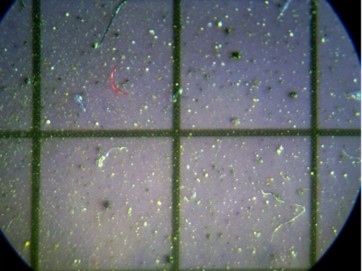
Figure 1: Microplastic particles identified in snow samples (Photo credit: Arctic Today).
This project does not offer a CASE studentship
Each host has a slightly different application process.
Find out how to apply for this studentship.
All applications must include the CENTA application form.
Choose your application route
The project will utilise unique infrastructure from experimental observatories in Northern Sweden and the Nepalese and Indian Himalayas to quantify microplastic particle accumulation and releases. Snow cores will be analysed for microplastic accumulation across observatories with different vegetation, topographic and microclimatological gradients. Discharge generated from snow lysimeters will be collected to analyse how microplastics are released during melt and how concentrations can be related to snow water equivalent. Analysis of microplastic concentrations in meltwater fed streams together with water isotopes in snow endmembers across the vertical snow profile will help to distinguish the time-variant release and relevance of particles from different layers of the snowpack. Comparison of results obtained from different experimental observatories will provide a fundamental understanding on how drivers of particle accumulation and release mechanisms varies between regions, biomes and catchment types, underlining global model estimates and risk assessments.
DRs will be awarded CENTA Training Credits (CTCs) for participation in CENTA-provided and ‘free choice’ external training. One CTC can be earned per 3 hours training, and DRs must accrue 100 CTCs across the three and a half years of their PhD.
The student will benefit from hands-on training in field and laboratory analytical techniques for the extraction, identification and characterisation of microplastics from environmental samples, as well as big data analytical approaches. Unique opportunities for training and international networking will be provided through participation in the PlasticUnderground international doctoral network organised by the lead supervisor. This includes a programme specifically designed for supporting the development of early career researchers working on environmental plastic pollution with entrepreneurial and innovation transfer skills.
Year 1: Study design together with supervisors and international partners, Development of microplastic extraction and analysis methodologies from existing snow cores and melt water; establishment of methodology to determine meltwater contributions from across vertical snow-profiles.
Year 2: Field sampling of snow accumulation and meltwater microplastics; identification of time-variant meltwater contributions from across vertical snow profiles of different regions; particle transport and discharge along stream networks.
Year 3: Scenarios of changes to snow accumulation and melt regimes to develop projections of future microplastic accumulation and release risks in remote cold regions.
1. Akanyange, S.N., Zhang, Y., Zhao, X., Adom-Asamoah, G., Ature, A.R.A., Anning, C., Tianpeng, C., Zhao, H., Lyu, X. and Crittenden, J.C. (2022) A holistic assessment of microplastic ubiquitousness: Pathway for source identification in the environment. Sustainable Production and Consumption, 33, pp.113-145.
2. Krause, S., Baranov, V., Nel, H.A., Drummond, J.D., Kukkola, A., Hoellein, T., Smith, G.H.S., Lewandowski, J., Bonet, B., Packman, A.I. and Sadler, J. (2021) Gathering at the top? Environmental controls of microplastic uptake and biomagnification in freshwater food webs. Environmental Pollution, 268, p.115750.
3. Evangeliou, N., Grythe, H., Klimont, Z., Heyes, C., Eckhardt, S., Lopez-Aparicio, S. and Stohl, A. (2020) Atmospheric transport is a major pathway of microplastics to remote regions. Nature communications, 11(1), p.3381.
4. Zhang, Y., Gao, T., Kang, S., Allen, D., Wang, Z., Luo, X., Yang, L., Chen, J., Hu, Z., Chen, P. and Du, W. (2023) Cryosphere as a temporal sink and source of microplastics in the Arctic region. Geoscience Frontiers, 14(4), p.101566.
5. Horton, A.A., Walton, A., Spurgeon, D.J., Lahive, E. and Svendsen, C. (2017) Microplastics in freshwater and terrestrial environments: Evaluating the current understanding to identify the knowledge gaps and future research priorities. Science of the total environment, 586, pp.127-141.
For any enquiries related to this project please contact Stefan Krause ([email protected]).
To apply to this project:
Applications must be submitted by 23:59 GMT on Wednesday 6th January 2027.