

Across the globe, extreme climatic events such as heatwaves and droughts have increased dramatically in frequency and intensity over the past 30 years, with potentially profound consequences for freshwater ecosystems. Repeated heatwave events have blighted the UK in 2026 yet very little is known about their effect on river life. Rare long-term studies suggest the impacts may be long-lasting and profound, but questions remain regarding the resistance and resilience of ecosystem to these recurrent events, especially when they occur together. During heatwaves, water temperature may approach or exceed the thermal tolerance limits of river organisms, leading to physiological stress, functional impairments and even local extinctions of sensitive species, but we do not know the tolerance limits of most British river fauna. In some regions, river flows are suffering drought and in extreme cases shifting from perennial to intermittent, modifying the ecological connectivity among habitats within the river network. Where low river flows persist, connections to riparian ecosystems are likely to be enhanced as terrestrial flora and fauna colonise the riverscape, altering biodiversity and the structure and function of food webs in unknown ways. Despite the growing prevalence of extreme climatic events, research on their effects in streams and rivers continues to lag far behind other environmental stressors (e.g. acid pulses or pesticides) and has focused on community level responses (e.g. species richness and abundances). Far less is known about impacts of interacting extremes on ecosystem functioning (e.g. production, decomposition, consumption) and food webs. Similarly, knowledge of the extent of ecosystem recovery of ecosystem to drought and heatwave pulses is poorly understood, and much research is needed to understand the vulnerability of key biological groups (e.g. invertebrates) to heatwaves in running waters across the UK.
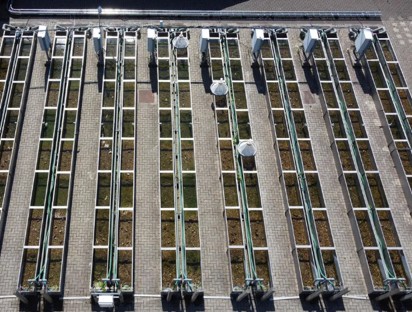
The successful candidate will join a team undertaking research to address these research gaps and will have the opportunity to conduct field surveys of thermal tolerance of key species across the UK along with flow / temperature manipulation experiments in a new state of the art mesocosm facility at the University of Birmingham (see Fig .1 below). These experiments will be combined with sampling and analysis of long-term records of flow, temperature and biodiversity in streams monitored by the Environment Agency, our project partner, in order to assess ecological resilience using time series data.
The results of the research will reveal how river biodiversity and ecosystem processes are affected by extreme events in an era of rapid global change, and will be used to help inform and guide climate change mitigation and adaptation policy.
Figure 1: You will have the opportunity to use artificial stream channels in the Ecolab facility on the University of Birmingham campus.
This project is a CENTA Flagship Project.
This project offers a CASE studentship
Each host has a slightly different application process.
Find out how to apply for this studentship.
All applications must include the CENTA application form.
Choose your application route
The project will test the effect of low flow and high temperature regimes on ecosystem functioning and food webs, including aquatic-terrestrial links. The doctoral researcher will:
The successful candidate will receive interdisciplinary training in hydroecology from staff and students within the School of Geography Earth an Environmental Sciences (GEES), University of Birmingham, and will also gain knowledge through collaboration with an international team of researchers as part of international collaborations. More specifically they will be trained in the use of laboratory assays of invertebrate thermal tolerance and mesocosms for global change research. Our project partner the Environment Agency will provide training in dissemination of findings to various stakeholder groups. A good understanding of experimental design, data science and statistical analysis will also be achieved. In addition, there will be scope to develop expertise in environmental sensing using the sensor network at the EcoLaboratory facility. The school supports a large, vibrant and well-resourced community of postgraduate researchers. DRs will be awarded CENTA Training Credits (CTCs) for participation in CENTA-provided and ‘free choice’ external training. One CTC can be earned per 3 hours training, and DRs must accrue 100 CTCs across the three and a half years of their PhD. As part of this community you will have access to a wide range of training opportunities tailored to early career researcher development, focussing on transferable project management skill, personal development, research practice and careers.
The project will benefit from links with the Environment Agency who will provide a placement opportunity, as well as access to long-term data records of flow and biodiversity in lowland rivers in their regions.
Year 1: You will establish experimental mesocosms and communities; refine methodologies and design of experiments; implementation of experiments. Undertake a literature review of the research field and begin analysis of historical data from the Environment Agency. Field visit to Iceland.
Year 2: Run experiments; sampling and data processing. Placement with Environment Agency to analyse long-term data. Analyse Iceland samples in collaboration with US colleagues.
Year 3: Data analysis, reporting and write-up.
Aspin, T.W.H., Matthews, T.J., Khamis, K., Milner, A.M., Wang, Z., O’Callaghan, M. & Ledger, M.E. (2018) Drought intensification drives turnover of structure and function in stream invertebrate communities. Ecography. DOI: 10.1111/ecog.03711.
Environment Agency (2018). New chalk streams strategy launched to protect ‘England’s rain forests’. Accessed on 26/09/2022. https://www.gov.uk/government/news/new-chalk-streams-strategy-launched-to-protect-england-s-rain-forests.
Lu, X., Gray, C., Brown, L.E., Ledger, M.E., Milner, A.M., Mondragon, R., Woodward, G., Ma, A. (2016) Drought rewires the cores of food webs. Nature Climate Change, 6, 875–878.
Woodward, G., Bonada, N., Brown, L.E., Death, R.G., Durance, I., Hladyz, S., Ledger, M.E., Milner, A.M., Ormerod, S.J., Thompson, R.M. (2016) Extreme climatic events and their consequences for biodiversity, food webs and ecosystem properties in running waters. Philosophical Transactions of the Royal Society B: Biological Sciences, 371, doi: 10.1098/rstb.2015.0274.
Ledger, M.E. & Milner, A.M. (2015) Extreme events in running waters. Freshwater Biology, 60, 2455-2460.Ledger, M.E. & Milner, A.M. (2015) Extreme events in running waters. Freshwater Biology. doi:10.1111/fwb.12673.
Ledger, M.E., Brown, L.E., Edwards, F.K., Hudson, L.N., Milner, A.M., Woodward, G. (2013). Extreme climatic events alter complex food webs: evidence from a mesocosm drought experiment. Advances in Ecological Research, 48, 343-395.
Ledger M.E., Brown L.E., Edwards F., Woodward G., Milner A.M. (2013) Drought impacts on the structure and functioning of complex food webs. Nature Climate Change, 3, 223-227.
Ledger M.E., Harris R.M.L., Armitage P.D. & Milner, A.M. (2012). Climate change impacts on community resilience: experimental evidence from a drought disturbance experiment. Advances in Ecological Research, 46, 211-258.
Woodward, G., Brown, L., Edwards, F.K., Hudson, L.N., Milner, A.M., Reuman, D.C. & Ledger, M.E.(2012). Climate change impacts in multispecies systems: drought alters food web size-structure in a field experiment. Philosophical Transactions of the Royal Society B, 367 (1605), 2990-2997.
Ledger, M.E., Edwards, F., Brown, L.E., Woodward, G. & Milner, A.M. (2011) Impact of simulated drought on ecosystem biomass production: an experimental test in stream mesocosms. Global Change Biology, 17, 2288-2297.
For any enquiries related to this project please contact:
Dr Mark Ledger:
https://www.birmingham.ac.uk/staff/profiles/gees/ledger-mark.aspx
Dr Kieran Khamis:
https://www.birmingham.ac.uk/staff/profiles/gees/khamis-kieran.aspx
Read about our EcoLaboratory:
https://www.birmingham.ac.uk/research/activity/ecolaboratory/index.aspx
To apply to this project:
Applications must be submitted by 23:59 GMT on Wednesday 6th January 2027.