

River biofilms are diverse microbial communities that grow on submerged surfaces and play critical roles in ecosystem functioning. Their composition and functional characteristics respond to environmental conditions, yet the drivers of these dynamics remain poorly understood. The project will map temporal changes in terrestrial habitats and weather across river networks and catchments and develop models that attribute biofilm community change to environmental drivers.
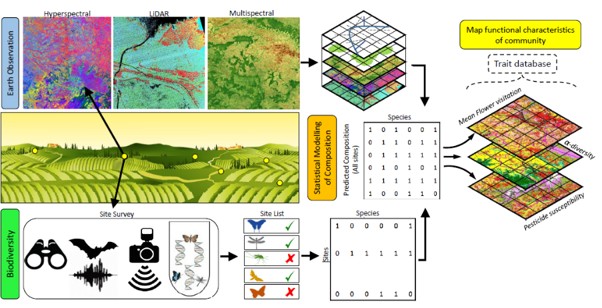
Most biodiversity cannot be observed directly from space, while eDNA provides taxonomically rich observations only at sampled locations. Bush et al. (2017) proposed CEOBE (Connecting Earth Observation to Biodiversity and Ecosystems), which links high-throughput eDNA data with Earth Observation (EO) through species distribution modelling.
This PhD will extend CEOBE to river-catchment systems by investigating how biofilm microbial communities, measured through eDNA, vary across locations, seasons and years, and how these changes can be explained by environmental drivers.
Key research questions are: (1) Can spatially sparse ecological monitoring be integrated with EO and modelling to estimate ecological condition across unsampled river reaches? (2) How reliably can areas requiring additional monitoring be identified to reduce uncertainty? (3) Can biofilm species distribution models be developed from EO and sparse eDNA observations?
The project will utilise existing Environment Agency eDNA data collected through the national River Surveillance Network (RSN), comprising ~1,700 biofilm samples from ~700 sites across England, selected using a GRTS sampling design, together with chemical measurements, traditional biodiversity observations and a subset of metagenomic data. These data provide insights into microbial diversity, community composition and potential ecosystem functions and offer a foundation for developing indicators of river ecosystem condition.
By integrating eDNA with EO and other environmental covariates, the project will seek to predict species occurrence, functional groups, community composition and ecosystem condition across unsampled (withheld) areas. Outputs will include estimates of alpha, beta and gamma diversity and associated uncertainties, supporting improved monitoring design. The co-design process with Defra ensures decision-relevant outputs and interoperability with existing DNA and EO evidence workflows. The project provides interdisciplinary training at Leicester and UKCEH, plus CASE experience with Defra’s DNA and EO Centres of Excellence and NCEO.
Figure 1: Overview of the CEOBE approach of ‘Connecting Earth Observation to Biodiversity and Ecosystems’. Top row left: EO data and other geographical datasets are used to generate spatially continuous maps of biophysical data (S1, S2). Middle row left: A real landscape with point-sample locations indicated by yellow dots. Bottom row left: Biodiversity is recorded manually using traditional methods, automated audio or image recording devices, or metabarcoding or metagenomic pipelines to generate a site/species table. However, most of the landscape is not sampled (empty rows in the table). Right side: The point samples are combined statistically with continuous biophysical maps to predict biodiversity composition over the whole landscape. In combination with ancillary data like trait databases, process-based models can then identify the functional composition of any location and map the expected distributions of ecosystem functions and services. Reproduced from Bush et al. (2017).
This project is a CENTA Flagship Project.
This project offers a CASE studentship
Each host has a slightly different application process.
Find out how to apply for this studentship.
All applications must include the CENTA application form.
Choose your application route
DRs will be awarded CENTA Training Credits (CTCs) for participation in CENTA-provided and ‘free choice’ external training. One CTC can be earned per 3 hours training, and DRs must accrue 100 CTCs across the three and a half years of their PhD.
The DR will receive multidisciplinary training in eDNA at UKCEH and in Earth Observation at NCEO @ University of Leicester. Training will cover eDNA sampling, extraction, multi-marker metabarcoding, contamination control and bioinformatics at UKCEH, EO and image time-series processing, modelling, and creating data processing workflows and uncertainty analysis at NCEO Leicester. Defra will provide operational and policy-facing secondments (3 to 18 months), allowing the models to be tested in a policy focused environment. The DR will develop open research and FAIR data practices, project management, scientific writing, stakeholder engagement and communication skills, alongside a personalised Training Needs Analysis.
Defra and EA are the principal stakeholders. They will provide CASE co-supervisors, access to samples and data and host secondments totalling at least three months. Activities will cover DNA quality assurance, EO data pipelines, policy evidence needs and testing of prototype outputs. Quarterly partner engagement and annual co-design reviews will maintain relevant.
Year 1: Co-design of a refined research plan with Defra; pilot data analysis study; InVEST model feasibility test; fundamental training; literature review; catchment/site selection; EO baseline mapping.
Year 2: Descriptive analysis of eDNA data; prototyping a model of environmental drivers; EO mapping; first CASE secondment; paper on sampling design and location identification to reduce uncertainty.
Year 3: Refined modelling of drivers of biofilm eDNA microbial communities; independent validation using unseen sample locations; derive catchment indicators; carry out a robust uncertainty analysis; second CASE secondment; intensified stakeholder engagement; papers on integration and indicators.
Final six months: Synthesis, thesis writing and publication submissions; release reproducible workflows and metadata; Defra implementation guidance, capacity building workshop and handover; conference dissemination and career development.
Blackman, R.C., Carraro, L., Keck, F. and Altermatt, F. (2024) ‘Measuring the state of aquatic environments using eDNA—upscaling spatial resolution of biotic indices’. Philosophical Transactions of the Royal Society B: Biological Sciences, 379(1904), p.20230121.
Bush, A., Sollmann, R., Wilting, A., Bohmann, K., Cole, B., Balzter, H., Martius, C., Zlinszky, A., Calvignac-Spencer, S., Cobbold, C.A. and Dawson, T.P. (2017) ‘Connecting Earth observation to high-throughput biodiversity data’. Nature ecology & evolution, 1(7), p.0176.
Carraro, L., Blackman, R.C. and Altermatt, F. (2023) ‘Modelling environmental DNA transport in rivers reveals highly resolved spatio-temporal biodiversity patterns’. Nature Scientific Reports, 13(1), p.8854.
Perry, W.B., Seymour, M., Orsini, L., Jâms, I.B., Milner, N., Edwards, F., Harvey, R., de Bruyn, M., Bista, I., Walsh, K. and Emmett, B. (2024): ‘An integrated spatio-temporal view of riverine biodiversity using environmental DNA metabarcoding’. Nature Communications, 15(1), p.4372.
Reji Chacko, M., Altermatt, F., Fopp, F., Guisan, A., Keggin, T., Lyet, A., Rey, P.L., Richards, E., Valentini, A., Waldock, C. and Pellissier, L. (2023) ‘Catchment-based sampling of river eDNA integrates terrestrial and aquatic biodiversity of alpine landscapes’. Oecologia, 202(4), pp.699-713.
Thorpe, A. C., Busi, S. B., Warren, J., Newbold, L. K., Taylor, J. D., Walsh, K., and Read, D. S. (2026) ‘River Microbiomes as Sentinels of National-Scale Freshwater Ecosystems’. Global Change Biology 32, no. 3: e70809.
Project contact: Prof. Heiko Balzter, University of Leicester, [email protected]
To apply to this project:
Applications must be submitted by 23:59 GMT on Wednesday 6th January 2027.