

Southern Africa exhibits sharp climatic and vegetation community transitions, making it unusually sensitive to past and future climate change. This sensitivity has been demonstrated by recent research using rock hyrax (Procavia capensis) middens – cemented accumulations of urine and faecal pellets – which provide some of the highest-resolution terrestrial palaeoclimate archives for the Southern Hemisphere (Chase et al., 2012; Chase et al., 2023). These archives record up to 70,000 years of climatic and ecological information. Most midden-based paleoclimatic research has used fossil pollen or carbon and nitrogen isotope analyses, but plant leaf wax biomarkers are also well preserved in middens (Carr et al., 2010) and can now be compared to extensive modern leaf wax calibration data available across southern Africa (e.g. Carr et al., 2014).
What is presently missing is an approach for developing statistically robust palaeoecological reconstructions using such biomarker data (see Polissar et al., 2025). More specifically, this project considers how we can develop reliable approaches for turning leaf wax biomarker data into reconstructions of palaeo-vegetation community change. To this end there are a range of Machine Learning (ML) approaches suited to the analysis of complex multivariate geochemical data. For example, Peaple et al. (2021) recently demonstrated that machine learning models could be used reconstruct long-term ecological changes in California using a relatively small modern leaf wax training data from three broad plant groupings.
The primary goal of this project is therefore to build on such work to develop and evaluate machine-learning classifier algorithms using our extensive modern southern African plant biomarker databases. The aim is to develop new ML-reconstructions of deep time ecological change across the region and to evaluate how we can make novel and more nuanced insights into ecosystem response and resilience across centennial to millennial scale climatic perturbations. This project will extend existing ML approaches to account for southern Africa’s floristic and structural diversity, while drawing on the extensive modern plant data and hyrax midden samples already collected by the supervisory team. The project is interdisciplinary and would suit applicants with backgrounds ranging from computer/data science, statistics, botany, (geo)chemistry, palaeontology, geography or environmental science.
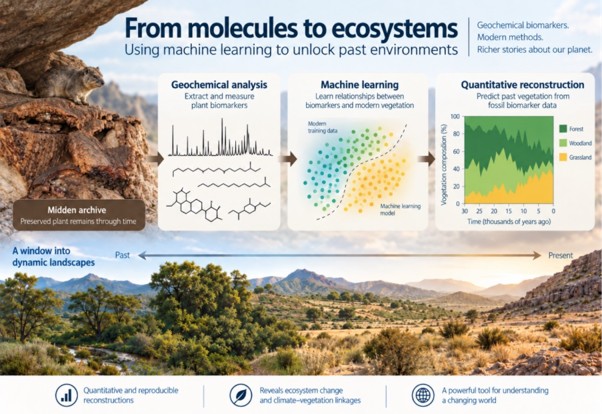
Figure 1: On the left an image of a rock hyrax and typical midden deposit, along with a conceptualisation of the proposed data analysis and data processing approach
This project does not offer a CASE studentship
Each host has a slightly different application process.
Find out how to apply for this studentship.
All applications must include the CENTA application form.
Choose your application route
Machine–learning algorithms will be trained using existing biomarker datasets, supported by new analyses of plant specimens already collected by the supervisory team. Laboratory analyses will involve solvent extraction, gas chromatography–mass spectrometry (GC/MS) methods and compound-specific stable isotope analyses. The project will also include a short visit to Montpellier to sub-sample archived hyrax middens for biomarker extraction. A range of machine-learning approaches will be developed and evaluated, with trained models applied to radiocarbon-dated midden sequences to generate deep-time probability estimates for vegetation classes. These outputs will be evaluated and interpreted alongside existing pollen and stable isotope records. There will be particular emphasis on understanding and quantifying the uncertainties in both ML-derived ecological reconstructions and existing isotope and pollen-based reconstructions.
DRs will be awarded CENTA Training Credits (CTCs) for participation in CENTA-provided and ‘free choice’ external training. One CTC can be earned per 3 hours training, and DRs must accrue 100 CTCs across the three and a half years of their PhD.
The doctoral researcher will develop skills in two key areas; 1) in the Leicester Environmental Stable Isotope lab, the Leicester supervisory team will provide training in all aspects of sample preparation, lipid extraction, GC/MS analysis and GC-IRMS (compound specific) stable isotope analysis, as well as the underpinning theory of biomarkers and stable light isotopes. The wider team (notably Harris) will provide training in the use of ML algorithms, model validation and uncertainty assessments, as well as support in building reproducible data science workflows and programming in R/Python platforms. Carr and Chase will support training on ecosystem function and character.
Along with the Leicester supervisors, the team includes Dr Brian Chase (CNRS Montpellier), who is the world’s foremost expert on rock hyrax middens and southern African palaeoecology. He will support the project via access to his hyrax midden archives in Montpellier and in the analysis of new midden records. Dr Angela Harris (University of Manchester) is an ecologist with expertise in machine learning, predictive modelling, and quantitative environmental analysis. She will support the design and evaluation of classification algorithms, assist with model validation and uncertainty assessment, and providing training in reproducible data science workflows and programming.
Year 1: Literature review, secondary data compilation, biome selection, initial lipid extraction and GC method development using archived materials.
Year 2: Completion of modern plant sample analyses, first-generation ML classifier training and validation, midden sample selection and dating. First conference presentation
Year 3: Hyrax midden sampling (Montpellier) and lipid extraction and classification, cross-validation against existing pollen/isotope records, extension to longer sequences if time and material permit, evaluation of ML derived ecological relative to traditional palaeoecological approaches.
Carr, A.S., Boom, A., Chase, B.M. (2010). ‘The potential of plant biomarker evidence derived from rock hyrax middens as an indicator of palaeoenvironmental change’. Palaeogeography, Palaeoclimatology, Palaeoecology, 285, pp. 175-183.
Carr, A.S., Boom, A., Chase, B.M., Meadows, M.E., Grimes, H.L., Harris, A. (2014) ‘Leaf wax n-alkane distributions in arid zone South African flora: environmental controls, chemotaxonomy and palaeoecological implications’. Organic Geochemistry, 67, pp.72-84.
Chase, B.M. et al., 2023. Linking upwelling intensity and orbital-scale climate variability in South Africa’s winter rainfall zone: insights from a ~70,000-year hyrax midden record. Quaternary Science Advances 10, 100081.
Peaple, M.D., Tierney, J.E., McGee, D., Lowenstein, T.K., Bhattacharya, T., Feakins, S.J. (2021) ‘Identifying plant wax inputs in lake sediments using machine learning’. Organic Geochemistry, 156, 104222.
Polissar, P.J., Karp, A.T. and D’Andrea, W.J. (2025). Mixed messages: Unmixing sedimentary molecular distributions reveals source contributions and isotopic values. Geochimica et Cosmochimica Acta, 396, pp.122-134.
Vogts, A., Moossen, H., Rommerskirchen, F., Rullkötter, J. (2009) ‘Distribution patterns and stable carbon isotopic composition of alkanes and alkan-1-ols from plant waxes of African rain forest and savanna C3 species’. Organic Geochemistry, 40, pp. 1037-1054.
For any enquiries related to this project please contact Dr Andrew Carr, [email protected].
To apply to this project:
Applications must be submitted by 23:59 GMT on Wednesday 6th January 2027.