

Orogenic gold deposits, one of the world’s main sources of gold, can also contain critical metal by-products such as tellurium, which is essential for the green transition as a component of solar panels. Extraction of by-products can be challenging with traditional processing methods, and controls on the mineralogy and by-product potential of these deposits are still not fully understood. This project provides an opportunity to study a newly discovered tellurium-rich orogenic gold deposit in Cameroon, investigating its ore forming processes and applying novel processing techniques to understand if tellurium can be recovered as a by-product.
Oriole Resources PLC is a UK-listed exploration company focused on gold exploration and development in Cameroon with multiple orogenic gold related projects. This research project will focus on an early-stage gold prospect within Oriole’s greenfield Mbe licence in central Cameroon. Since Mbe was granted in 2021, Oriole has completed regional scale soil and stream sampling, local scale infill soil sampling, geological mapping, rock chip and trenching sampling, identifying multiple prospects within the licence area. In addition, >12,000m of drilling at the MB01 prospect has been completed to date, with best intersections including 86.50m at 1.36g/t Au, 6.15m at 19.67g/t Au, and 27.20m at 1.69g/t Au. The characterisation of gold within the system (distribution, associated mineralogy etc.) is still at an early stage with preliminary work indicating that, unusually, much of the >1 Moz of gold is present as telluride minerals, which are more commonly associated with magmatic-hydrothermal epithermal gold deposits. This, coupled with the presence of igneous host rocks, may suggest a possible epithermal overprint or involvement of magmatic-hydrothermal fluids. However, the relationship between the mineralisation and the magmatism which formed the host rocks is still unknown, as are the characteristics of the ore forming fluids.
This project will characterise the gold-tellurium mineralisation and the conditions and sources of the ore-forming fluids at Mbe to determine:
1) if there was significant magmatic-hydrothermal influence during deposit formation;
2) if an epithermal overprint exists, was it gold enriching?;
3) whether novel Deep Eutectic Solvent (DES) processing techniques can be used to extract tellurium from this deposit.
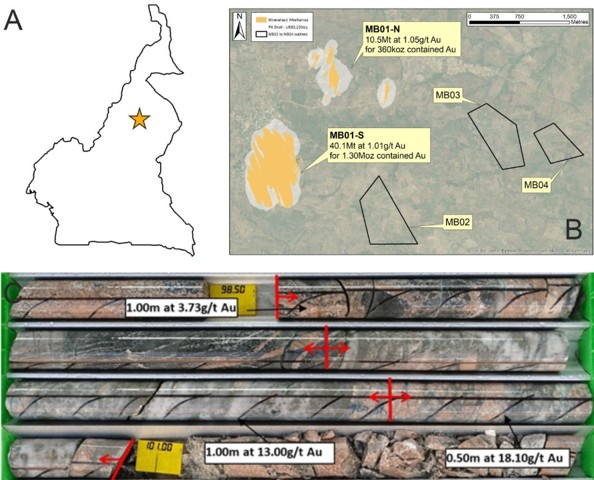
Figure 1: A) Location of Mbe prospect (gold star) within Cameroon. B) Four main prospects identified within the Mbe licence area: MB01- MB04, with Inferred Mineral Resource mineralised wireframes and US$3,200/oz pit shells for MB01-S and MB01-N deposits. C) Example of gold-pyrite-telluride mineralisation at Mbe from drill core.
This project is a CENTA Flagship Project.
This project offers a CASE studentship
Each host has a slightly different application process.
Find out how to apply for this studentship.
All applications must include the CENTA application form.
Choose your application route
Characterisation of the mineralisation will be by field mapping / sampling, together with logging and sampling of drill cores from Oriole Resources’ drilling campaign on Mbe. Mineralogical analysis will include optical microscopy, µ-XRF, scanning electron microscopy (SEM), and automated mineralogy using University of Leicester’s Zeiss Sigma 300 with Mineralogic software. Characterisation of the fluids will be via fluid inclusion microthermometry at Leicester and UCL and micro laser-Raman at UCL. Stable isotope analysis (S, H, O and potentially C-O) will be undertaken at the NERC isotope facility (SUERC), subject to a successful facility application, and will be used to constrain the source of the fluids and any magmatic influence. Typical ore minerals, bulk samples and mineral concentrates will be used to test the leaching efficiency of a range of potential DES to provide proof of concept for development of a new mineral processing route that recovers Te alongside Au.
DRs will be awarded CENTA Training Credits (CTCs) for participation in CENTA-provided and ‘free choice’ external training. One CTC can be earned per 3 hours training, and DRs must accrue 100 CTCs across the three and a half years of their PhD.
Field skills – Core logging of mineralisation, geological mapping, sampling.
Laboratory skills – Ore petrography. µ-XRF scanning. Cathodoluminescence. Fluid inclusion microthermometry, including micro-Raman spectroscopy. Stable isotope measurements. Use of SEM and automated-SEM, to derive geometallurgical information that informs leaching behaviour such as mineralogy and liberation in tandem with experience in the use of novel solvents such as DES.
Data analysis skills – Use of 2D GIS (such as QGIS/ArcGIS) and 3D GIS (such as Micromine) to spatially analyse data, use of industry software such as Iogas for large geochemistry datasets.
Presentation skills – Oral and poster presentations, preparing publications.
The student will receive individual bespoke training by members of the supervision team in the skills detailed above.
You will join a thriving community of mineral resource researchers in as well as materials scientists and chemists within the Centre for Sustainable Resource Extraction
Oriole Resources PLC will provide logistical support during field work, and provide access to samples, and data. The successful applicant will have regular progress meetings and opportunities for discussion with Oriole Resources personnel, as well as gaining field experience in relation to an early-stage exploration programme at a greenfield project through the project placement.
The successful applicant will be based at the University of Leicester and will visit UCL for blocks of time to use lab facilities. Regular project meetings will take place involving all supervisors.
Year 1: Literature review, field mapping and sampling and work on drill core from initial drilling campaign to define vein paragenesis. Ore mineralogy using transmitted and reflected light microscopy, µ-XRF, SEM and automated mineralogy by SEM. CENTA training and networking events.
Year 2: Quartz characterisation with cathodoluminescence. Fluid inclusion petrology, including microRaman spectroscopy, and fluid inclusion microthermometry at UCL. Preparation for stable isotope work and pilot stable isotope study and application for full study. Presentation at UK conference in winter and international conference in summer. Initial manuscript. Continuing CENTA training.
Year 3: Stable isotope analysis at SUERC, DES test work at Leicester. Preparation of thesis and manuscripts for publication. Presentation of work at national and international conferences.
Gaboury, D. (2019) ‘Parameters for the formation of orogenic gold deposits’, Applied Earth Science, 128(3), pp. 124–133. doi: 10.1080/25726838.2019.1583310.
Groves, D.I., Santosh, M., Deng, J., Wang, Q., Yang, L., Zhang, L., 2020. ‘A holistic model for the origin of orogenic gold deposits and its implications for exploration.’ Mineralium Deposita 55, pp. 275–292. https://doi.org/10.1007/s00126-019-00877-5
Jenkin GRT, Al-Bassam AZM, Harris RC, Abbott AP, Smith DJ, Holwell DA, Chapman RJ, Stanley CJ (2016). The application of deep eutectic solvent ionic liquids for environmentally-friendly dissolution and recovery of precious metals. Minerals Engineering, 87, 18-24. DOI: 10.1016/j.mineng.2015.09.026
Spence-Jones C, Jenkin GRT, Boyce AJ, Hill NJ, Sangster CJS (2018). Tellurium, magmatic fluids and orogenic gold: An early magmatic fluid pulse at Cononish gold deposit, Scotland. Ore Geology Reviews, 102, 894-905. DOI: 10.1016/j.oregeorev.2018.05.014
For project enquiries please contact [email protected].
For more information on Leicester’s Centre for Sustainable Resource Extraction visit: https://le.ac.uk/csre.
https://orioleresources.com/projects/mbe/
To apply to this project:
Applications must be submitted by 23:59 GMT on Wednesday 6th January 2027.