

The transition to a low-carbon economy requires not only renewable energy, but sustainable ways to manufacture the chemicals on which society depends. Electrochemical conversion offers a route to drive chemical transformations using renewable electricity, but its wider application is limited by poor selectivity and competing hydrogen evolution. This is particularly important for carbon dioxide (CO2) conversion, where controlling proton and electron transfer is central to determining which products are formed.
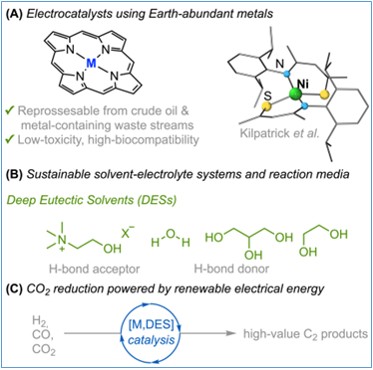
This project will investigate whether the reactivity of water can be deliberately tuned using deep eutectic solvents (DESs) to control electrocatalytic carbon conversion. DESs are highly tunable liquids formed through strong hydrogen-bonding interactions and can profoundly alter solvation, proton activity and the structure of water. Rather than treating water simply as an inert solvent or proton source, this project will establish how its chemical properties change within DES/water mixtures and determine whether these changes can be used to favour productive carbon reduction over competing hydrogen evolution.
Earth-abundant metalloporphyrinoid catalysts will provide molecular platforms for this investigation. Their well-defined coordination environments allow catalyst structure, proton transfer and reaction selectivity to be connected mechanistically. CO2 reduction will provide the principal environmental application, complemented by electro-hydrogenation of carbonyl substrates as a mechanistic test of how activated water reactivity controls selective proton-coupled electron transfer. Collaboration with Dr Dominik Halter at the University of Antwerp will provide expertise in electrocatalytic hydrogenation and enable research secondments.
The project will combine molecular catalyst synthesis, electrochemistry, spectroscopy and spectroelectrochemistry to establish quantitative relationships between water properties, catalyst speciation, reaction kinetics and product selectivity. It will also investigate whether DESs can provide a route to recover and repurpose metal-containing porphyrinoids from complex environmental feedstocks, building on recent work by Kilpatrick et al. demonstrating efficient DES-mediated extraction of metalloporphyrins and metal species from crude oil. Ultimately, the project will establish design principles for using tunable, recyclable solvent systems to enable more selective and resource-efficient electrocatalytic carbon conversion.
Figure 1: Harnessing renewable energy with captured CO2 for the chemical value chain.
This project does not offer a CASE studentship
Each host has a slightly different application process.
Find out how to apply for this studentship.
All applications must include the CENTA application form.
Choose your application route
The student will synthesise and characterise a series of metalloporphyrinoid catalysts based on non-precious metals using established inorganic and spectroscopic methods. DES mixtures will then be prepared with systematically varied compositions to establish relationships between solvent composition, hydrogen bonding, water activity and proton-transfer behaviour using IR, Raman and NMR spectroscopy.
Catalyst electrochemistry will initially be investigated by cyclic voltammetry and controlled-potential electrolysis in conventional and DES/H2O media. CO2 reduction will provide the principal environmental application, while complementary electro-hydrogenation of carbonyl substrates will provide a mechanistically informative platform for investigating proton-coupled electron transfer and competing hydrogen evolution. Products will be quantified using GC, HPLC and NMR spectroscopy.
In situ spectroelectrochemistry will identify catalyst resting states and reaction intermediates, linking changes in water properties to catalytic selectivity. Finally, DES-mediated recovery of metalloporphyrinoids from representative environmental feedstocks will be investigated, with recovered materials assessed for subsequent catalytic use and recyclability.
DRs will be awarded CENTA Training Credits (CTCs) for participation in CENTA-provided and ‘free choice’ external training. One CTC can be earned per 3 hours training, and DRs must accrue 100 CTCs across the three and a half years of their PhD.
The successful candidate will gain extensive training in air- and moisture-sensitive inorganic synthesis, including Schlenk and glovebox techniques, alongside electrochemical methods including cyclic voltammetry and controlled-potential electrolysis. They will develop expertise in spectroscopy, spectroelectrochemistry and quantitative product analysis using GC, HPLC and NMR. Training will also cover the preparation and characterisation of deep eutectic solvents, sustainable resource recovery and catalyst recycling. Research secondments with the Halter group at the University of Antwerp will provide specialist training in electrocatalysis and electro-hydrogenation.
Dr Sandy Kilpatrick (University of Leicester) will lead the project, providing expertise in 3d metal molecular catalysis, deep eutectic solvents and CO2 conversion. Dr Patricia Rodriguez Macia (University of Leicester) is second supervisor with bio-catalysis and IR spectroelectrochemistry expertise. Dr Dominik Halter (University of Antwerp) provides complementary expertise in electrocatalysis, electro-hydrogenation and spectroelectrochemistry. The collaboration builds on an active RSC-funded collaboration between the groups investigating the use of DES media to tune water reactivity in electrosynthesis. The student will undertake one or more research secondments in Halter’s laboratory to develop specialist electrochemical expertise. No CASE partner is currently proposed.
Year 1 Synthesis and characterisation of 3d metal metalloporphyrinoid catalysts. Preparation of DES mixtures with systematically varied compositions. Spectroscopic and electrochemical investigation of water structure, hydrogen bonding, proton-transfer behaviour and reduction potentials. Initial investigation of DES-mediated extraction and recovery of metal-containing porphyrinoids from representative environmental feedstocks.
Year 2 Electrocatalytic investigation of CO2 reduction reaction (CO2RR) in conventional and DES media, establishing relationships between water properties, catalyst identity, and selectivity for CO2RR vs. hydrogen evolution reaction. Complementary electro-hydrogenation of carbonyl substrates will probe the generality of the approach. Research secondment(s) with the Halter group at the University of Antwerp. In situ UV/Vis, Raman and related spectroelectrochemical studies will investigate catalyst speciation and reaction intermediates.
Year 3 Integration of optimised catalysts and DES media to establish how water reactivity can be controlled to favour selective CO2 conversion. Correlation of solvent properties, catalyst speciation, kinetics and product selectivity to establish mechanistic design principles. Investigation of catalyst recovery and reuse, including materials obtained through DES-mediated resource recovery. Dissemination through publications, conferences and stakeholder engagement.
Mirinn, E., Abbott, A.P. and Kilpatrick, A.F.R. (2026). ‘Deep eutectic solvents as recyclable media for metal removal from crude oil’. RSC Advances, 16(18), pp.16211-16219. doi: 10.1039/d5ra09189f.
Huang, T., Lyu, Y., Chen, J. and Halter, D.P., (2026). ‘Similarities and Differences Between CO2 Reduction and Electro‐Hydrogenation of Organic Carbonyls with Fe Porphyrins: A Case Study.’ ChemElectroChem, 13(5), p.e202500377. doi: 10.1002/celc.202500377.
Chen, Y. and Mu, T. (2019) ‘Conversion of CO2 to value-added products mediated by ionic liquids’, Green Chemistry, 21(10), pp. 2544–2574. doi: 10.1039/c9gc00827f.
Grim, R. G. et al. (2020) ‘Transforming the carbon economy: Challenges and opportunities in the convergence of low-cost electricity and reductive CO2 utilization’, Energy and Environmental Science, 13(2), pp. 472–494. doi: 10.1039/c9ee02410g.
Vasilyev, D. V et al. (2019) ‘A General and Facile Approach for the Electrochemical Reduction of Carbon Dioxide Inspired by Deep Eutectic Solvents’, ChemSusChem, 12(8), pp. 1635–1639. doi: 10.1002/cssc.201900579.
Potential applicants are welcome to discuss the project informally with the project supervisors:
Dr Sandy Kilpatrick https://www.kilpatrickgroup.uk/ (research group website) https://le.ac.uk/people/alexander-kilpatrick (UoL staff pages)
Dr Patricia Rodriguez Macia https://rodriguezmacialab.com
Dr Dominik P. Halter https://www.halter-research.com/
To apply to this project:
Applications must be submitted by 23:59 GMT on Wednesday 6th January 2027.