

Understanding past climates is essential for humanity’s ability to anticipate, adapt to, and mitigate future climate changes. It is paramount to constrain palaeoceanographic variations to understand heat distribution on the planet and long-term storage of CO2 in the deep ocean. The evolution of water-masses in the Atlantic remains poorly constrained, including the influence of climatic and orbital parameters.
This project proposes to reconstruct the palaeoceanographic history of the Atlantic Ocean at unprecedented resolution using geochemical properties of oceanic ferromanganese (Fe-Mn) crusts. Fe-Mn crusts form by the accumulation of Fe and Mn oxyhydroxides precipitated from ambient seawater on indurated ocean floor substrates. As one of the slowest processes on Earth (a few mm/Myr) and given the high reactivity of these colloids, Fe-Mn oxides efficiently scavenge and accumulate (trace) metals from seawater over millions of years. Fe-Mn crusts can thus contain reliable records of the distribution and changes in oceanographic currents. Furthermore, the composition of Fe-Mn crusts is influenced by evolving continental weathering rates through changes in climate, oceanic gateways, and latitudinal oceanography.
This project uses samples spanning depth and latitudinal transects in the Atlantic Ocean to produce an integrated temporal framework of isotopic and compositional records of Fe-Mn crusts. These ultra-high-resolution records are encoded with variations induced by astronomical parameters, which allow accurate ages. These records enable reconstructing the provenance, distribution, intensity, and interaction of ocean water masses throughout the Cenozoic, focussing on intervals with i) large-scale cryosphere changes (e.g., formation and evolution of Antarctic ice sheet and initiation of Northern Hemisphere glaciation); ii) tectonic variability (e.g., opening / closing Atlantic gateways); and iii) track the evolution of the AMOC (e.g., during warmer and colder periods).
The samples thus capture Atlantic palaeoceanography through major Cenozoic climatic and tectonic events, something which cannot always be achieved with deep-sea sediment cores. The project integrates Atlantic basin tectonic evolution with climate change to produce a high-resolution Atlantic palaeoceanographic record.
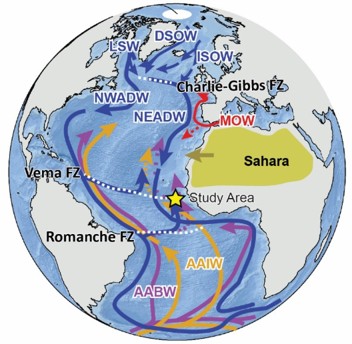
Figure 1: Modern oceanographic circulation in the Atlantic Ocean showing the main intermediate and deep-water masses: Labrador Seawater (LSW), Denmark straight overflow water (DSOW), Iceland‐Scotland ridge overflow water (ISOW), east and west NADW (ENADW and WNADW, respectively), Antarctic intermediate and bottom water (AAIW and AABW, respectively), and Mediterranean outflow water (MOW) (modified from Josso et al., 2020).
This project does not offer a CASE studentship
Each host has a slightly different application process.
Find out how to apply for this studentship.
All applications must include the CENTA application form.
Choose your application route
This research will generate new ultra-high-resolution mXRF data complemented by Pb-isotope data generated using the latest developments in high-resolution laser-ablation inductively coupled plasma mass spectrometry (LA-ICP-MS). These data will establish the temporal framework of the samples focusing on mXRF and Pb isotopes stratigraphic correlation (Josso et al., 2020). Age modelling will be developed through multi-proxy modelling including mXRF and Pb cyclostratigraphy (Josso et al., 2019, 2021), and integrated with the less robust, but widely employed Cobalt chronometer.
Palaeoceanographic reconstructions use a combined approach of redox-sensitive (e.g., Fe, Mn, Ni, Co) and detrital elements (e.g., K, Ti), supplemented by scanning electron microscopy (SEM) and targeted ICP-MS measurements.
A student-led NEIF application could provide supporting data for age models and palaeoceanographic interpretation (e.g., Be and Nd isotopes).
Data analysis, processing, and modelling will be done through R and MATLAB, and involve Bayesian statistical techniques and time series analysis with astronomical tuning.
DRs will be awarded CENTA Training Credits (CTCs) for participation in CENTA-provided and ‘free choice’ external training. One CTC can be earned per 3 hours training, and DRs must accrue 100 CTCs across the three and a half years of their PhD.
The Doctoral Researcher will receive training in (clean) laboratory procedures for ICP-MS, Scanning Electron Microscopy (SEM), and/or Tornado M4 mXRF data acquisition, QA/QC of geochemical data, and uncertainty in isotope and geochemistry analysis. This includes advanced data management and visualisation in R or Matlab, statistical and data analysis in R or Matlab, Python and Quarto analysis such as Bayesian Regression modelling, and geochronology.
They will also receive training in proposal writing skills, including co-developing a NEIF application. Additional training includes managing stress during a PhD, oral presentation at conferences and public engagement combining both education and outreach activities.
Year 1: Literature review for familiarisation with topics of deep-sea mineral deposits, palaeoceanographic studies, age modelling and relevant geochemical systems. Familiarisation with samples and existing datasets. Training to work in lab environments and methodology development for acquisition and extraction of quantitative datasets. Sample preparation into thin sections, SEM and mXRF training. Training on coding (could be R, Matlab, Python) and time series analysis. Active participation in public engagement.
Year 2: Ultra-high resolution mXRF and Pb isotopes data acquisition and development of sample correlated stratigraphy. Introduction to Geoactive Interactive Correlation software. Comparative age modelling study on cyclostratigraphy and Co-Chronometry. Preparation of manuscript and dissemination of results at conference(s). Active participation in public engagement.
Year 3: Palaeoceanographic reconstruction of water-mases interactions in various astronomical configurations and Cenozoic climate states. Characterisation of evolving detrital input and its impact on the geochemistry and mineralogic textures of deep-sea deposits. Preparation of another manuscript and dissemination of results at conference(s). Active participation in public engagement.
Josso, P. et al., 2019. Improving confidence in ferromanganese crust age models: A composite geochemical approach. Chemical Geology, 513: 108-119.
Josso, P. et al., 2020. Development of a Correlated Fe-Mn Crust Stratigraphy Using Pb and Nd Isotopes and Its Application to Paleoceanographic Reconstruction in the Atlantic. Paleoceanography and Paleoclimatology, 35(10): e2020PA003928.
Josso, P., van Peer, T., Horstwood, M.S.A., Lusty, P., Murton, B., 2021. Geochemical evidence of Milankovitch cycles in Atlantic Ocean ferromanganese crusts. Earth and Planetary Science Letters, 553: 116651.
Lusty, P., Hein, J.R., Josso, P., 2018. Formation and occurrence of ferromanganese crusts: Earth’s storehouse for critical metals. Elements, 14(5): 313-318.
For further information, please contact Dr. Tim van Peer, [email protected].
To apply to this project:
Applications must be submitted by 23:59 GMT on Wednesday 6th January 2027.