

Current science suggests that around 3.8-4 billion years ago the Earth’s atmosphere along with organic hazes were able to dampen UV radiation sufficiently, allowing life in the form of metabolising microbes to emerge. Therefore, understanding how atmospheres evolve and sustain long-term habitability remains a foundational challenge in comparative planetology and deep-time climate science. Ancient Mars ~3.5-3.8 billion years ago is key to testing and improving the paradigm of ancient Habitability on ‘Warm and Wet’ planets, which is the driver for much of Mars’s present and planned exploration. Inferred elevated pCO2 pressures are assumed to be a route towards allowing sustained liquid water, reduced radiation environment and chemical processes that make for a Habitable environment. Models have invoked pCO2 and also cloud cover, high levels of methane, SO2 and associated aerosols in an attempt to explain the inferred environment, but none successfully: climate models have been unable to recreate stable warm surface conditions, given the lower solar luminosity in that era. However, none of these models approach the accuracy of new state-of-the-art present day Earth
climate models.
For this project you will use the more detailed knowledge possible from terrestrial models to make a breakthrough in our understanding of the past Martian climate and Habitability. Building upon the nEBM model development at Leicester, you will first test the model with modern day atmospheric observations of Mars. You will design experiments to test hypotheses of whether ancient Mars could have sustained life, and draw comparisons to the Archean era on Earth. We expect that results from this project will influence current and upcoming Mars exploration, notably the ESA ExoMars mission.
During the proposed 3.5 years studentship we will produce:
1. A new published model for the ancient Mars climate using knowledge transferred from Earth’s climate physics and which takes into account CO2 atmospheric pressures and compositions, aerosols and clouds. 2. A new understanding of how ancient Mars maintained a Habitable ‘Warm and Wet’ environment using Mars Science Laboratory data, current Mars atmospheric data and the PhD’s new climate model. 3. Open source Python-based model of ancient Mars climate
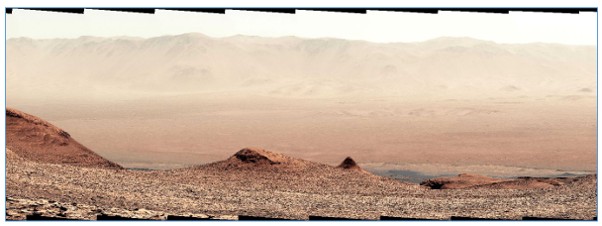
Figure 1: The Mars Science Laboratory Curiosity rover has traversed over 1000 m thickness of sediments, many of which were deposited from water ~3.5-3.8 Ga. MSL has also identified up to 10 weight % carbonate in some of the drillholes consistent with a thick early CO2-rich atmosphere. Determining the atmospheric controls on the origin and stability of this ancient habitable environment is the central aim of this PhD studentship. The studentship project will use Curiosity Data from sulfate and carbonate-bearing Gale Crater sediments as one of the data inputs to the climate modelling. Image MastCam/JPL/NASA.
This project does not offer a CASE studentship
Each host has a slightly different application process.
Find out how to apply for this studentship.
All applications must include the CENTA application form.
Choose your application route
The project will adapt and transfer advanced terrestrial climate physics approaches developed for modern Earth climate models to investigate the atmospheric conditions required to sustain surface liquid water on ancient Mars and thus a Habitable environment for primitive organisms. Existing Mars climate models and published greenhouse scenarios will be evaluated against geological observations from Gale Crater obtained by the Curiosity rover. Constraints on ancient atmospheric composition will be derived from carbonate abundances, mineralogy and evidence for long-lived lakes preserved within the Gale stratigraphy. Model simulations will explore the effects of CO₂, H₂, CH₄, SO₂, clouds and aerosols on surface temperature and climate stability.
DRs will be awarded CENTA Training Credits (CTCs) for participation in CENTA-provided and ‘free choice’ external training. One CTC can be earned per 3 hours training, and DRs must accrue 100 CTCs across the three and a half years of their PhD.
Python-based skills for the advanced data modelling.
Presentation and Writing skills for the PhD, Conferences, papers. As part of the University of Leicester Doctoral College and School of Physics & Astronomy, there will be a series of probation, presentation milestones to help ensure successful completion of the PhD in 3.5 years.
There will be opportunities for undergraduate demonstrating e.g. workshops, laboratory session assistance for the University undergraduate programme, giving valuable training in teaching and assessment.
The student can take Mars Science Laboratory operations roles training if wished.
The student will gain broad experience working with NCEO, Open University, Edinburgh, Leicester
The student will join the NASA Mars Science Laboratory mission, and will be part of the mission’s science discussions, analysis and gathering of mineralogical data.
Year 1: Training in terrestrial climate modelling; review and reproduce benchmark ancient Mars simulations. Compile geological constraints from Mars Science Laboratory data, including carbonate and sulfate abundances, sedimentary environments and plausible atmospheric compositions. Define
testable climate scenarios and implement the baseline ancient Mars model.
Year 2: Adapt and validate the climate model for early-Mars conditions, including lower solar luminosity, atmospheric pressure and composition, clouds, dust and volcanic aerosols. Conduct systematic sensitivity experiments and compare outputs with existing Mars climate models and geological observations. Present initial results and prepare the first paper.
Year 3: Run integrated simulations of leading ancient Mars greenhouse scenarios and determine which conditions can sustain surface liquid water. Test model predictions against the environmental record preserved in Gale Crater and other well-constrained Mars sites. Quantify uncertainties, refine
the model and prepare second publication.
Final six months: Complete synthesis simulations, archive model code and outputs, write and submit the thesis, and communicate the results to the Mars and terrestrial climate-modelling communities.
Catling, D.C. and Zahnle, K.J., 2020. The archean atmosphere. Science advances, 6(9), p.eaax1420. https://doi.org/10.1126/sciadv.aax1420
Cnossen, I., Sanz-Forcada, J., Favata, F., Witasse, O., Zegers, T. and Arnold, N.F., 2007. Habitat of early life: Solar X-ray and UV radiation at Earth’s surface 4–3.5 billion years ago. Journal of Geophysical Research: Planets, 112(E2). https://doi.org/10.1029/2006JE002784
Rampe E.B., D.F. Blake, T.F. Bristow, D.W. Ming, D.T. Vaniman,… J.C. Bridges, et al., the MSL Science Team. (2020) Mineralogy and geochemistry of sedimentary rocks and eolian sediments in Gale crater, Mars: A review after six Earth years of exploration with Curiosity. Geochemistry, 80.
https://doi.org/10.1016/j.chemer.2020.125605
Todd, Z.R., Lozano, G.G., Kufner, C.L., Ranjan, S., Catling, D.C. and Sasselov, D.D., 2024. UV transmission in prebiotic environments on early Earth. Astrobiology, 24(5), pp.559-569. https://doi.org/10.1089/ast.2023.0077
Tutolo, B. M., Hausrath, E. M., … Bridges, J. C. et al.., (2025). Carbonates identified by the Curiosity rover indicate a carbon cycle operated on ancient Mars. Science, 388(6744), 292-297. doi:10.1126/science.ado9966
Wordsworth, R., et al., 2021. A coupled model of episodic warming, oxidation and geochemical transitions on early Mars. Nature Geoscience, 14, pp.127-132. https://doi.org/10.1038/s41561-021-00701-8
For further details please contact Professor John Bridges, [email protected], and Dr Tim Trent, [email protected].
More information about our research can be seen at:
https://www.wcrl.co.uk/research
https://le.ac.uk/people/john-bridges
https://profiles.open.ac.uk/james-holmes
https://www.nceo.ac.uk/contact-us/people/dr-luke-smallman/
To apply to this project:
Applications must be submitted by 23:59 GMT on Wednesday 6th January 2027.